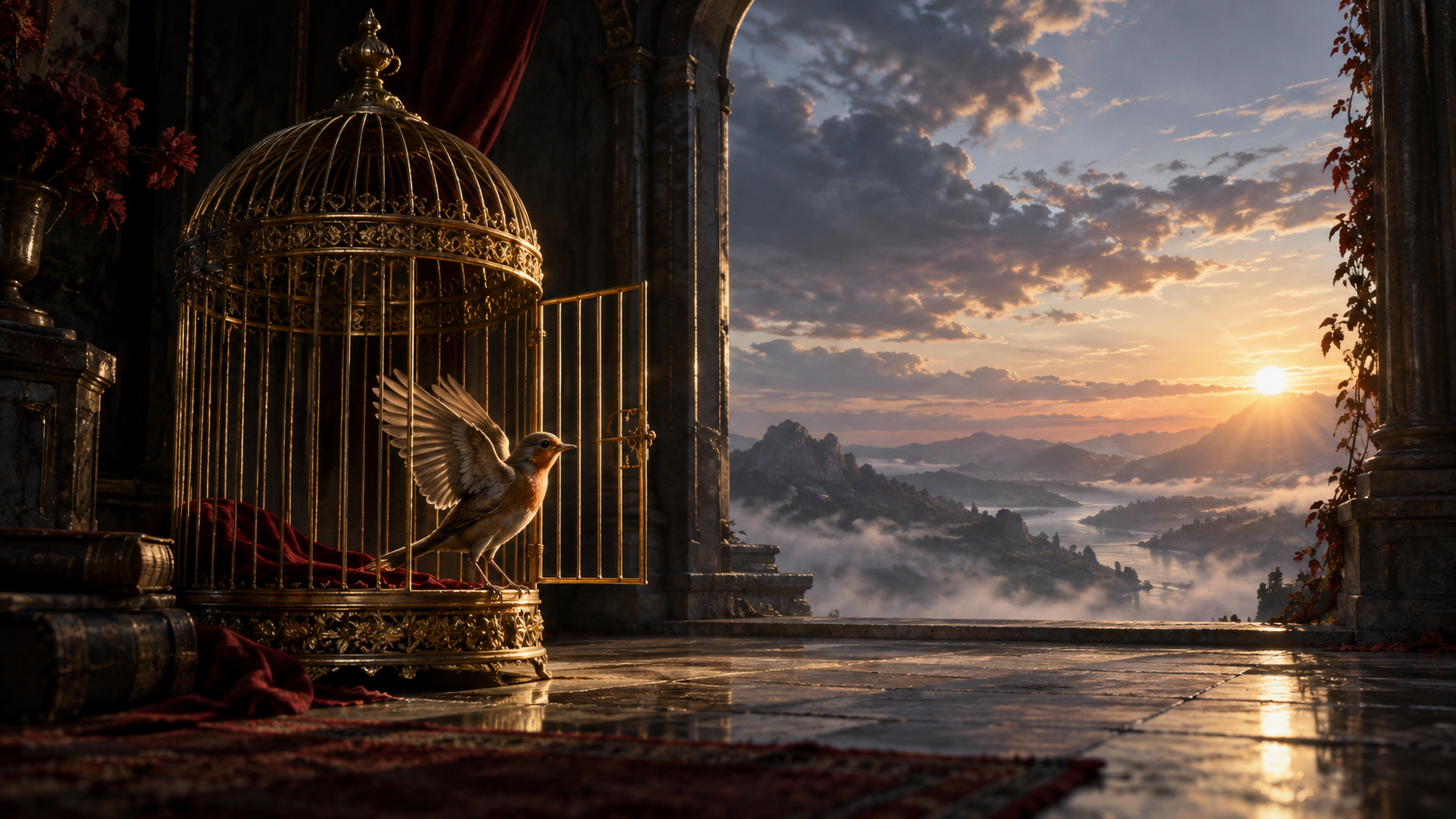
There once was a bird born inside a magnificent golden cage.
The bars caught the morning light and scattered it across the room. People came from distant places to admire them. They praised the cage for its beauty, its craftsmanship, its value. They praised the bird for the song it had learned to sing inside it.
From the day it opened its eyes, the bird was told that the cage was protection. Beyond the bars, the world was unpredictable. The wind could throw it from the sky. Rain could soak its feathers. Hunger could find it. Wings could fail.
Inside, there was food. There was water. There was a polished mirror in which the bird could see itself exactly as the cage allowed it to be seen.
So the bird learned the shape of safety before it ever learned the shape of the sky.
It learned when to wake, when to sing, when to be silent. It learned which thoughts were rewarded and which questions made the room uncomfortable. It learned the songs of its parents, the warnings of its elders, the rules of the keepers, and the expectations of those who gathered to listen.
Each lesson became familiar. Each familiar thing began to feel true.
The bird could see others crossing the open sky. Sometimes their bodies disappeared into the clouds. Sometimes they returned with stories of forests, rivers, storms, and distances too large to measure from a perch.
The bird called them reckless.
But at night, when the room was quiet, something inside its chest moved whenever the wind touched the cage.
Its wings remembered what its mind had been taught to fear.
One morning, the keeper opened the door and walked away.
No command was given. No hand reached inside. Nothing stood between the bird and the endless blue beyond the window.
For the first time, the cage was open.
The bird moved toward the doorway. It felt the living air pass across its feathers. It looked down at the floor, then out toward the horizon.
It had spent its whole life asking for freedom.
Now freedom was asking something of it.
The bird searched for a reason to remain.
It remembered every warning. It imagined every fall. It thought of the food that arrived without effort, the mirror that never contradicted it, the familiar perch worn smooth beneath its feet.
It told itself the cage was not a prison because it was made of gold.
It told itself that choosing to stay was the same as being free.
Days passed. The door remained open.
Visitors came and saw the bird inside. Some pitied it. Some admired its loyalty. Some said that if it truly wanted the sky, it would have flown already.
But they did not understand: the door had opened in a single morning; the cage had been built inside the bird over a lifetime.
The strongest bars were no longer made of gold.
They were made of fear repeated until it sounded like wisdom. Of tradition accepted without examination. Of approval mistaken for love. Of obedience mistaken for peace. Of a life made smaller so gradually that smallness began to feel like identity.
The strongest bars were no longer around the bird.
They were inside it.
And so the question was no longer whether the door was open.
The question was whether the bird could question what it had been taught about its wings.
Could it accept that fear might travel with it and fly anyway?
Could it leave behind the admiration of those who preferred its song inside the cage?
Could it become unfamiliar to itself long enough to discover what else it might be?
The bird stood at the threshold.
Behind it waited certainty, polished and gold.
Before it waited the sky—unpromised, uncontrollable, alive.
It opened its wings.
Not because the fear had disappeared.
Because, at last, it understood that courage was not the absence of fear. Courage was refusing to let fear make the final decision.
The cage may be golden.
The song inside it may be beautiful.
But the sky is still waiting.
— JW Holloway