Page 1
Read page text
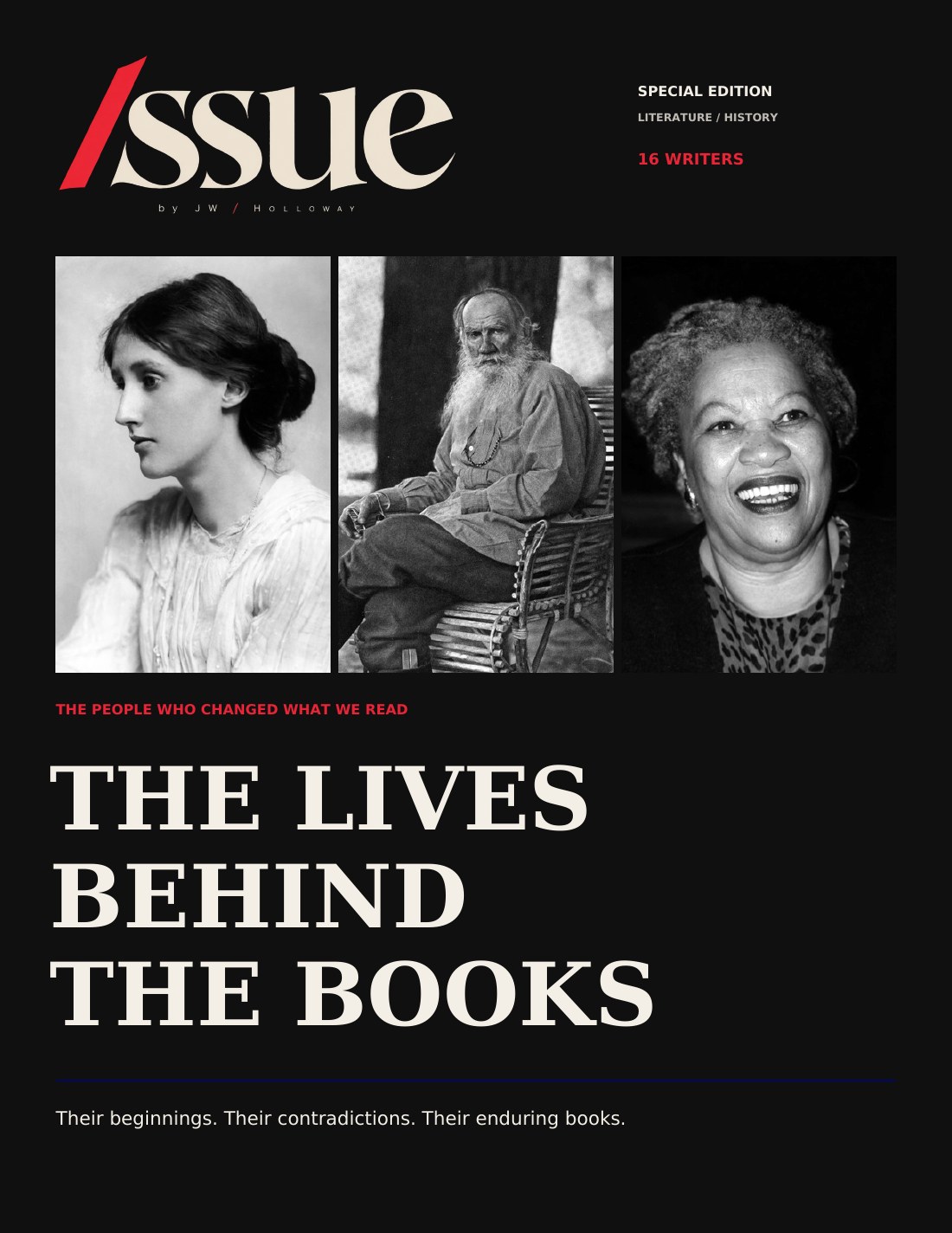
The Lives Behind the Books. An Issue magazine edition by J. W. Holloway.
Page 2
Read page text
A /SSUE SPECIAL EDITION
Before the book, there was a life.
We meet a writer first through a voice. Only later do we discover the room, the job, the family, the friendship or the obstacle behind it. A title on a shelf begins to look different when we see the person who had to make it.
This edition brings together sixteen writers across a thousand years. It is a selection, not a ranking and not a complete history of literature. Many traditions and extraordinary authors lie beyond these pages. The purpose is to open doors: to make an unfamiliar name approachable and a familiar book worth returning to.
Each profile follows three threads: the life and the route into writing; the person as far as the surviving evidence allows; and a reading guide to the work. The craft notes are editorial interpretations, invitations to notice how the writing works.
The portraits are historical photographs or works of art, reproduced in black and white. Where photography did not exist—or a likeness is uncertain—the caption says so. No portrait in this edition was generated by AI.
J.W. HOLLOWAY
/ssue / Literature, art and the lives behind them
Page 3
Read page text
Page 4
Read page text
BEYOND THE MYTH OF GENIUS
How does a writer become?
There is no single doorway. Some writers grow up inside libraries; others learn through jobs, travel, theatre or the pressure of exclusion. A career may begin early and be recognised late. Sometimes recognition arrives only after the writer is gone.
That variety matters. The idea of the born genius can conceal the labour: Austen revising, Dickens meeting the demands of serial publication, Morrison writing alongside editorial work. It can also conceal help. Books pass through the hands of relatives, printers, translators, friends and editors.
The story of literature is partly a story of what survives. Shakespeare’s fellow actors collected his plays. Dickinson’s manuscripts became a contested editorial inheritance. Kafka’s unpublished writing depended on a friend refusing his instructions. The shelf we inherit is not an untouched record of the past.
A biography can sharpen a reading without explaining everything. We should not reduce a novel to a disguised confession or mistake a character’s words for an author’s beliefs. The work is made: selected, arranged, revised and given form.
Nor does literary importance make a person flawless. Contradictions belong in these lives. The most useful portrait is neither worship nor demolition; it lets achievement and limitation remain visible together.
Read these pages as beginnings. Choose one book. Hear the voice before deciding what the reputation means. If a long classic seems forbidding, start with a story, an essay or a scene. Attention is a more useful entrance requirement than expertise.
A reputation is inherited. A reading is your own.
Page 5
Read page text
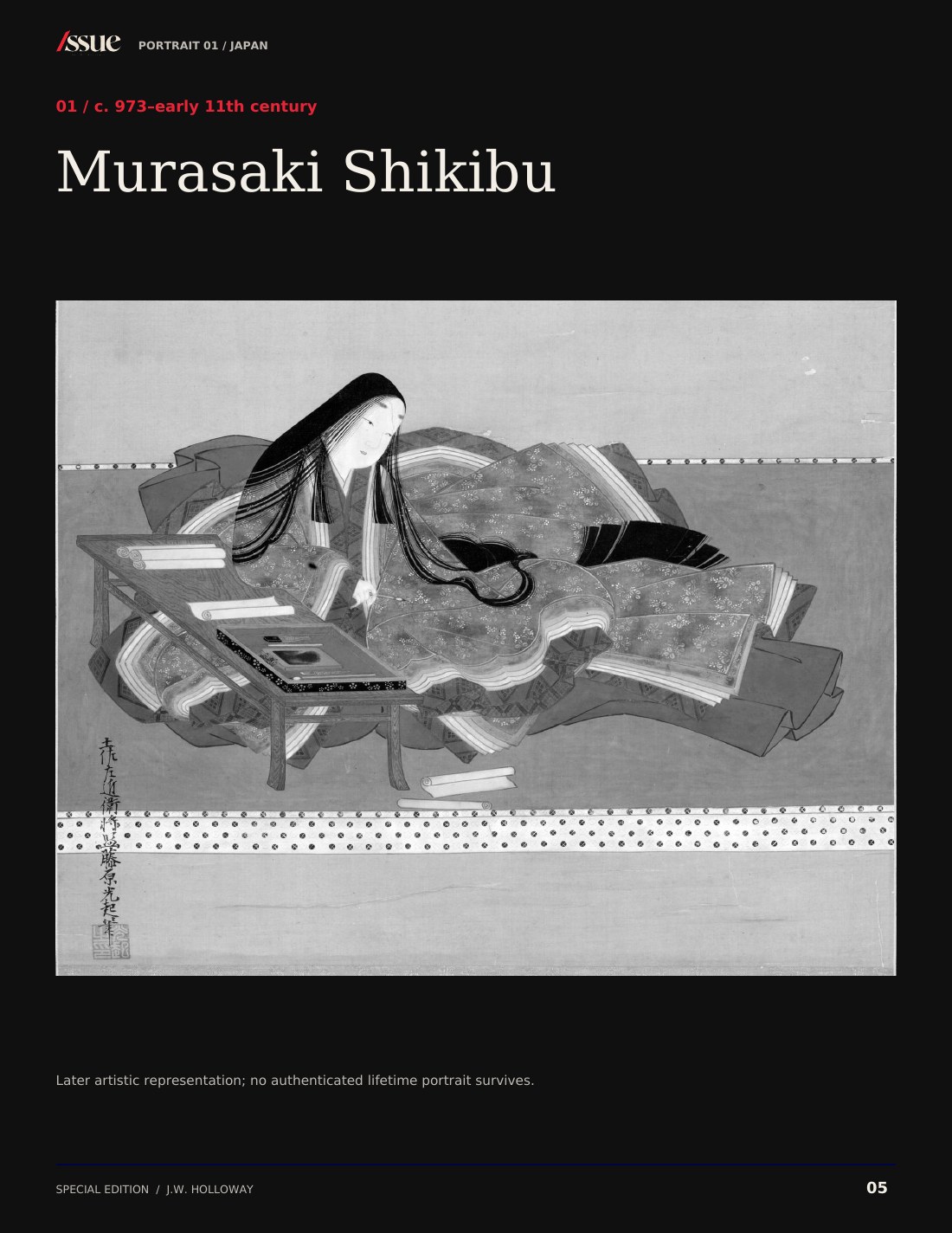
01 / c. 973–early 11th century Murasaki Shikibu
Later artistic representation; no authenticated lifetime portrait survives.
Page 6
Read page text
An inner world, a thousand years old
LIFE & LITERARY BEGINNINGS
At the imperial court of Heian Japan, poetry could carry a message that ordinary speech could not. Murasaki Shikibu turned that world of ceremony, longing and social calculation into The Tale of Genji, one of the earliest surviving long novels. Her personal name and the exact dates of her life remain uncertain. The name by which we know her belongs partly to the courtly world she inhabited.
Born into a literary family, she became a lady-in-waiting to Empress Shōshi. Her learning and close observation gave her material for fiction whose characters are never quite as simple as their public roles. Genji circulated in manuscript; its life began in a culture of copying, reading aloud and exchange, long before a modern publishing industry.
THE PERSON BEHIND THE NAME
Her diary offers glimpses of a watchful, sometimes critical observer of court life. It is evidence of a particular voice, not permission to invent her private feelings. Later images of her are imaginative portraits, not records of her appearance.
READ LIKE A WRITER
Notice how a small gesture can reveal a social world. An unanswered message, a poem or a change of season may carry the weight that another novel gives to an argument.
ON THE READING SHELF
The Tale of Genji
early 11th century
An expansive exploration of desire, status, loss and time.
The Diary of Lady Murasaki
early 11th century
A shorter entrance into the court and the writer’s observing mind.
Collected poems
compiled in the medieval period
Read in a modern annotated translation for the poems’ social context.
Page 7
Read page text
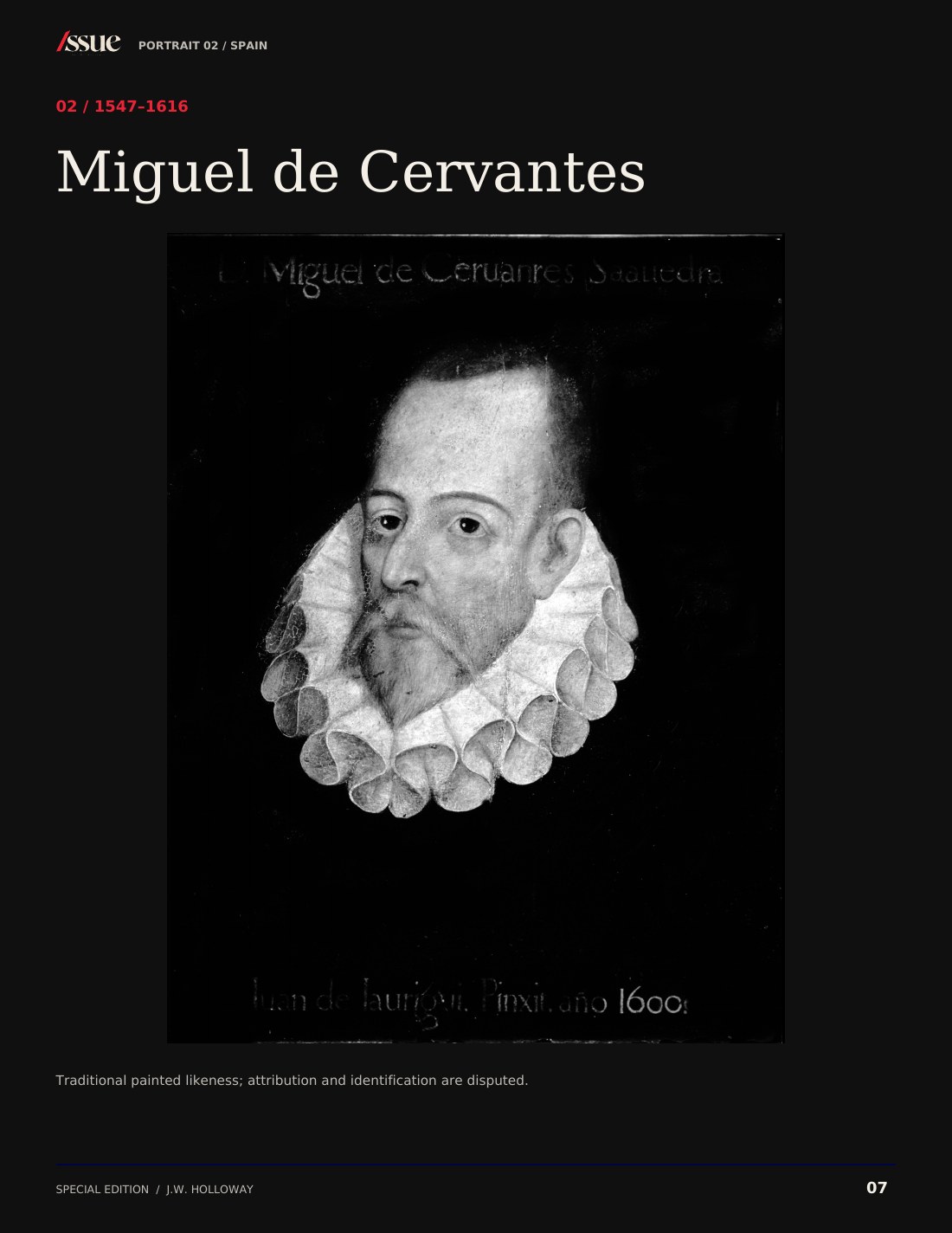
02 / 1547–1616 Miguel de Cervantes
Traditional painted likeness; attribution and identification are disputed.
Page 8
Read page text
The dreamer and the world
LIFE & LITERARY BEGINNINGS
Cervantes did not arrive at literary fame by a direct road. He served as a soldier, was wounded at the Battle of Lepanto, and spent five years captive in Algiers before being ransomed. Back in Spain, writing existed alongside precarious employment and financial trouble.
The first part of Don Quixote appeared in 1605, when he was in his late fifties; the second followed in 1615. A man who mistakes the world for a chivalric romance became the centre of a remarkably modern book. Cervantes made room for jokes, competing narrators, wounded pride and the unsettling possibility that stories change how people live. Success came late, after years of work in forms that included poetry, drama and prose fiction.
THE PERSON BEHIND THE NAME
The surviving record shows persistence through captivity and money problems. It does not give us a transparent view of his temperament. The familiar painted likeness reproduced here is disputed and should not be mistaken for a securely documented sitting.
READ LIKE A WRITER
Read Don Quixote and Sancho Panza together. Their disagreements make a conversation between imagination and practical experience; neither voice can entirely silence the other.
ON THE READING SHELF
Don Quixote
1605; 1615
Begin with an annotated modern translation, and keep both parts in view.
Exemplary Novels
Shorter stories that reveal his range beyond the famous knight.
The Trials of Persiles and Sigismunda
A posthumously published romance of travel and adventure.
Page 9
Read page text
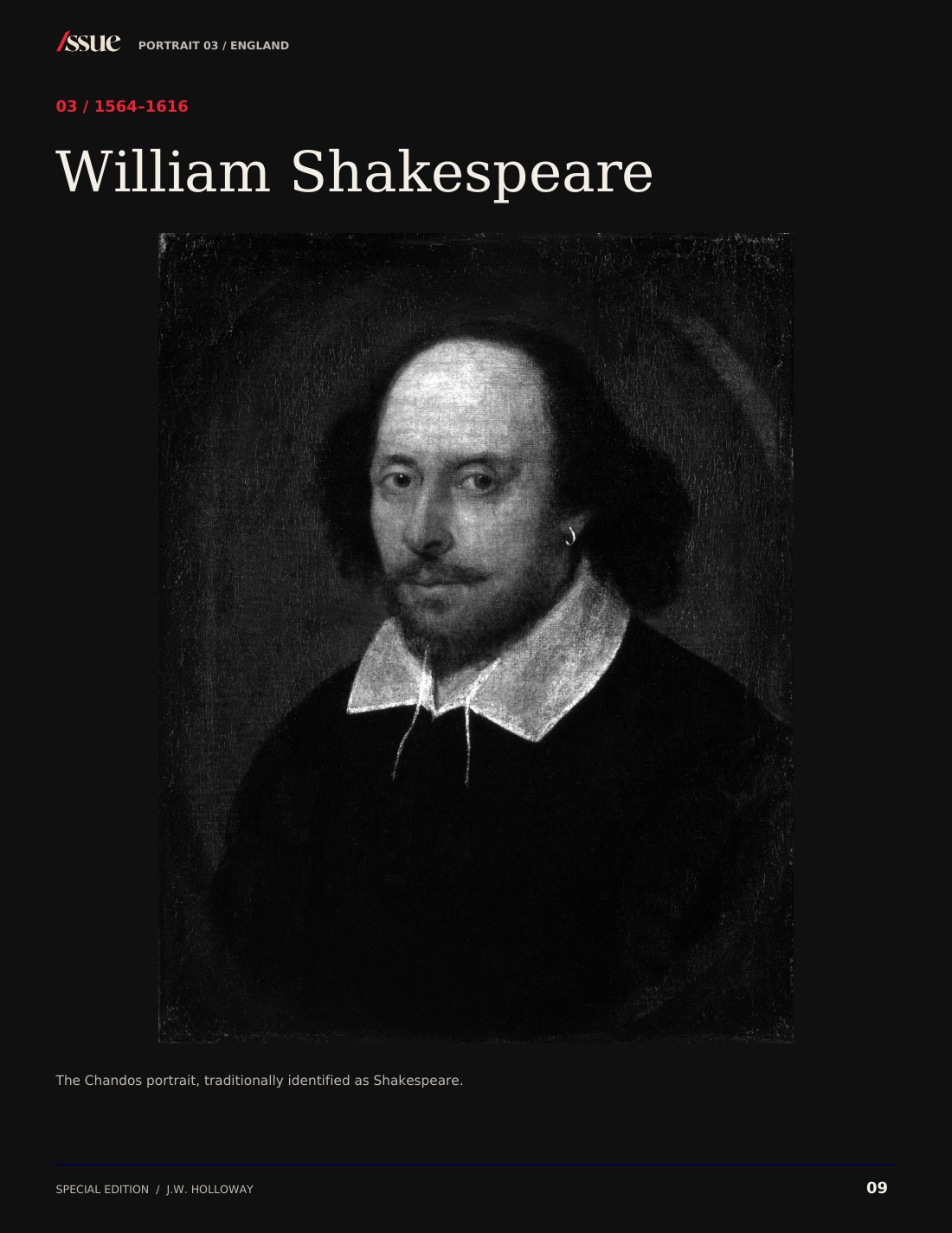
03 / 1564–1616 William Shakespeare
The Chandos portrait, traditionally identified as Shakespeare.
Page 10
Read page text
A life built for the stage
LIFE & LITERARY BEGINNINGS
Shakespeare grew up in Stratford-upon-Avon, married Anne Hathaway and became a father before establishing himself in the London theatre. How he crossed that distance is not fully documented. By 1592, he was known in London; in 1594 he joined the company that became the King’s Men.
He worked as an actor, playwright and company shareholder. This was a collaborative business: words had to live in the mouths of performers and hold the attention of a paying crowd. His career moved through comedy, history, tragedy and romance. After his death, colleagues helped preserve his plays in the First Folio of 1623. Without that act of collection, much of the work might not have survived.
THE PERSON BEHIND THE NAME
Business and family records tell us more than personal confessions do. Calling him a particular kind of friend or husband would go beyond the evidence. The abundance of his characters should not be confused with an abundance of biographical facts.
READ LIKE A WRITER
Listen to a scene before analysing it. A sentence can change direction as a character thinks; rhythm, interruption and silence often tell you as much as the literal words.
ON THE READING SHELF
Hamlet
c. 1600–1601
A son, a court and an investigation that becomes a crisis of action.
Macbeth
c. 1606
An exceptionally concentrated study of ambition and consequence.
Sonnets
Love, time and self-scrutiny compressed into fourteen-line forms.
Page 11
Read page text
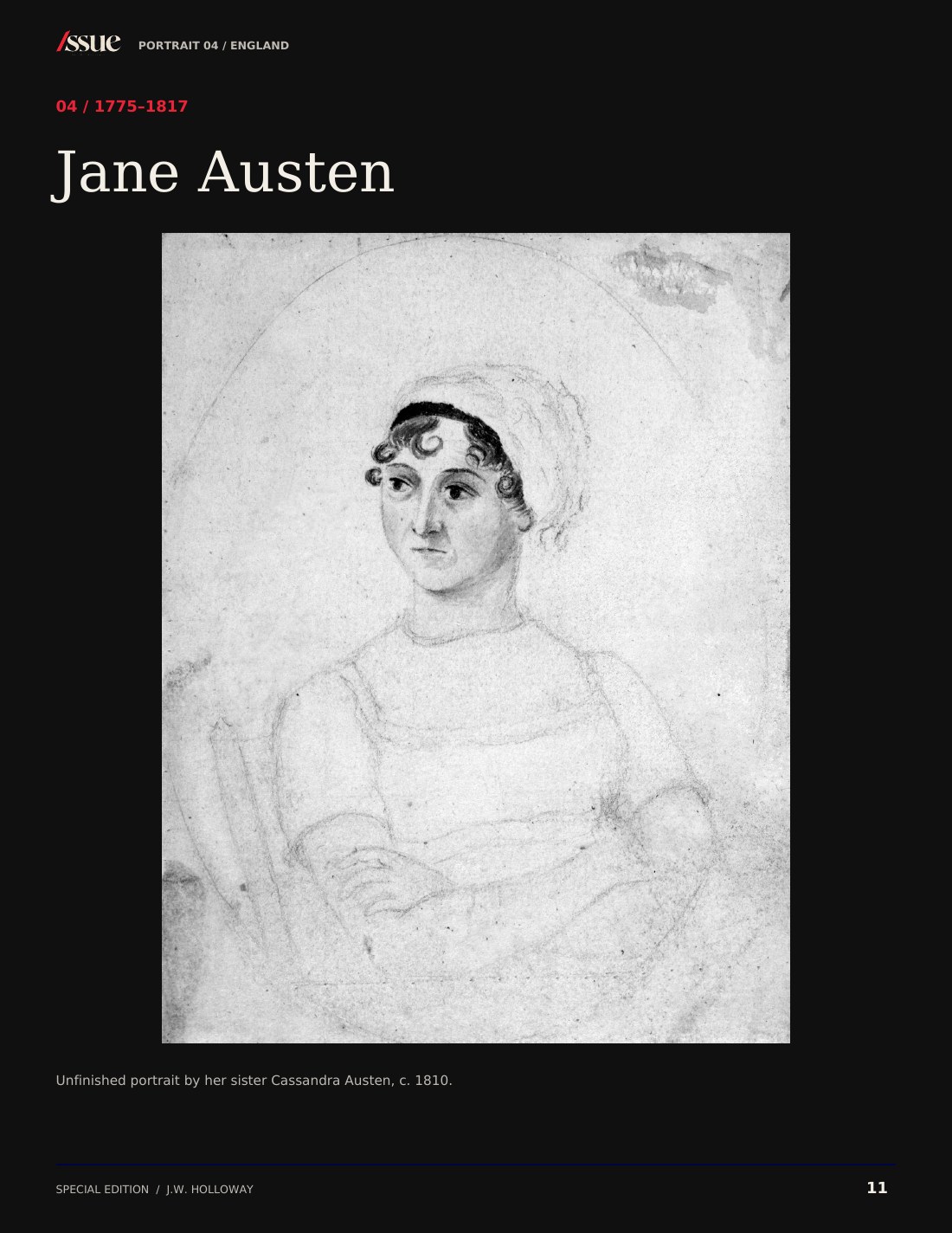
04 / 1775–1817 Jane Austen
Unfinished portrait by her sister Cassandra Austen, c. 1810.
Page 12
Read page text
The revolution in the drawing room
LIFE & LITERARY BEGINNINGS
Austen learned to write through reading, family entertainment and youthful experiments in fiction. Born into a Hampshire clergyman’s family, she developed stories long before her name appeared on a title page. The stability of a home at Chawton, from 1809, helped make her final productive years possible.
Sense and Sensibility appeared in 1811, credited simply to “A Lady”. Pride and Prejudice followed in 1813. Her six completed novels make courtship inseparable from property, reputation and women’s limited economic choices. Publication was an achievement of revision and persistence, not the effortless flowering of a sheltered life. Northanger Abbey and Persuasion appeared after her death, in a volume dated 1818.
THE PERSON BEHIND THE NAME
Her surviving letters and youthful writings show playfulness and a sharp ear for absurdity. Yet the record is incomplete: her sister Cassandra destroyed some letters. The genteel image of “dear Aunt Jane” cannot contain all the wit and judgement of the books.
READ LIKE A WRITER
Watch the distance between what a character believes and what a sentence quietly allows the reader to see. Austen makes misreading other people both comic and consequential.
ON THE READING SHELF
Pride and Prejudice
The most inviting entry: quick dialogue, attraction and revised judgement.
Emma
A confident heroine discovers how much she has misunderstood.
Persuasion
1817; title page 1818
A quieter novel of time, regret and second chances.
Page 13
Read page text
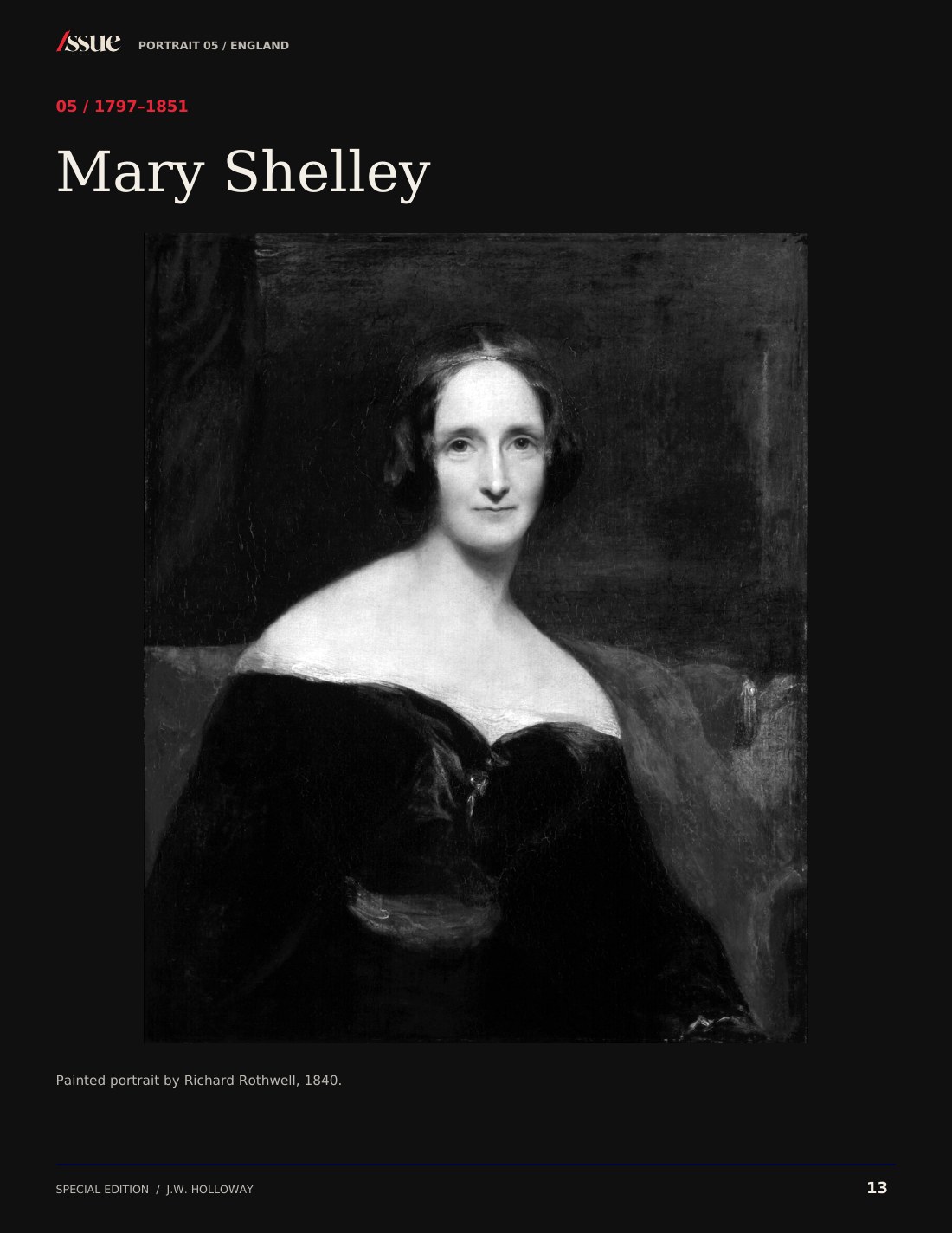
05 / 1797–1851 Mary Shelley
Painted portrait by Richard Rothwell, 1840.
Page 14
Read page text
Who answers for a creation?
LIFE & LITERARY BEGINNINGS
Mary Shelley grew up among radical ideas. Her parents were the writers Mary Wollstonecraft and William Godwin; her mother died soon after her birth. Books and intellectual conversation formed part of her education, but loss and instability shaped her life as well.
In 1816, near Lake Geneva, a ghost-story challenge helped begin the work that became Frankenstein. Published anonymously in 1818, it asked what a maker owes to the life he has made. Shelley was twenty when the novel appeared. After Percy Bysshe Shelley’s death in 1822, she continued writing, raising their surviving son and editing her husband’s work. Her career extended far beyond the single book that made her famous.
THE PERSON BEHIND THE NAME
Letters and journals record bereavement, financial pressure and sustained literary work. Reducing her to the teenage companion of famous men obscures an independent author who kept producing novels, biography and travel writing.
READ LIKE A WRITER
Pay attention to who is allowed to tell the story. Victor’s account is not the last word. The creature’s voice changes the moral position from which the reader judges him.
ON THE READING SHELF
Frankenstein
1818; revised 1831
Choose an edition that identifies which version it prints.
The Last Man
A future catastrophe becomes a story of isolation and human loss.
Lodore
Family obligation, upbringing and the possibilities open to women.
Page 15
Read page text
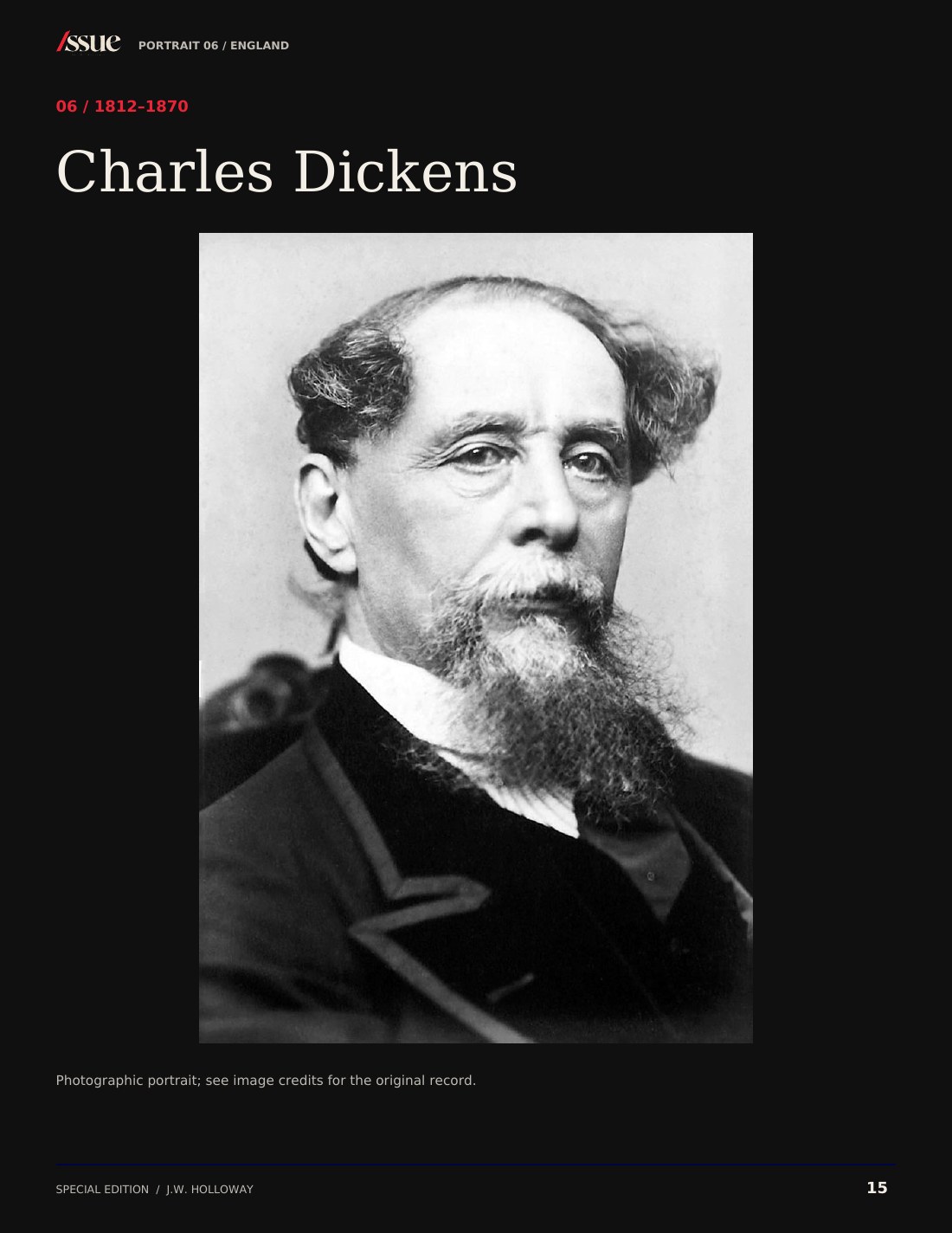
06 / 1812–1870 Charles Dickens
Photographic portrait; see image credits for the original record.
Page 16
Read page text
The city becomes a voice
LIFE & LITERARY BEGINNINGS
A period of childhood work in a blacking factory, and his father’s imprisonment for debt, left Dickens with a lasting knowledge of insecurity. He later learned shorthand and worked as a reporter. Journalism trained him to notice speech, movement and the telling detail in a crowded street.
Sketches under the name Boz led into the extraordinary success of The Pickwick Papers, issued in parts from 1836. Serial publication made suspense a practical craft: readers had to want the next instalment. Dickens became a novelist, editor and celebrated public reader, combining comedy with anger at neglect, bureaucracy and cruelty. His popularity did not soften his interest in the people a prosperous society preferred not to see.
THE PERSON BEHIND THE NAME
Contemporaries knew an energetic performer and organiser. His public generosity and sympathy for fictional children coexist with a troubled domestic record, including his separation from Catherine Dickens. Admiring the work need not flatten the man into a saint.
READ LIKE A WRITER
Read the names and voices aloud. Dickens can build a person from a repeated phrase, then use that apparent caricature to reveal something painful about the world around them.
ON THE READING SHELF
Great Expectations
1860–1861
A young man learns to question his ideas of class and worth.
A Christmas Carol
A short, theatrical tale of memory, fear and moral change.
Bleak House
1852–1853
A larger undertaking: a legal system becomes a social labyrinth.
Page 17
Read page text
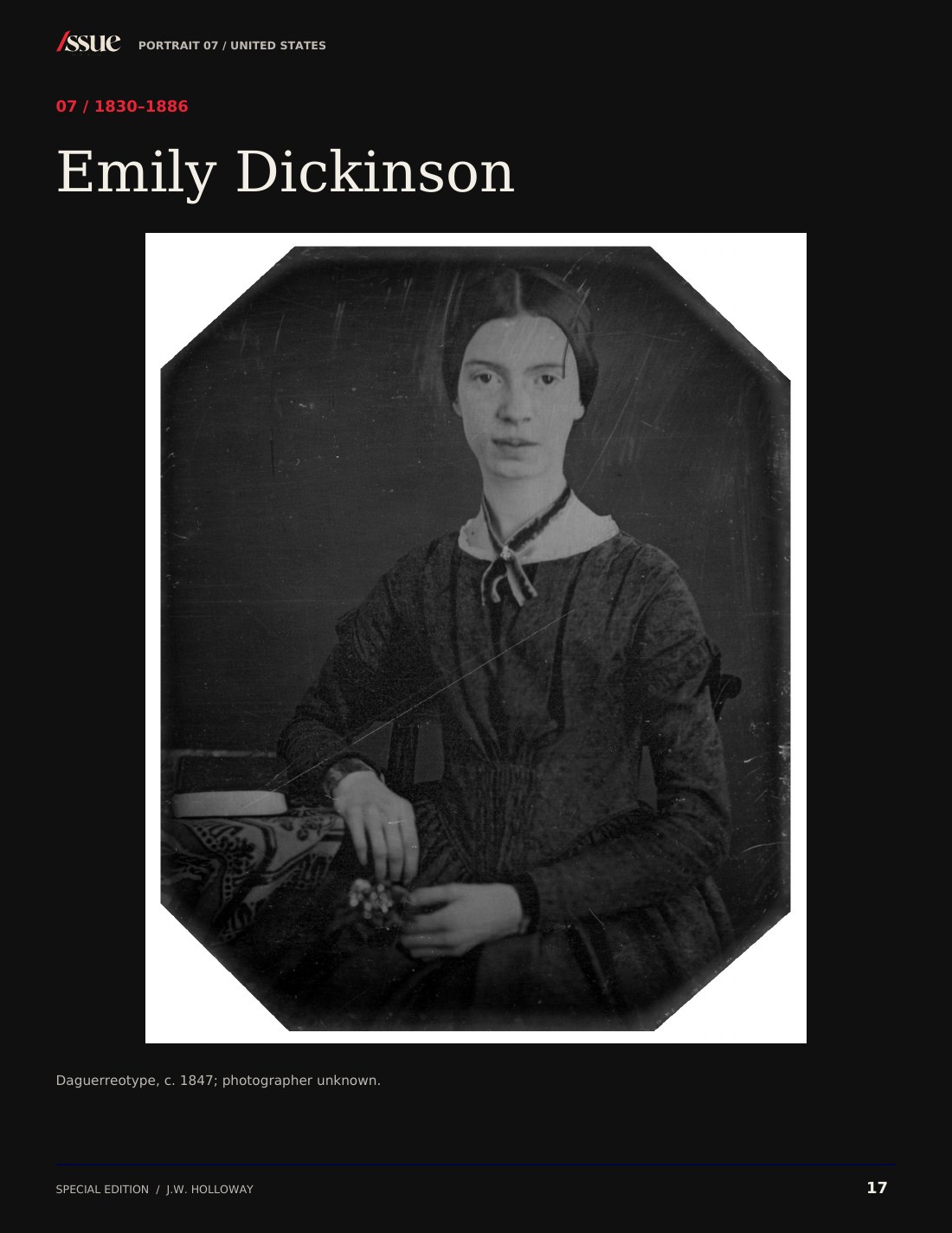
07 / 1830–1886 Emily Dickinson
Daguerreotype, c. 1847; photographer unknown.
Page 18
Read page text
A small room. An immense mind.
LIFE & LITERARY BEGINNINGS
Dickinson lived most of her life in Amherst, Massachusetts. She studied, read widely, tended plants and maintained important relationships through letters. During an intensely productive period, she copied many poems into handmade booklets now called fascicles.
Only a small number of her poems appeared in print while she was alive, generally without her name. Her first posthumous collection came in 1890. Early editors altered punctuation and presentation; later scholarship returned readers closer to the manuscripts. Her literary breakthrough was therefore also an editorial history: the world had to learn how to read a poet whose work did not arrive in the usual published form.
THE PERSON BEHIND THE NAME
The image of an isolated woman in white is only part of the story. Correspondence reveals affection, humour and intellectual exchange. Privacy did not mean an absence of relationships, and the poems should not be treated as a diary with a single hidden key.
READ LIKE A WRITER
Let the dash remain a pause rather than repairing it. Dickinson’s compressed language makes uncertainty active: a poem can hold faith and doubt without choosing an easy ending.
ON THE READING SHELF
Poems
Historically important, but substantially shaped by its editors.
The Poems of Emily Dickinson
1998, ed. R. W. Franklin
A scholarly route into the full body of poetry.
Selected letters
various editions
Read alongside the poems for the social life of her language.
Page 19
Read page text
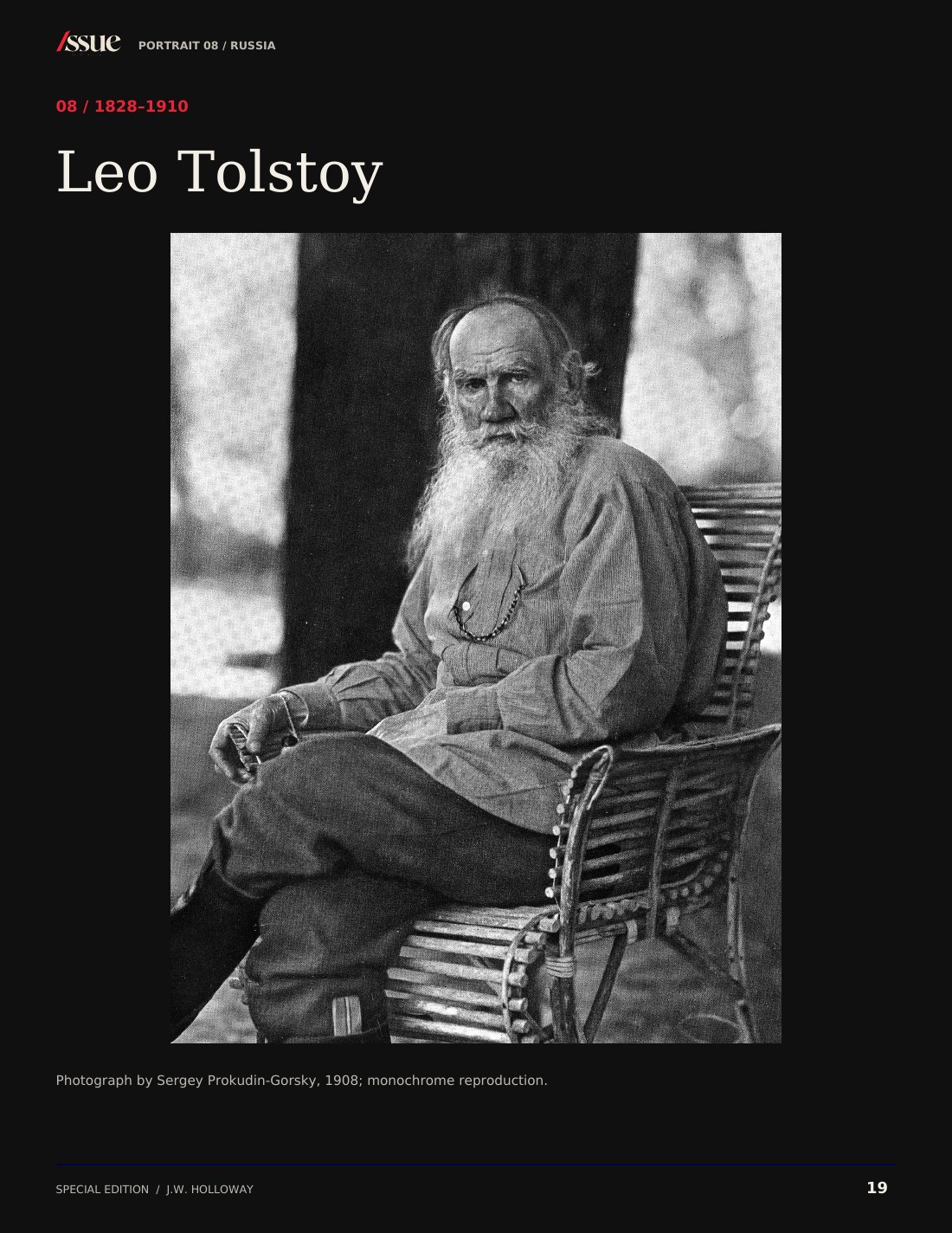
08 / 1828–1910 Leo Tolstoy
Photograph by Sergey Prokudin-Gorsky, 1908; monochrome reproduction.
Page 20
Read page text
The whole world at the table
LIFE & LITERARY BEGINNINGS
Born into an aristocratic family, Tolstoy experienced military life before becoming the author of enormous fictional worlds. Childhood, published in 1852, and the Sevastopol stories helped establish his reputation. War, family life and the movement between private feeling and public history became central materials.
War and Peace and Anna Karenina secured his place as a major novelist. Later, a spiritual crisis led him toward religious and ethical writing, criticism of violence and a rejection of many conventions of wealth and status. His influence extended beyond fiction. Yet the effort to live by his convictions brought conflict, including within his household.
THE PERSON BEHIND THE NAME
His diaries show a demanding habit of self-examination. Any account of his achievement should also recognise Sofia Tolstaya’s work with manuscripts and family life. The contradiction between radical ideals and aristocratic privilege belongs inside the portrait, not outside it.
READ LIKE A WRITER
Notice how history enters through ordinary things: a meal, a misunderstanding, a journey home. The large scale works because the smallest changes in attention remain visible.
ON THE READING SHELF
The Death of Ivan Ilyich
A brief and searching place to begin: what makes a life meaningful?
Anna Karenina
1875–1877
Love, family, social judgement and competing visions of a good life.
War and Peace
1865–1869
A vast novel of households and war; take time with its many voices.
Page 21
Read page text
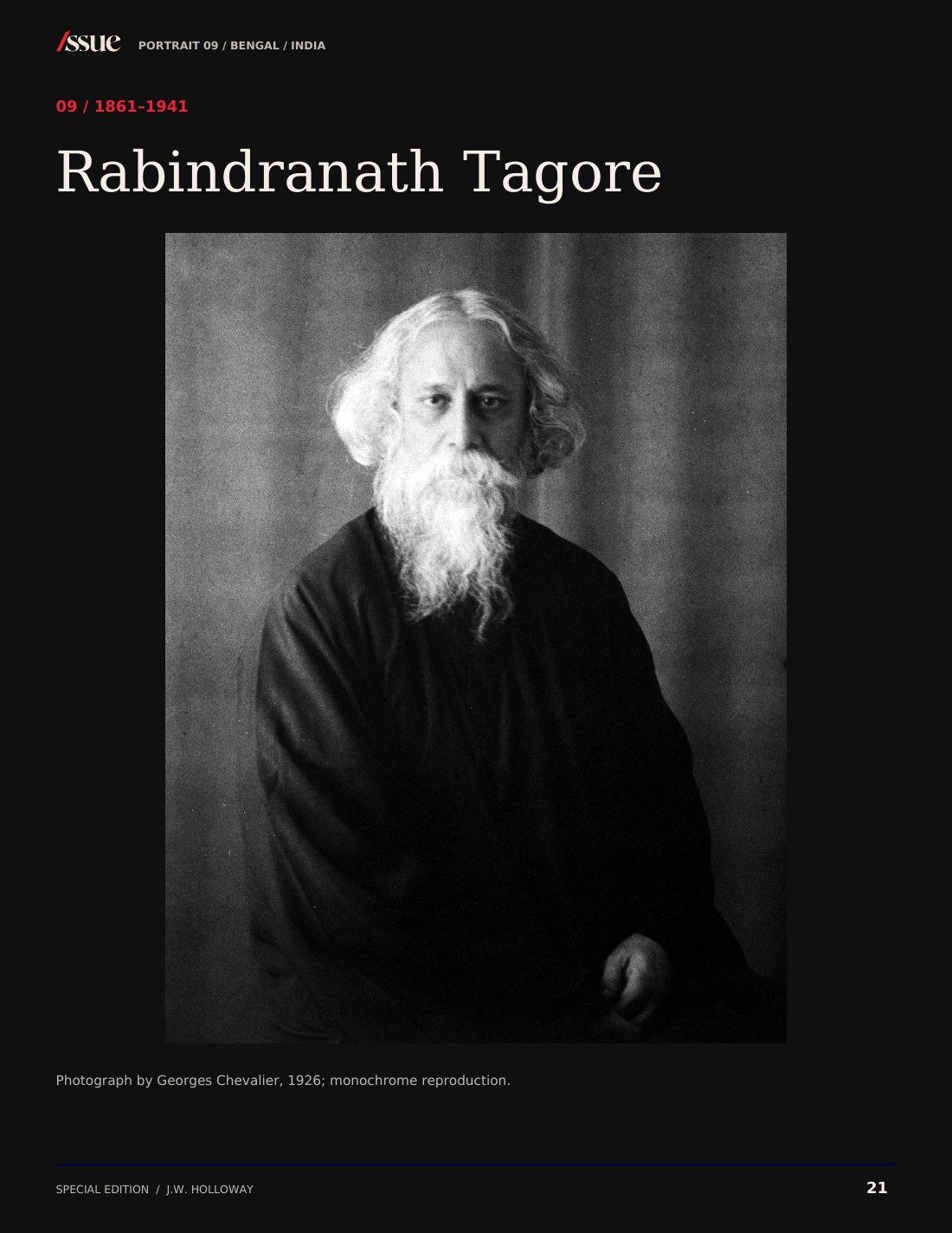
09 / 1861–1941 Rabindranath Tagore
Photograph by Georges Chevalier, 1926; monochrome reproduction.
Page 22
Read page text
A voice across borders
LIFE & LITERARY BEGINNINGS
Tagore grew up in a culturally active Bengali family and began writing young. Poetry was only one part of his creative life: he also wrote songs, stories, plays and novels, and later painted. His work developed within the Bengal Renaissance while remaining engaged with questions beyond national borders.
His English renderings of poems in Gitanjali helped introduce him to an international readership. In 1913, he received the Nobel Prize in Literature, the first non-European laureate in that category. At Santiniketan, his educational work put artistic and intellectual exchange into practice. The celebrated poet was also a builder of institutions and an experimenter in how people might learn.
THE PERSON BEHIND THE NAME
His public record shows a thinker willing to challenge power and narrow nationalism. He renounced his British knighthood after the 1919 Jallianwala Bagh massacre. Neither the serene portrait nor the label “mystic” captures the full range of his arguments and activities.
READ LIKE A WRITER
Read the songs and the fiction together. The lyric voice seeks connection, while the novels test what happens when desire, political loyalty and moral responsibility pull in different directions.
ON THE READING SHELF
Gitanjali
Bengali 1910; English selection 1912
Compare editions: the English selection is not a direct copy of the Bengali book.
The Home and the World
A domestic triangle opens onto nationalism and political temptation.
Selected short stories
various editions
An accessible entrance into his observation of everyday lives.
Page 23
Read page text
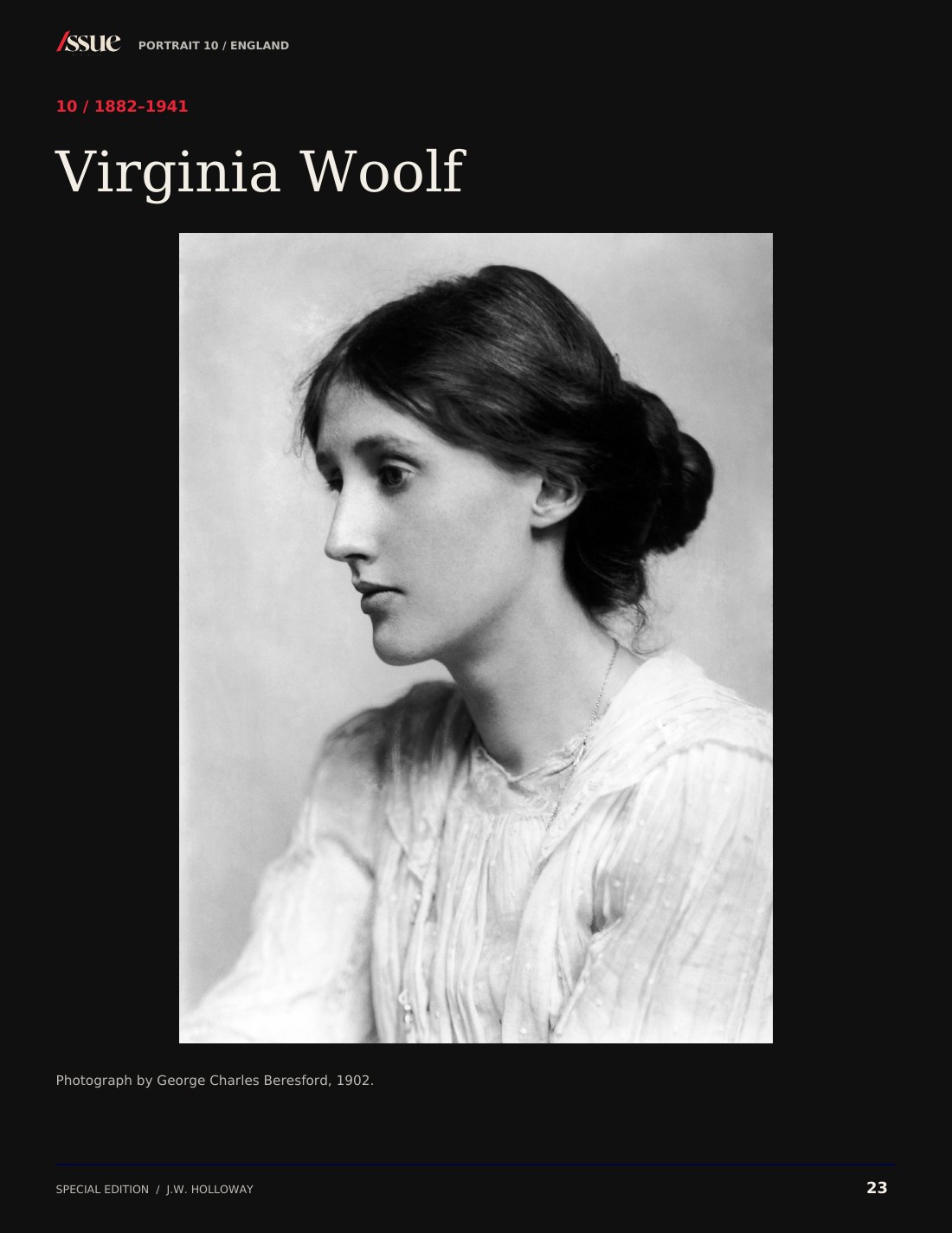
10 / 1882–1941 Virginia Woolf
Photograph by George Charles Beresford, 1902.
Page 24
Read page text
The drama of a passing thought
LIFE & LITERARY BEGINNINGS
Woolf grew up in a literary household and became part of the circle later known as Bloomsbury. She worked as a reviewer and essayist as well as a novelist. With Leonard Woolf, she founded the Hogarth Press in 1917, bringing the physical work of printing into her literary life.
Her first novel, The Voyage Out, appeared in 1915. Over the following decade she developed experiments in time, memory and shifting consciousness. Mrs Dalloway and To the Lighthouse made inward experience a powerful organising force. In A Room of One’s Own, she examined the material conditions—money, education and space—that allow a woman to write.
THE PERSON BEHIND THE NAME
Diaries and letters show an exacting worker, an alert social observer and a lively correspondent. She also experienced severe mental illness and died by suicide. Her achievements should not be reduced to illness, nor should suffering be romanticised as the source of artistic value.
READ LIKE A WRITER
A single day can contain decades. Follow how a sound or a street corner releases a memory, and how one consciousness gives way to another without a conventional scene break.
ON THE READING SHELF
Mrs Dalloway
One day in London opens into memory, war and social performance.
To the Lighthouse
Family life and absence reshaped by the movement of time.
A Room of One’s Own
A compact, provocative essay on women and the conditions of authorship.
Page 25
Read page text
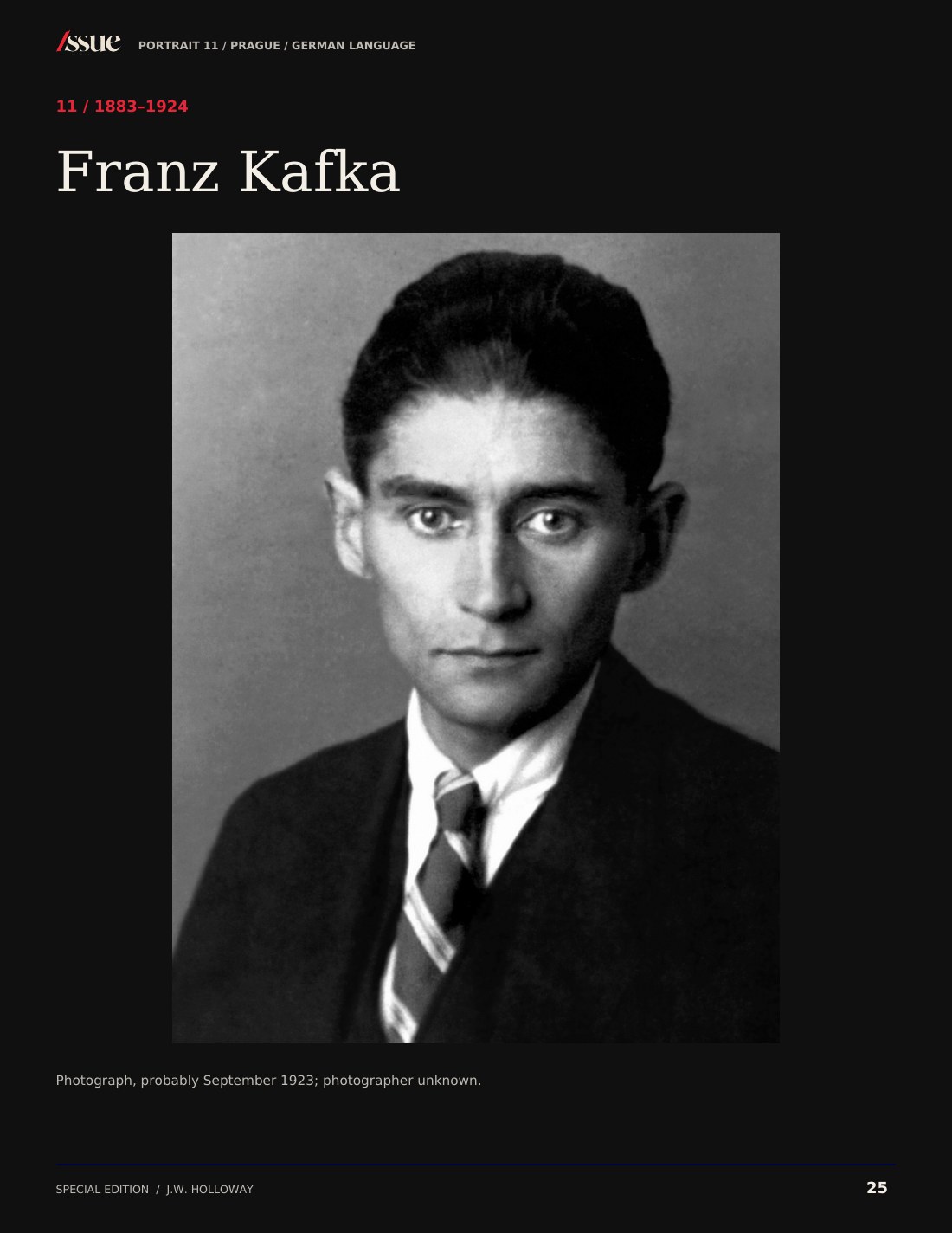
11 / 1883–1924 Franz Kafka
Photograph, probably September 1923; photographer unknown.
Page 26
Read page text
The rules remain invisible
LIFE & LITERARY BEGINNINGS
Kafka was born into a German-speaking Jewish family in Prague. Trained in law, he worked in insurance while writing fiction. The bureaucratic world was not merely an abstract nightmare to him; it was also a place of daily employment and professional responsibility.
Some stories, including The Metamorphosis, appeared during his lifetime. Much of the work behind his later reputation did not. After Kafka’s death from tuberculosis, his friend Max Brod disregarded instructions to destroy unpublished manuscripts and helped bring the novels into print. The history of his fame is inseparable from that difficult act of preservation.
THE PERSON BEHIND THE NAME
The image of a permanently solitary prophet of dread misses the humour and relationships visible in his letters and other records. The Morgan Library’s account of his archive reveals a life of family, friendship, drawing and study as well as doubt.
READ LIKE A WRITER
The extraordinary event is often stated plainly. Kafka does not need a thunderclap; he lets ordinary sentences and everyday procedures expose how helpless a person can become inside a system.
ON THE READING SHELF
The Metamorphosis
Begin here: an impossible change meets painfully ordinary family pressures.
The Trial
1925, posthumous
A prosecution without an intelligible charge or dependable procedure.
The Castle
1926, posthumous
An unfinished novel of access, authority and endless deferral.
Page 27
Read page text
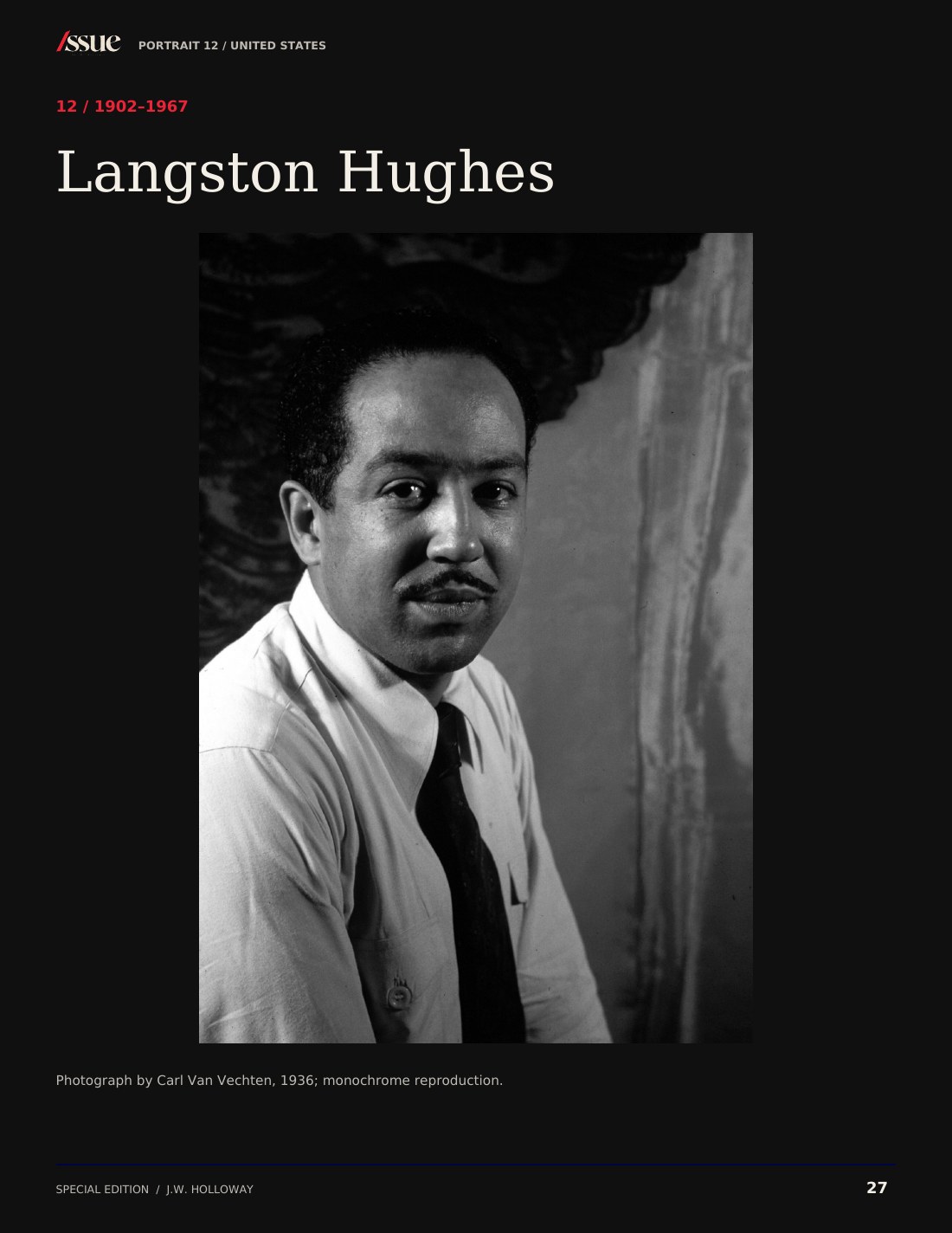
12 / 1902–1967 Langston Hughes
Photograph by Carl Van Vechten, 1936; monochrome reproduction.
Page 28
Read page text
A poem with a heartbeat
LIFE & LITERARY BEGINNINGS
Hughes became a central voice of the Harlem Renaissance by bringing Black everyday life and the rhythms of music into poetry. Travel, varied jobs and a wide range of reading helped form his outlook. His early poem “The Negro Speaks of Rivers” appeared in 1921; The Weary Blues, his first collection, followed in 1926.
He worked across poetry, fiction, plays, autobiography and newspaper columns. Rather than reserving literature for respectable or exceptional lives, he made space for workers, dreamers, neighbours and performers. His essays also argued for the freedom of Black artists to create without measuring themselves against white approval.
THE PERSON BEHIND THE NAME
His public writing joins artistic confidence to a sustained interest in community. The range of his forms matters: a columnist speaking to readers, a dramatist working for a stage and a poet shaping a line are different faces of the same working life.
READ LIKE A WRITER
Hear the line before you explain it. Repetition can become rhythm, and a familiar musical pattern can carry weariness, humour, protest or hope without announcing a lesson.
ON THE READING SHELF
The Weary Blues
The first collection, with its meeting of lyric poetry and music.
The Big Sea
An autobiography of early life, travel and literary beginnings.
Montage of a Dream Deferred
A sequence whose changing rhythms build a portrait of Harlem.
Page 29
Read page text
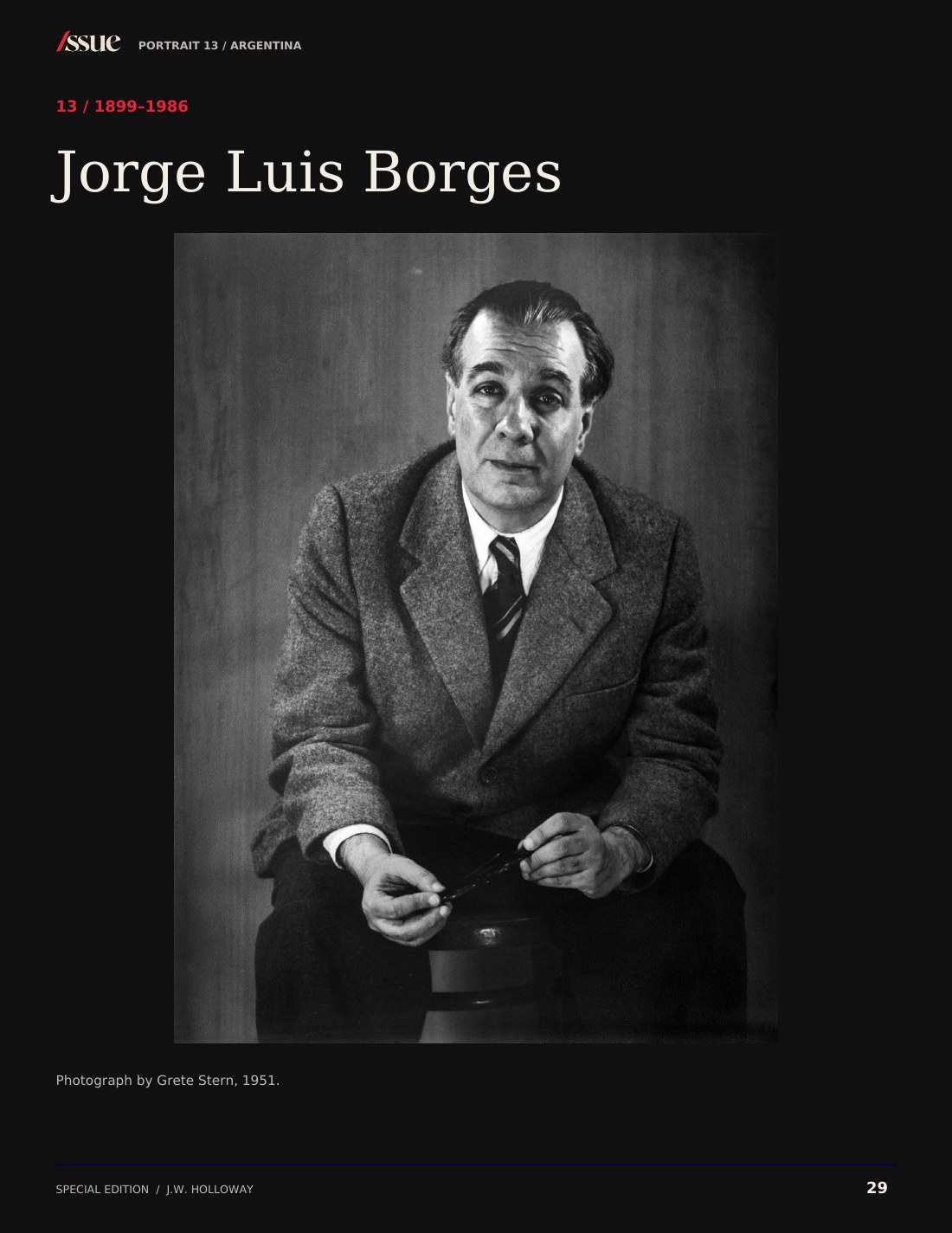
13 / 1899–1986 Jorge Luis Borges
Photograph by Grete Stern, 1951.
Page 30
Read page text
An infinity inside a short story
LIFE & LITERARY BEGINNINGS
Borges grew up among books and languages, lived in Europe as a young man and returned to Buenos Aires to write poetry, essays and fiction. He worked in libraries and eventually directed Argentina’s National Library. Progressive loss of sight changed the practical conditions of his reading and writing, but did not end his literary life.
Ficciones and The Aleph established the stories for which he is most widely known. International recognition expanded through translation and the Formentor Prize, shared with Samuel Beckett in 1961. A few pages could contain an invented scholar, a false document or a universe whose governing idea quietly destroyed ordinary certainty.
THE PERSON BEHIND THE NAME
His public persona often returned to the role of reader. He made erudition playful, but his political views also attracted criticism. A complete portrait allows literary admiration and disagreement to coexist rather than treating intellectual brilliance as moral infallibility.
READ LIKE A WRITER
Ask what happens when an idea becomes literal. An infinite library is not just scenery: it changes what knowledge, meaning and a human lifetime could possibly be.
ON THE READING SHELF
Ficciones
Labyrinths, invented books and stories that think like philosophical puzzles.
The Aleph
A second major collection, including visions of totality and identity.
Dreamtigers / The Maker
Brief prose and poems in conversation with memory and imagination.
Page 31
Read page text
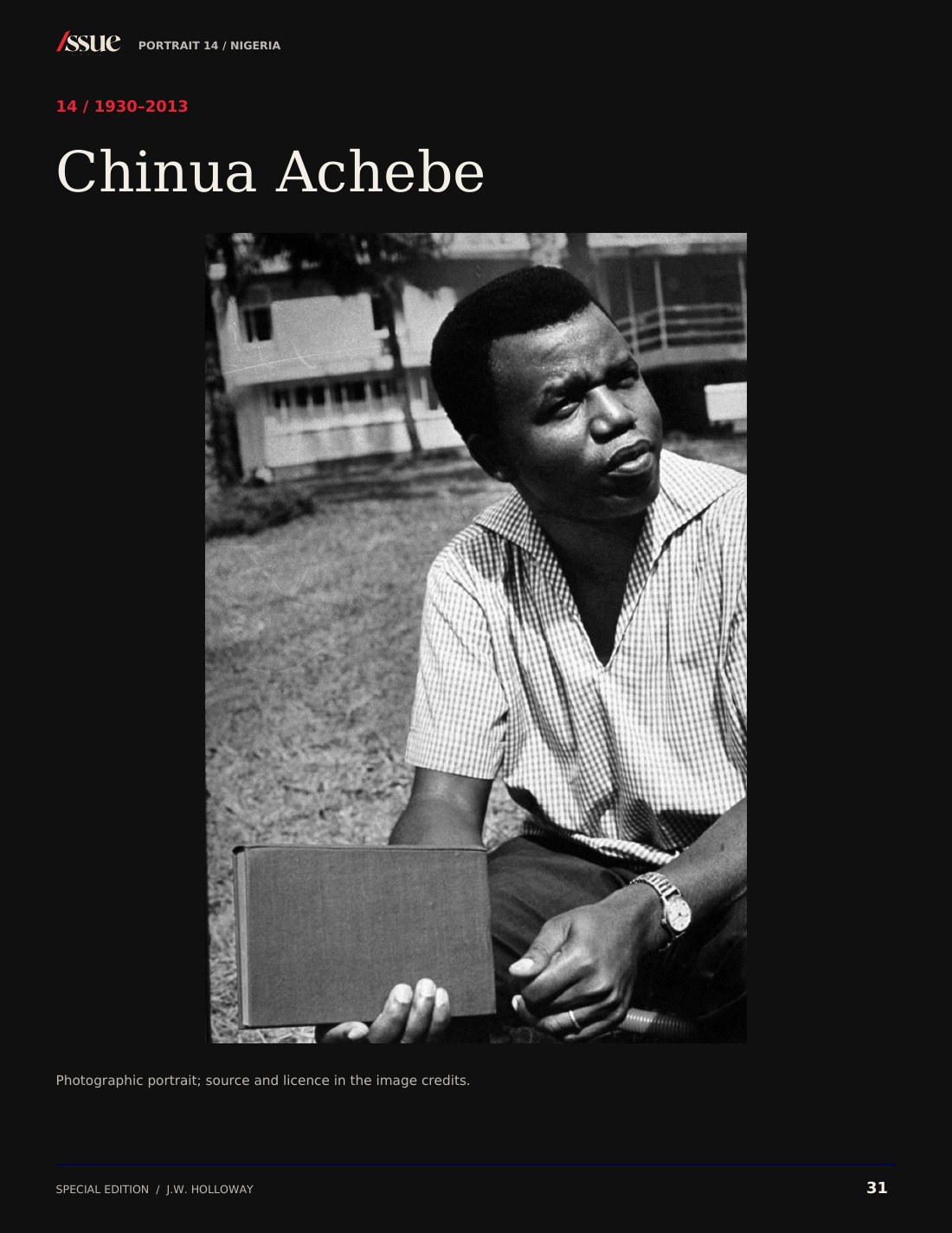
14 / 1930–2013 Chinua Achebe
Photographic portrait; source and licence in the image credits.
Page 32
Read page text
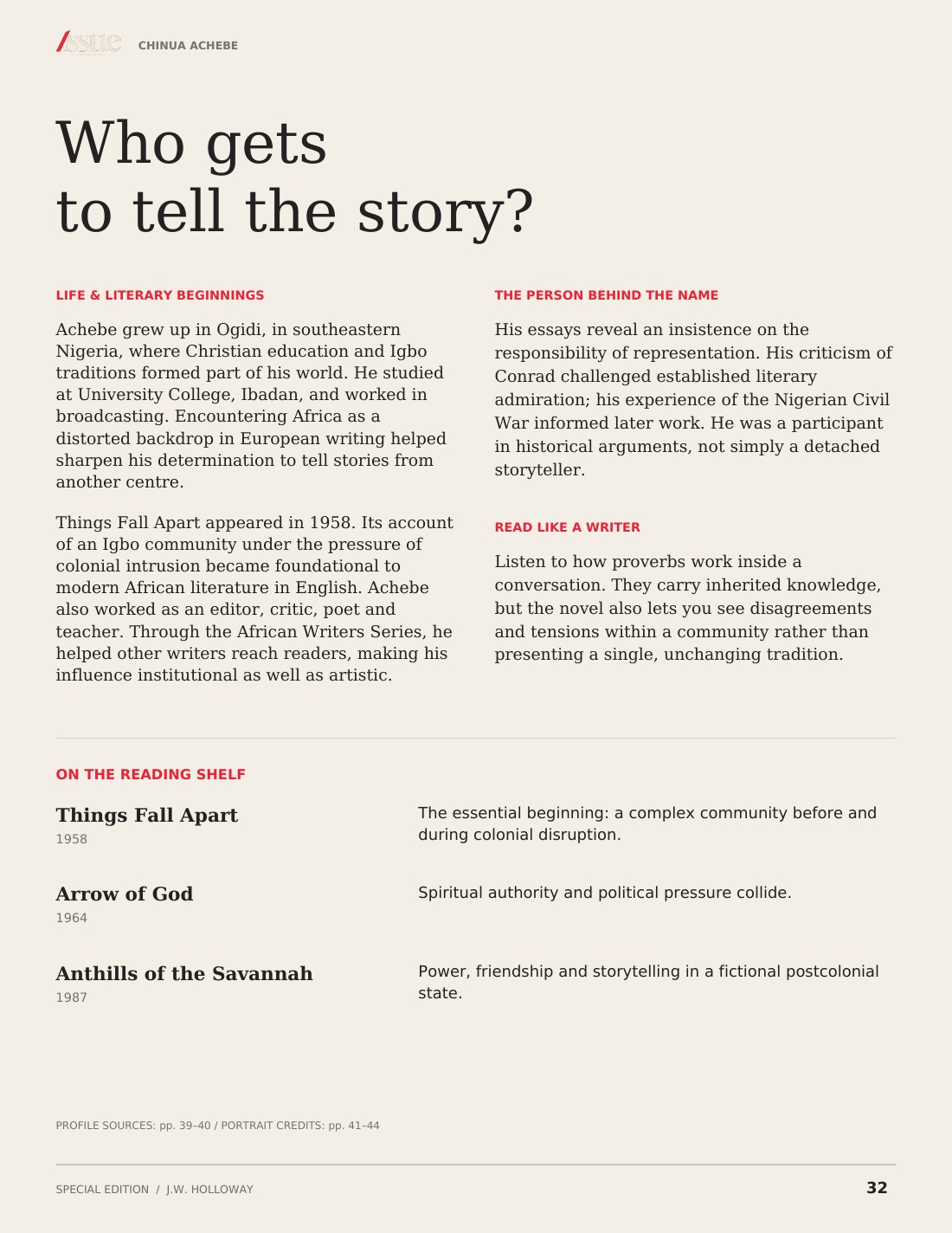
Who gets to tell the story?
LIFE & LITERARY BEGINNINGS
Achebe grew up in Ogidi, in southeastern Nigeria, where Christian education and Igbo traditions formed part of his world. He studied at University College, Ibadan, and worked in broadcasting. Encountering Africa as a distorted backdrop in European writing helped sharpen his determination to tell stories from another centre.
Things Fall Apart appeared in 1958. Its account of an Igbo community under the pressure of colonial intrusion became foundational to modern African literature in English. Achebe also worked as an editor, critic, poet and teacher. Through the African Writers Series, he helped other writers reach readers, making his influence institutional as well as artistic.
THE PERSON BEHIND THE NAME
His essays reveal an insistence on the responsibility of representation. His criticism of Conrad challenged established literary admiration; his experience of the Nigerian Civil War informed later work. He was a participant in historical arguments, not simply a detached storyteller.
READ LIKE A WRITER
Listen to how proverbs work inside a conversation. They carry inherited knowledge, but the novel also lets you see disagreements and tensions within a community rather than presenting a single, unchanging tradition.
ON THE READING SHELF
Things Fall Apart
The essential beginning: a complex community before and during colonial disruption.
Arrow of God
Spiritual authority and political pressure collide.
Anthills of the Savannah
Power, friendship and storytelling in a fictional postcolonial state.
Page 33
Read page text
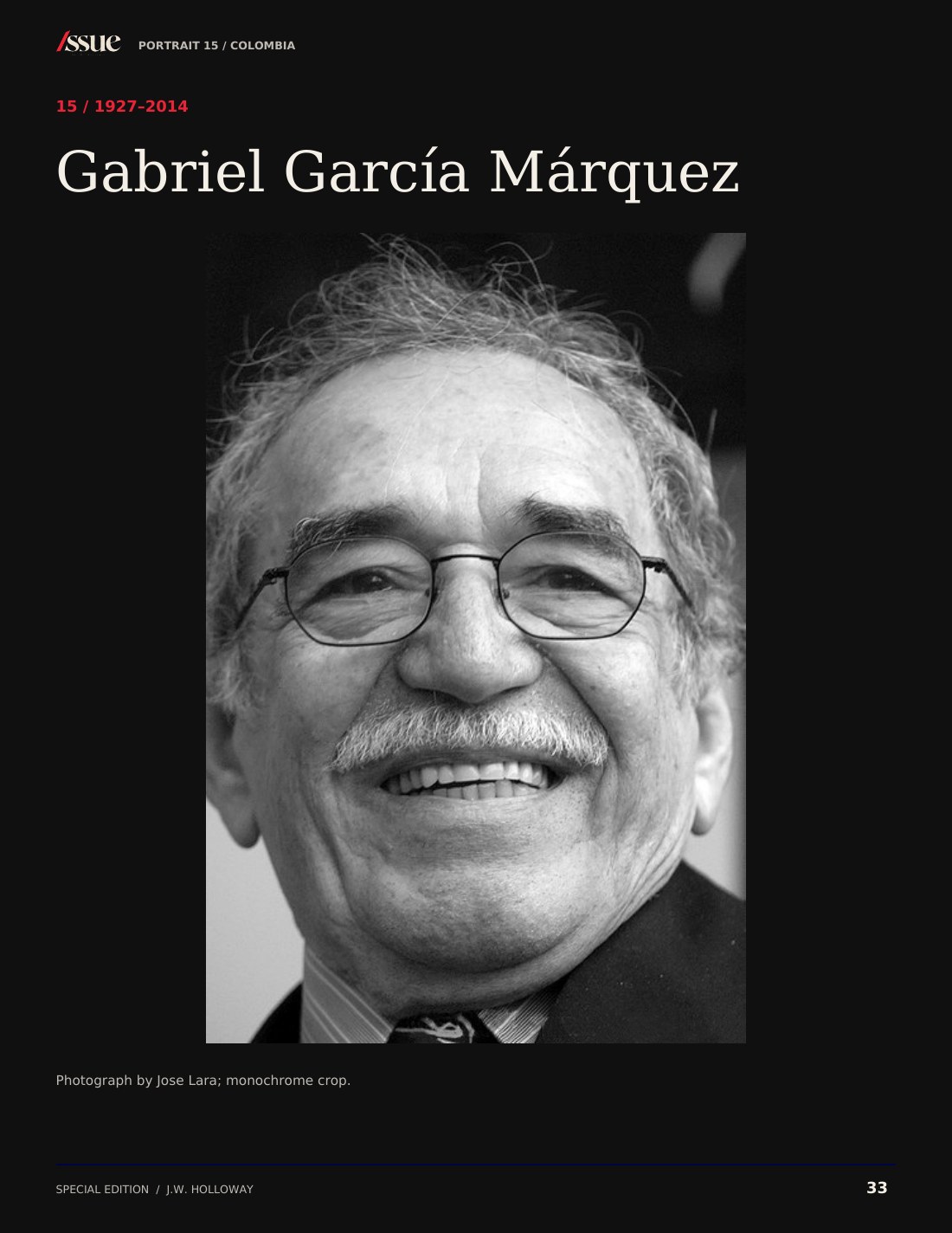
15 / 1927–2014 Gabriel García Márquez
Photograph by Jose Lara; monochrome crop.
Page 34
Read page text
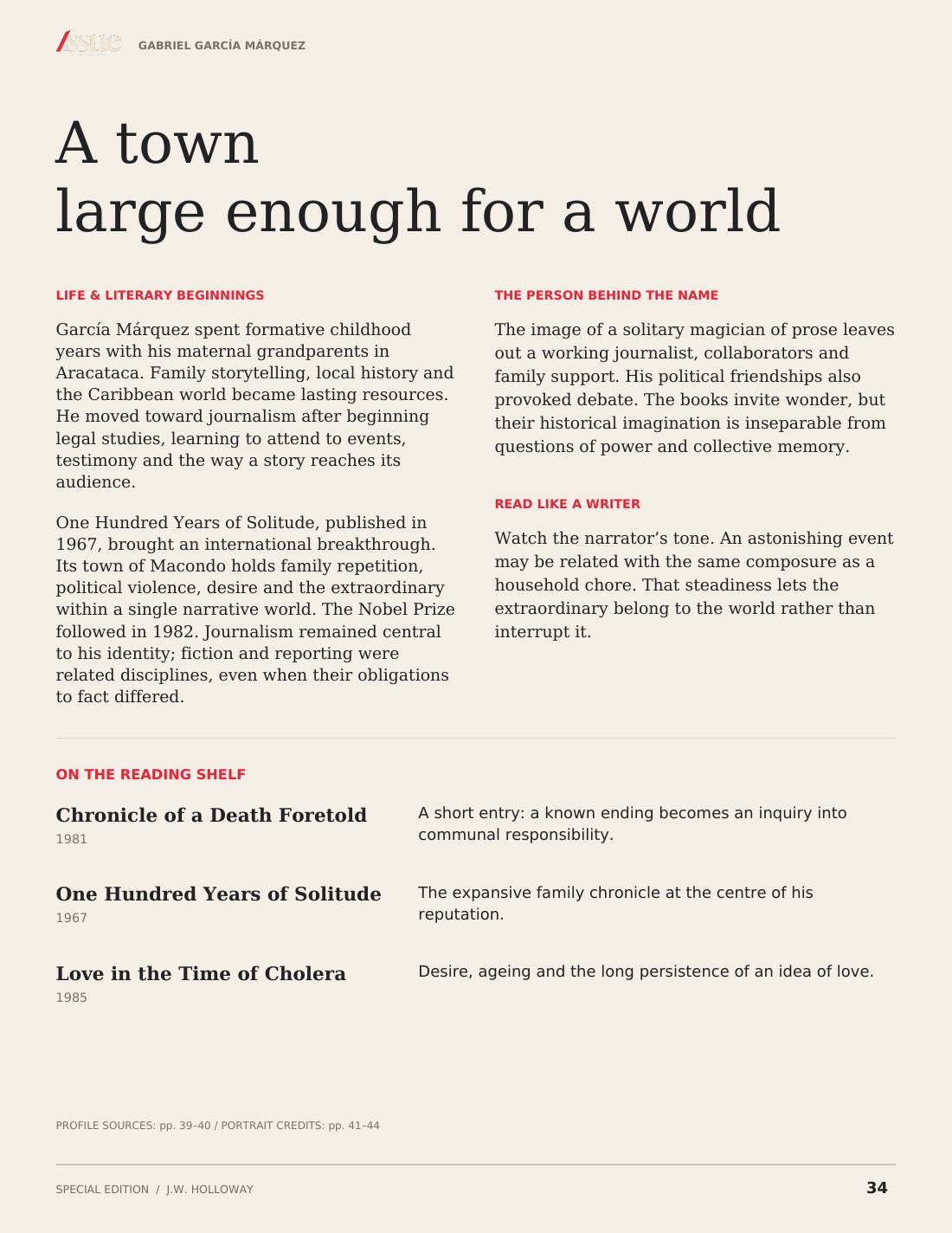
A town large enough for a world
LIFE & LITERARY BEGINNINGS
García Márquez spent formative childhood years with his maternal grandparents in Aracataca. Family storytelling, local history and the Caribbean world became lasting resources. He moved toward journalism after beginning legal studies, learning to attend to events, testimony and the way a story reaches its audience.
One Hundred Years of Solitude, published in 1967, brought an international breakthrough. Its town of Macondo holds family repetition, political violence, desire and the extraordinary within a single narrative world. The Nobel Prize followed in 1982. Journalism remained central to his identity; fiction and reporting were related disciplines, even when their obligations to fact differed.
THE PERSON BEHIND THE NAME
The image of a solitary magician of prose leaves out a working journalist, collaborators and family support. His political friendships also provoked debate. The books invite wonder, but their historical imagination is inseparable from questions of power and collective memory.
READ LIKE A WRITER
Watch the narrator’s tone. An astonishing event may be related with the same composure as a household chore. That steadiness lets the extraordinary belong to the world rather than interrupt it.
ON THE READING SHELF
Chronicle of a Death Foretold
A short entry: a known ending becomes an inquiry into communal responsibility.
One Hundred Years of Solitude
The expansive family chronicle at the centre of his reputation.
Love in the Time of Cholera
Desire, ageing and the long persistence of an idea of love.
Page 35
Read page text
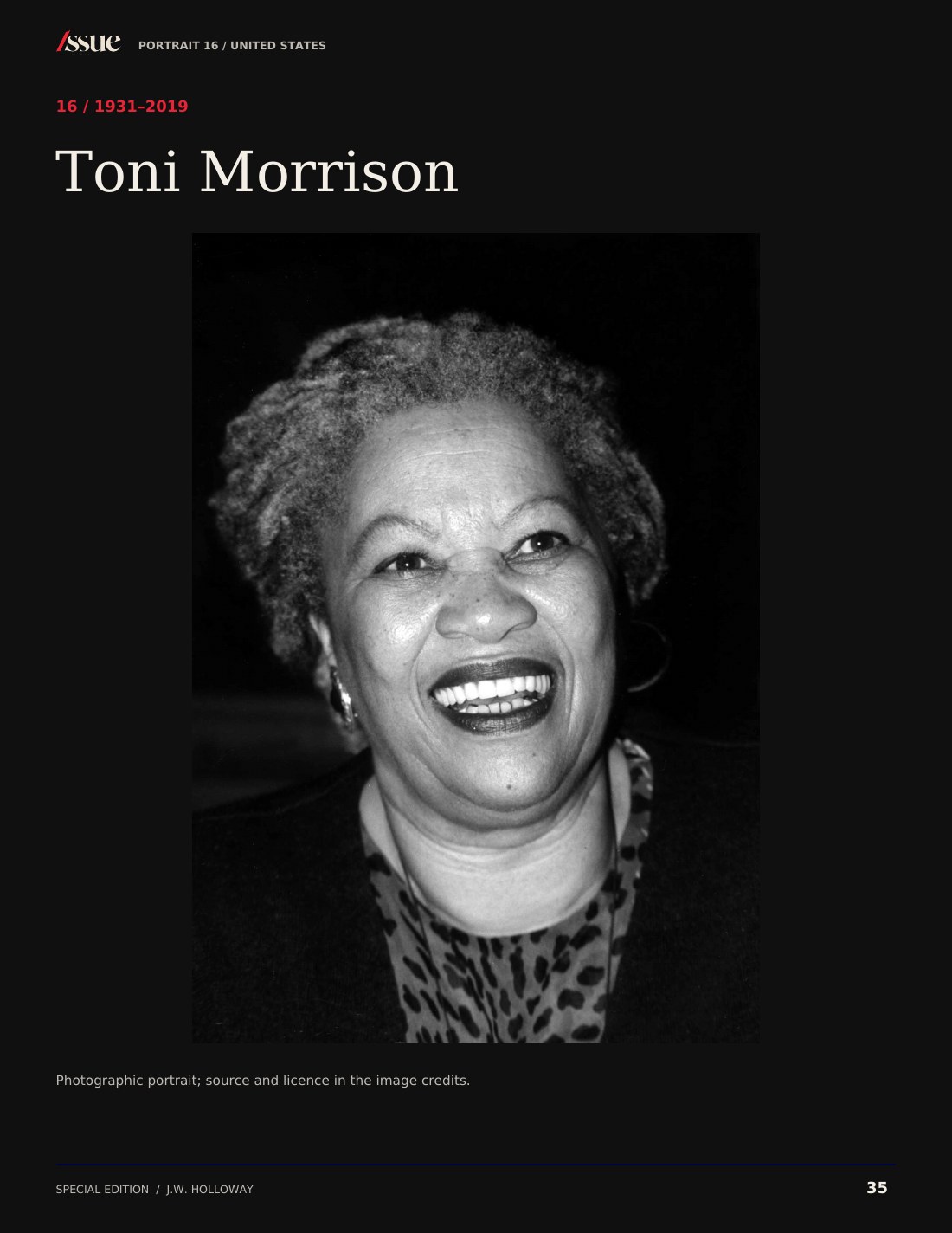
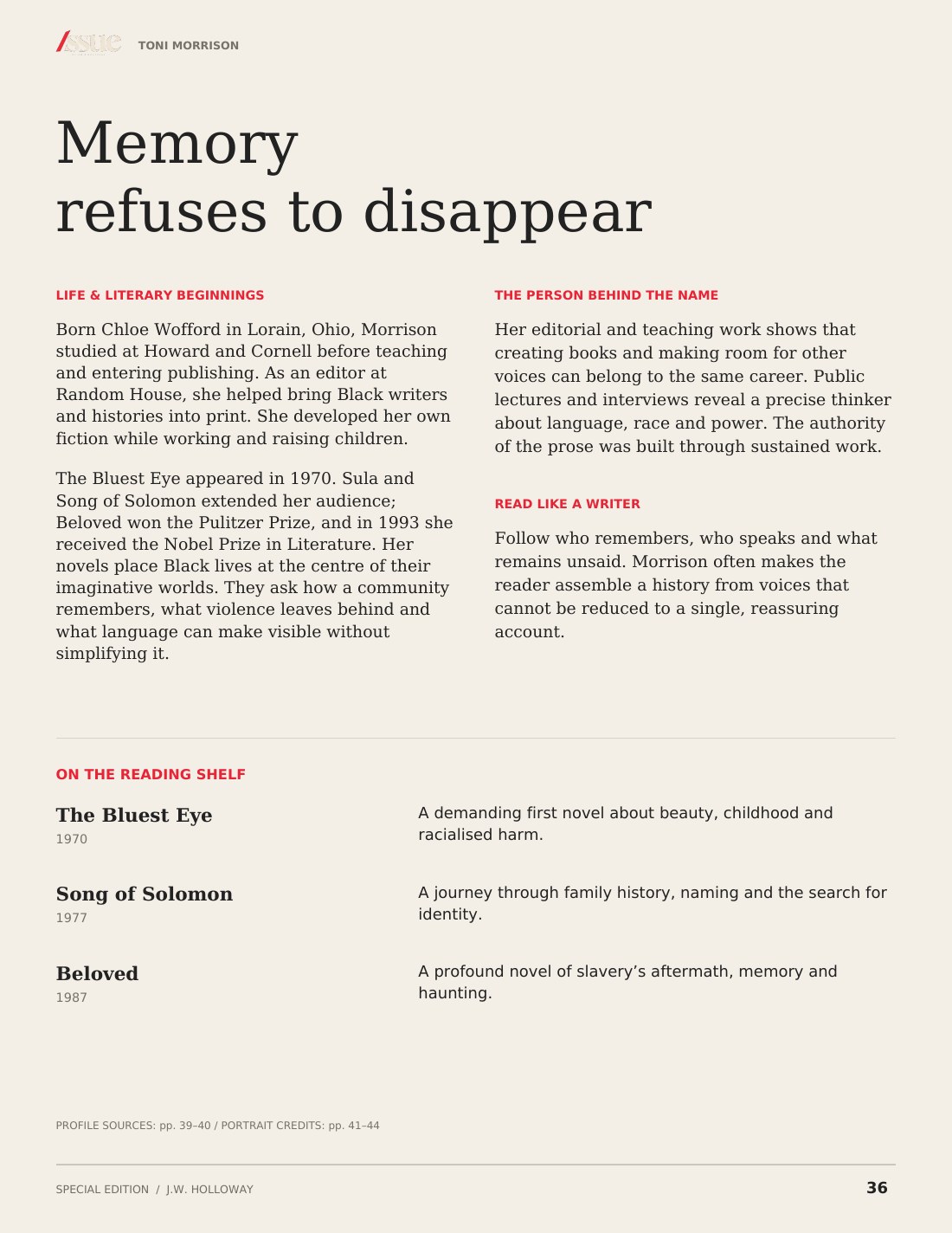
16 / 1931–2019 Toni Morrison
Photographic portrait; source and licence in the image credits.
Page 36
Read page text
Memory refuses to disappear
LIFE & LITERARY BEGINNINGS
Born Chloe Wofford in Lorain, Ohio, Morrison studied at Howard and Cornell before teaching and entering publishing. As an editor at Random House, she helped bring Black writers and histories into print. She developed her own fiction while working and raising children.
The Bluest Eye appeared in 1970. Sula and Song of Solomon extended her audience; Beloved won the Pulitzer Prize, and in 1993 she received the Nobel Prize in Literature. Her novels place Black lives at the centre of their imaginative worlds. They ask how a community remembers, what violence leaves behind and what language can make visible without simplifying it.
THE PERSON BEHIND THE NAME
Her editorial and teaching work shows that creating books and making room for other voices can belong to the same career. Public lectures and interviews reveal a precise thinker about language, race and power. The authority of the prose was built through sustained work.
READ LIKE A WRITER
Follow who remembers, who speaks and what remains unsaid. Morrison often makes the reader assemble a history from voices that cannot be reduced to a single, reassuring account.
ON THE READING SHELF
The Bluest Eye
A demanding first novel about beauty, childhood and racialised harm.
Song of Solomon
A journey through family history, naming and the search for identity.
Beloved
A profound novel of slavery’s aftermath, memory and haunting.
Page 37
Read page text
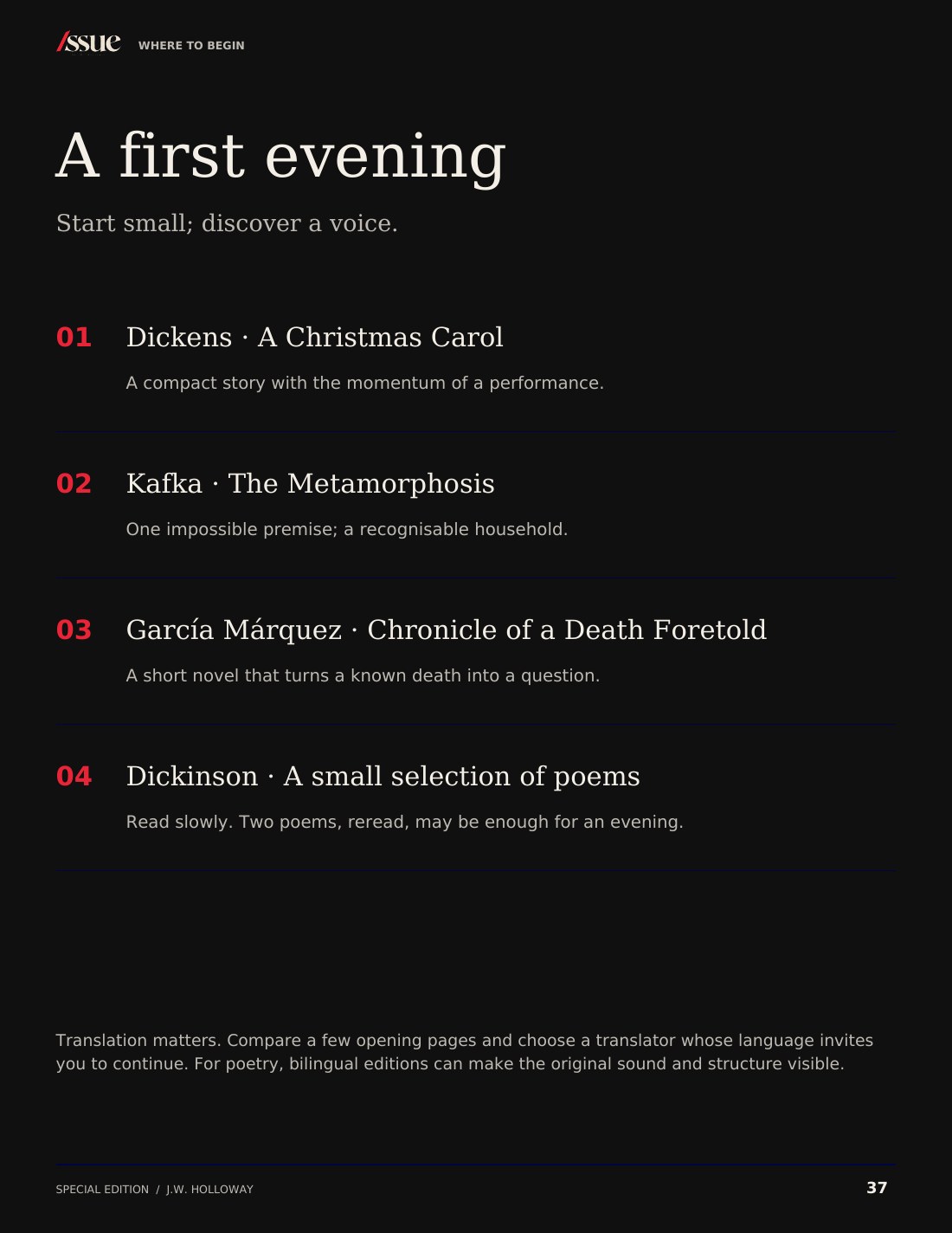
A first evening
Start small; discover a voice.
Dickens · A Christmas Carol
A compact story with the momentum of a performance.
Kafka · The Metamorphosis
One impossible premise; a recognisable household.
García Márquez · Chronicle of a Death Foretold
A short novel that turns a known death into a question.
Dickinson · A small selection of poems
Read slowly. Two poems, reread, may be enough for an evening.
Translation matters. Compare a few opening pages and choose a translator whose language invites you to continue. For poetry, bilingual editions can make the original sound and structure visible.
Page 38
Read page text
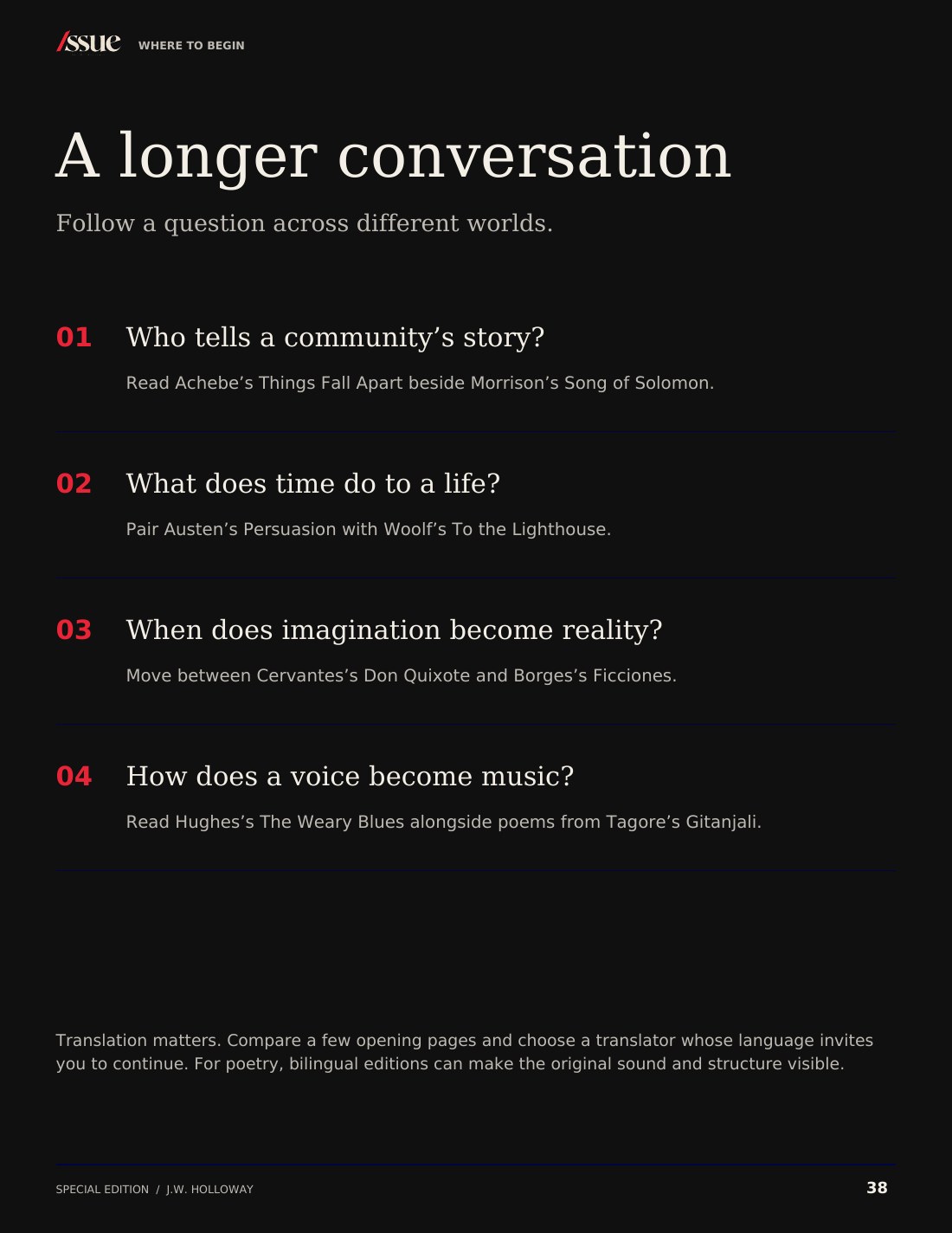
A longer conversation
Follow a question across different worlds.
Who tells a community’s story?
Read Achebe’s Things Fall Apart beside Morrison’s Song of Solomon.
What does time do to a life?
Pair Austen’s Persuasion with Woolf’s To the Lighthouse.
When does imagination become reality?
Move between Cervantes’s Don Quixote and Borges’s Ficciones.
How does a voice become music?
Read Hughes’s The Weary Blues alongside poems from Tagore’s Gitanjali.
Translation matters. Compare a few opening pages and choose a translator whose language invites you to continue. For poetry, bilingual editions can make the original sound and structure visible.
Page 39
Read page text
Page 40
Read page text
Page 41
Read page text
Page 42
Read page text
Page 43
Read page text
Page 44