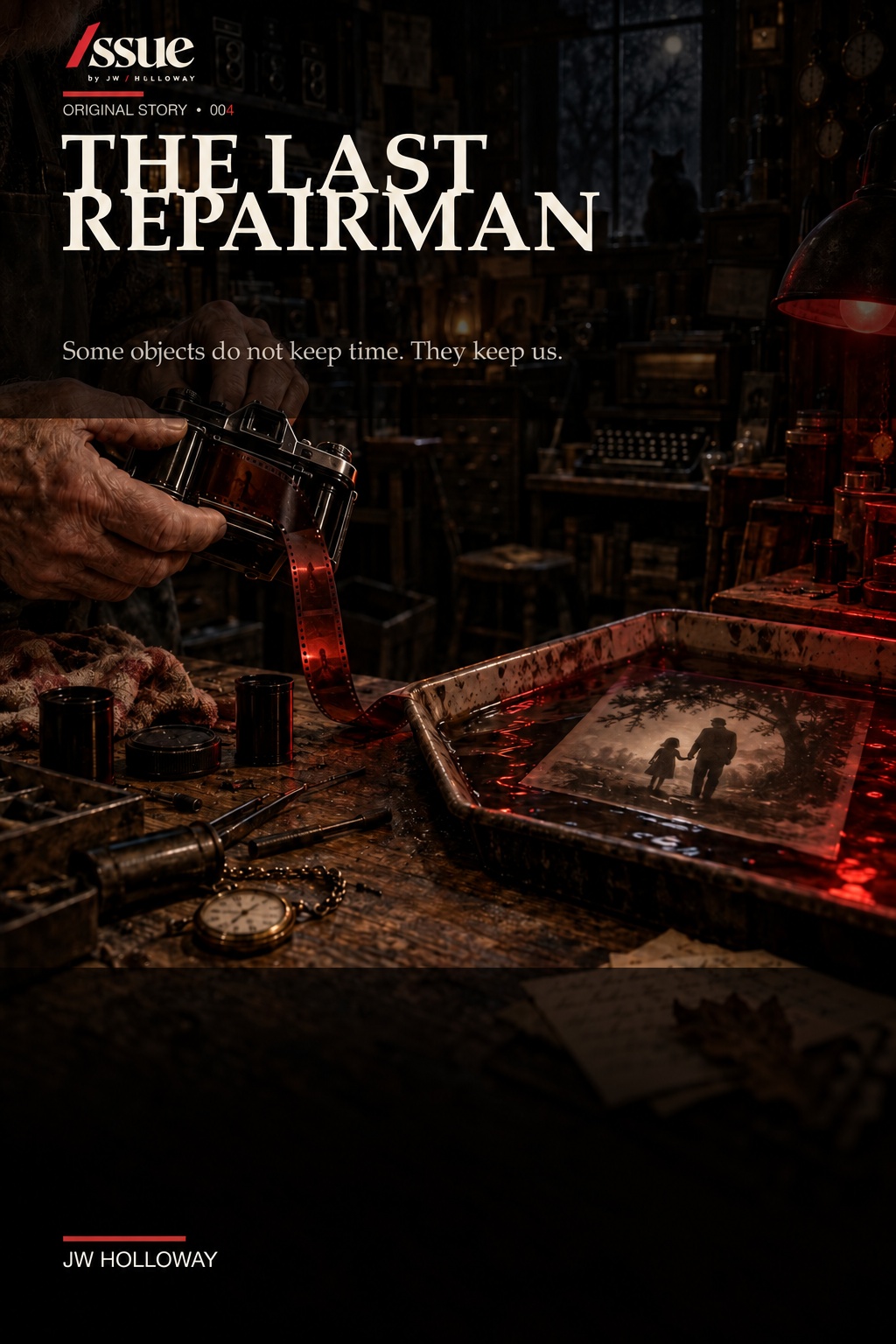
The shop that refused to disappear
By the time Mara Venn found the repair shop, the rain had polished the city into a sheet of black glass. Advertisements moved across the pavement beneath her feet. Buildings recognized pedestrians and changed their windows to match each passing desire. Coats warmed themselves. Cars arrived before anyone called them. Nothing waited to be asked anymore.
The shop waited.
It stood between a sleep clinic and a white storefront where people rented memories for anniversaries. Its sign was painted by hand: VALE AND SON, REPAIRS. The word SON had faded almost completely. Behind the glass, watches hung like small moons. Cameras stared from shelves with blind, round eyes. A typewriter rested under a gray cloth, its keys making the shape of teeth beneath fabric.
Mara pushed the door. A brass bell gave one tired note.
The air smelled of machine oil, wet wool, old paper, and the faint mineral odor of a darkroom. Somewhere in the back, a clock counted with the confidence of a heart.
An old man sat beneath a green lamp, holding a wristwatch near his ear. His hands were large and brown with age, the fingertips darkened by graphite and chemicals. A magnifying lens covered one eye.
“You are closing,” Mara said.
“So is everything,” he answered. “That has never stopped people from arriving late.”
She placed the camera on his bench. It was a black mechanical Serein 35, heavy enough to feel deliberate. A crack crossed the viewfinder. The leather covering had lifted at one corner, revealing brass worn smooth by a thumb.
The old man did not touch it. “Where did you get that?”
“It belonged to my father.”
Outside, the rain pressed its fingers against the window.
“Your father’s name?”
“Adrian Venn.”
The clock behind him missed a beat. Or perhaps Mara did.
The roll inside
Elias Vale removed the camera’s bottom plate with a coin worn nearly blank. He worked without hurry, arranging each screw on a square of ivory paper. Mara watched his hands and thought of her father teaching her to tie a fishing knot: make the loop slowly; speed is what the frightened hand does.
Adrian Venn had vanished twenty-two years earlier when the North River broke through its storm wall. The city called him one of the missing, then one of the presumed dead, then—after the legal number of years—simply dead. Mara had been seven. Her memories of him survived as fragments: cedar soap, a whistle with two notes, rain shining on his hair, the weight of this camera against his chest.
Elias opened the back. A roll of film waited inside.
Mara leaned closer. “That cannot be there.”
“Film often is where people forget they left it.”
“My mother had the camera cleaned after he disappeared. I checked it myself when she died. It was empty.”
Elias turned the take-up spool a fraction. The film tightened with a papery whisper. On its edge, handwritten in red ink, was a date.
Tomorrow’s date.
Mara laughed once, sharply. “Someone is playing a cruel joke.”
“A joke needs an audience.” Elias looked around the empty shop. “We appear to be short one.”
He placed the camera in a black changing bag and slid his arms into its sleeves. The bag moved beneath his hands as if a small animal were breathing inside. When he withdrew the metal cassette, his face had lost its color.
“You knew him,” Mara said.
Elias looked toward the rain. “I repaired his cameras.”
“That is not what I asked.”
He switched off the green lamp. “No,” he said. “It is not.”
What the darkness developed
The darkroom was hardly larger than a wardrobe. Red light gathered in three shallow trays. Bottles stood in rows, their handwritten labels bleached by years. Elias moved with the memory of repetition: developer, stop bath, fixer, wash. He did not explain. Mara did not ask.
The first strip emerged pale and dripping. Thirty-six frames.
Elias held it to the light. His breath stopped.
They made contact sheets. Images appeared slowly, shadows choosing bodies, silver becoming faces.
Frame one showed Mara at nine, asleep across two chairs in a hospital corridor while her mother sat beside her. No photographer had been there. Frame four showed her at fourteen on the roof of their apartment, opening the letter that told her she had won a scholarship. Frame eleven showed her wedding morning—the marriage had lasted eight months—and captured her alone in the bathroom, forehead against the mirror, knowing before the ceremony what she would not admit for another year.
The camera had been locked in her mother’s closet through all of it.
Every photograph had been taken from a little distance, at the height from which her father once watched her. None recorded the moments people displayed. They showed what happened just before the smile, or after everyone had left.
Mara gripped the edge of the sink. “These are fabricated.”
Elias placed a loupe over frame twenty-three. “Fabrications are cleaner.”
The photographs carried scratches, uneven exposure, a hair trapped in the gate. In one, moonlight had leaked through a curtain and burned a white wound into the negative. They possessed the flaws of physical events.
Frame thirty-four showed Mara as she was now, standing outside Vale and Son in the rain.
Frame thirty-five showed tomorrow morning. She stood in the doorway holding the Serein to her eye. Behind Elias, the repair shop was burning.
The final frame appeared black.
Mara looked at him. “What happens tomorrow?”
Elias lowered himself onto a stool. The room ticked with cooling pipes.
“Tomorrow,” he said, “the city demolishes this block.”
The camera that remembered
Elias unlocked a drawer beneath the enlarger and removed a notebook bound with red thread. Adrian’s name filled the first page. The entries were diagrams, exposure tests, equations, and observations written in the compact hand Mara remembered from birthday cards.
Her father had not tried to build a camera that photographed the future. He had tried to understand why certain objects seemed to carry the people who used them. A violin changed beneath one musician’s hand. A wooden stair remembered every footstep in the hollow at its center. A letter retained pressure where the writer had hesitated.
“He believed attention leaves a physical trace,” Elias said. “Not a ghost. Not magic. A pattern. Matter altered by being loved, handled, repaired.”
Adrian had modified the Serein’s pressure plate with an alloy used in early memory storage. The camera did not expose what stood before its lens. Under rare conditions, it exposed what had been impressed upon the object by years of human attention.
“Then why are there images from after he died?” Mara asked.
“Because he prepared the roll for you.”
“How could he know my life?”
Elias turned the notebook to its last written page. “He did not know the events. He knew where his attention would remain.”
Mara wanted to reject the sentence. Instead, she remembered the feeling that had followed her through empty apartments and crowded stations: not that someone watched her, but that somewhere she remained visible.
“Why did you keep this from me?”
The old man’s hands closed around the notebook. “The night of the flood, Adrian came here. The storm wall had failed. He could have gone home, but the river had reached the school archive. There were photographs, letters, recordings—three generations of the neighborhood. He went back for them.”
“And you let him.”
“I went with him.”
Elias rolled up his left sleeve. A pale rope of scar tissue climbed from wrist to elbow. “He pulled me out. I could not pull him.”
For twenty-two years, Elias had repaired the objects rescued that night. He had returned watches to widows, radios to sons, typewriters to women whose first books had been written on them. One by one, the shelves emptied. The camera was the last object Adrian had entrusted to him.
“Why now?” Mara whispered.
“Because tomorrow they erase the last place that remembers him.”
The photograph dated tomorrow
At eight the next morning, demolition machines turned into Bellweather Street. They were white, silent, and clean enough to resemble medical instruments. A notice illuminated the shop window: RENEWAL BEGINS TODAY. Beneath it, in smaller letters, the city promised that nothing of value would be lost.
Mara arrived carrying the Serein and Adrian’s notebook. Elias was inside, wrapping clocks in newspaper.
“You came back,” he said.
“The photograph said I would.”
“Photographs say many things. Mostly after we decide to listen.”
A city officer entered and explained that the block had been digitally documented. Every façade, room, and registered object could be reconstructed through the municipal archive. The physical structures were therefore redundant.
Elias asked whether the archive had recorded the smell of rain in the floorboards, the burn on the counter where Adrian had set down a soldering iron, or the groove worn into the threshold by forty-three years of people carrying broken things inside.
The officer looked briefly embarrassed. “Those details have no civic value.”
“That,” Elias said, “is why cities die before their buildings do.”
The machines advanced. Neighbors gathered beneath umbrellas. They had come carrying objects: a radio, a mechanical doll, a box of letters tied in blue ribbon, a trumpet with a dent in its bell. Word had traveled during the night. People placed them along the pavement until the street resembled an exhibition of private lives.
Mara raised the camera.
Through the cracked viewfinder she saw Elias in the doorway and the red repair lamp glowing behind him. Reflected in the glass, a demolition machine’s warning beacon overlapped the lamp. On film, she understood, the two red lights would become fire.
The photograph had not predicted the shop burning. It had mistaken resistance for flame—or perhaps had found the correct symbol for it.
Mara pressed the shutter.
The mechanism struck with a clean metallic certainty. The film advanced to frame thirty-six.
At that sound, the crowd became still. It was a tiny sound, almost nothing against the machinery. Yet every person heard it: the closing of one moment and the opening of another.
The city officer lowered his tablet.
“What exactly are you asking for?” he said.
Mara looked at the objects lining the street. “Time,” she answered. “Not forever. Enough to prove this place is still alive.”
The final frame
The demolition was delayed for thirty days. The newspapers called it nostalgia. The networks called it an analog protest. People who had never repaired anything arrived to be photographed beside their grandparents’ objects. Children learned to thread film, clean a type basket, oil a clock, and mend a torn page with paper thin as skin.
Thirty days became a year. Vale and Son became the Bellweather Archive and Workshop. Nothing inside was displayed behind glass unless it was too fragile to touch. A museum tells you not to handle the past; Elias believed the past survived precisely because someone did.
He died five winters later at his workbench, one hand resting beside an open watch. It had begun ticking again.
Many years after that, when Mara’s hair had turned the color of fixer crystals, a boy brought her the old Serein. He had found it in a cabinet at the workshop. The counter showed thirty-six exposures.
“Is there really a picture inside?” he asked.
“There is always a picture inside,” Mara said. “The difficult part is discovering who it belongs to.”
Together they entered the darkroom. Under the red lamp, she developed the final frame her father had left black. An image rose through the chemical surface.
It showed the workshop decades in the future. The shelves were changed, the street beyond the window unfamiliar, but the scarred wooden bench remained. A child stood on a stool repairing a camera while an old woman guided his hands.
Mara recognized herself. She recognized the boy beside her.
At the bottom edge of the negative, where no camera could have written, four words appeared in Adrian Venn’s handwriting:
KEEP WHAT KEEPS US.
The boy read them aloud.
Outside, the city continued replacing itself. Buildings rose and vanished. Devices awakened, answered, and became obsolete. But inside the workshop, the child turned a tiny screw with deliberate care, and the old camera waited in Mara’s hands—not preserved, not worshiped, but ready to be used again.
For the first time in many years, she heard her father’s two-note whistle.
It came from nowhere she could prove.
It came from everything he had touched.
Continue the world
Explore the complete 35-page edition of  004 The Analog Rebellion—essays, stories, poetry, photography, and reflections on the human objects that remember.
004