Page 1
Read page text
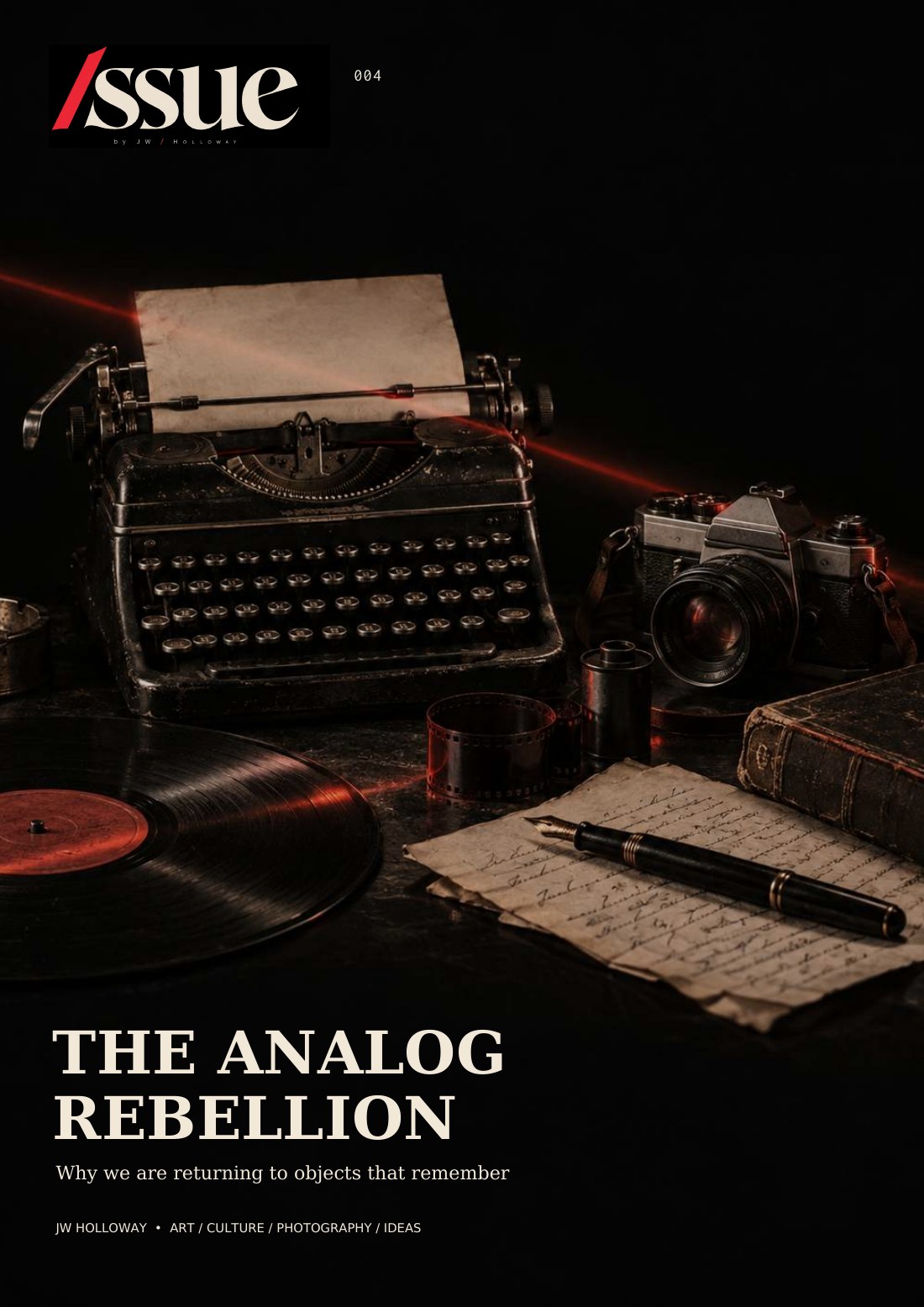
The Analog Rebellion. An Issue magazine edition by J. W. Holloway.
Page 2
Read page text
Page 3
Read page text
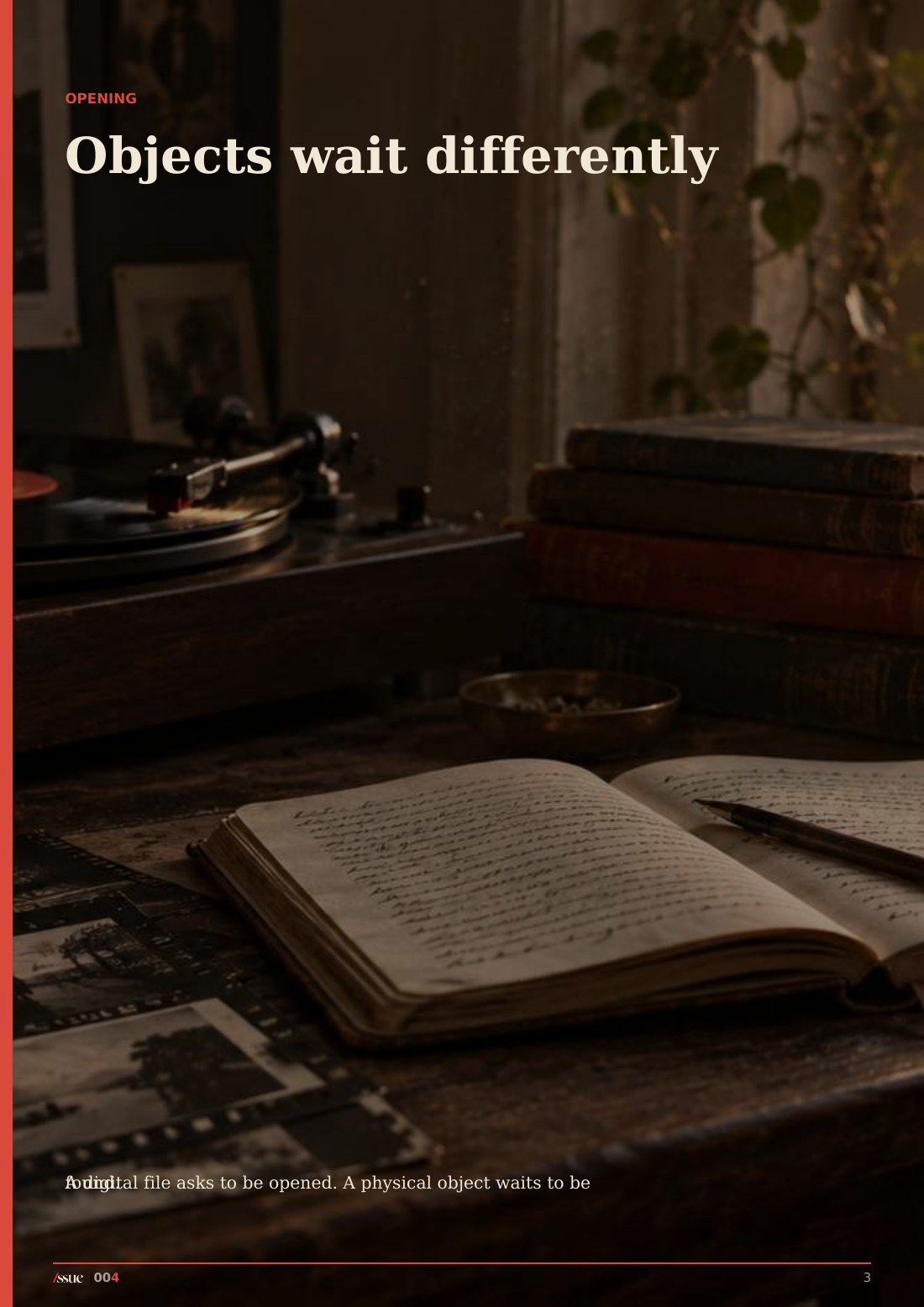
OPENING Objects wait differently
A digital file asks to be opened. A physical object waits to be found.
Page 4
Read page text
EDITOR’S LETTER What friction gives back
The analog rebellion is a refusal to let friction disappear from every part of life.
I have spent much of my life around machines that ask us to hurry. Cameras became instant. Letters became messages. Music became a file that appears before we have time to anticipate it. Convenience won, and much of that victory was deserved. Yet something followed us into the faster world: a quiet suspicion that speed may have taken more than waiting away. This issue began with a typewriter and a camera. Both were resting in darkness. Neither could update itself. Neither was trying to attract my attention. They simply waited for a human hand. That patience felt radical. The analog objects returning to our lives are not magical. Film can be expensive. Typewriters jam. Records collect dust. Paper tears. Their limitations are precisely what make them meaningful. They ask us to choose before we press the shutter, listen through the end of a song, and live with the mark we have made. The analog rebellion is not a rejection of technology. I use digital tools every day. It is a refusal to let friction disappear from every part of life. Friction can be where attention begins. This issue is about objects, but beneath the objects it is about presence. A letter carries the pressure of a hand. A negative holds a moment that cannot be reviewed. A repaired camera carries evidence that someone believed it deserved another life. These
Page 5
Read page text
EDITOR’S LETTER
What friction gives back - continued
things remind us that making and remembering are physical acts. They leave traces. So does a life.
Page 6
Read page text
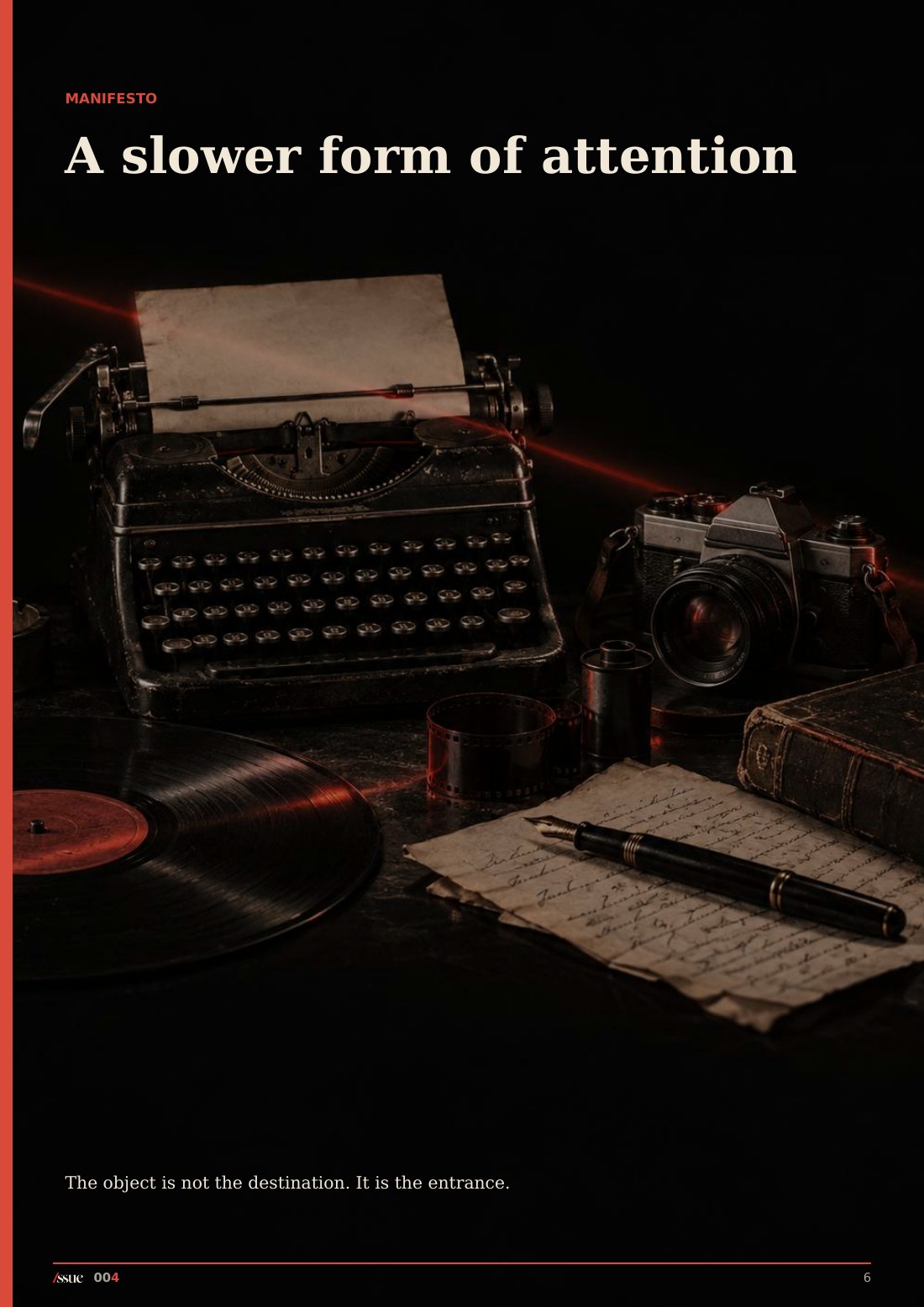
MANIFESTO A slower form of attention
The object is not the destination. It is the entrance.
Page 7
Read page text
CULTURE The Analog Rebellion
The future was supposed to make the past unnecessary. Instead, the past has returned carrying a notebook, a roll of film, and a record under its arm. People raised on instant images are loading cameras that cannot show them what they have taken. Writers surrounded by perfect keyboards are buying machines with stubborn keys. Listeners with access to almost every song ever recorded are lowering needles onto vinyl and waiting through the soft crackle before the music begins. It would be easy to call this nostalgia. Nostalgia explains part of it, but not enough. Nostalgia looks backward. What is happening now feels more like a correction. Digital life removes resistance. That removal is one of its miracles. It is also one of its dangers. When everything becomes effortless, choices lose weight. We take fifty photographs because no single frame costs us anything. We skip a song before it has introduced itself. We delete a sentence without leaving evidence that it ever existed. Analog tools restore consequence. A roll of film gives us a finite number of exposures. A letter makes revision visible. A record has sides and an order. A typewriter forces a sentence to occupy space. These boundaries do not always make the work better, but they make us present for its creation. Presence may be what people are buying when they purchase an old camera. The object is only the entrance. Behind it is the possibility of moving at human speed. This
Page 8
Read page text
CULTURE
The Analog Rebellion - continued
does not require a war against the digital world. The useful question is simpler: which parts of life improve when they become faster, and which ones become thinner? Banking benefits from speed. Emergency medicine benefits from speed. Love, grief, reading, listening, and looking often do not. A culture that confuses faster with better eventually discovers the value of delay. Delay creates anticipation. It permits doubt. It makes room for the mind to catch up with the hand. The renewed life of film in cinema offers a revealing example. Filmmakers continue choosing photochemical film even when digital capture is easier and more flexible. They describe texture, discipline, and a quality of attention on set. The medium changes behavior before it changes the image. That may be the heart of the analog rebellion. The objects alter the person using them. A notebook does not send a notification. A film camera does not ask us to share. A vinyl record does not rearrange itself according to what an algorithm believes will keep us listening. These objects can be inconvenient, but their silence belongs to us. We do not need to romanticize inconvenience. We only need to recognize that a life without resistance can become a life without ritual. Ritual turns time into meaning. The record leaves its sleeve. The pen touches paper. The shutter is wound. The keys rise and strike. In each action, the body enters the thought. We remember that creativity did not begin as content. It began as a person making a mark and hoping another
Page 9
Read page text
CULTURE
The Analog Rebellion - continued
person might one day find it.
Page 10
Read page text
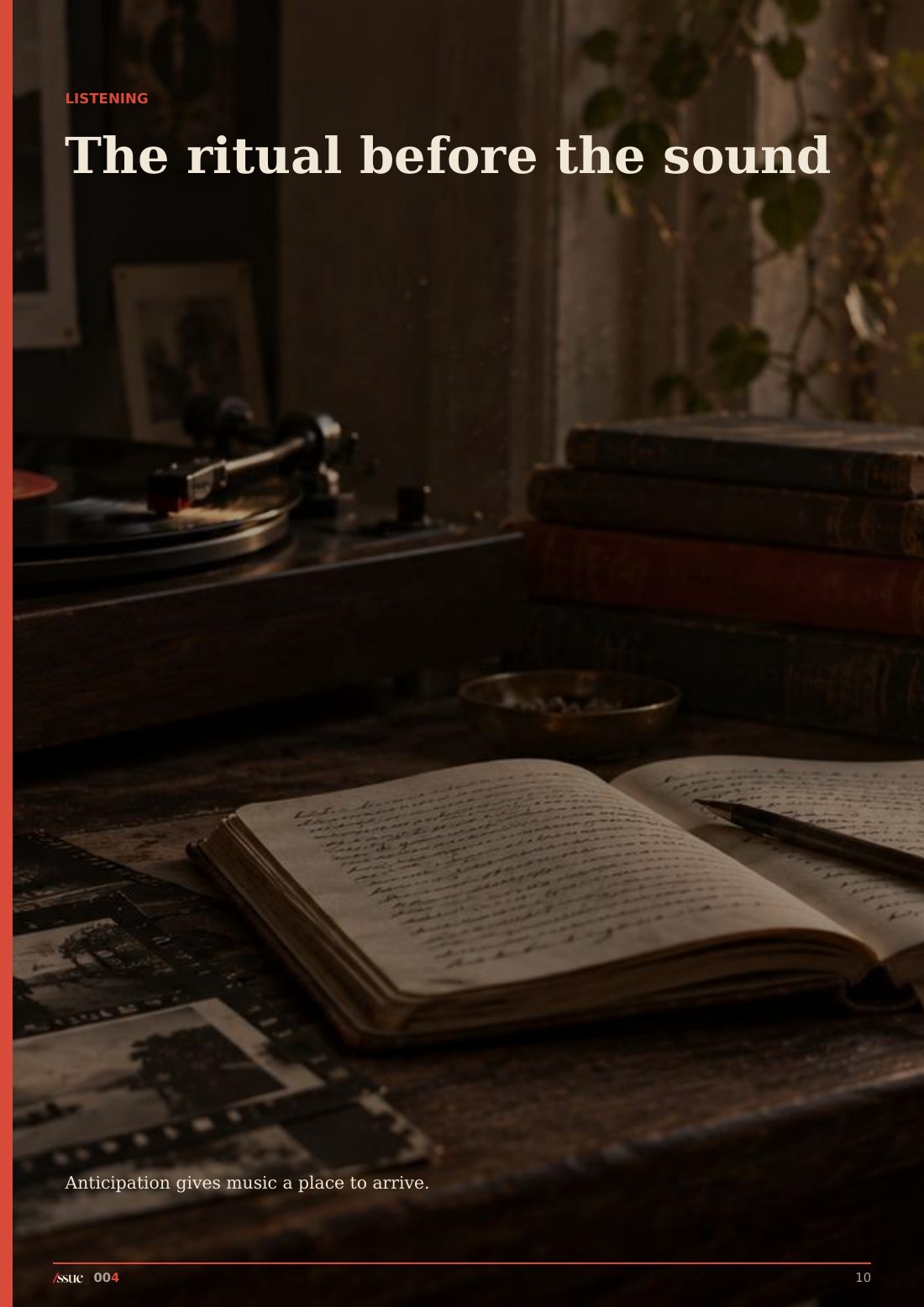
LISTENING The ritual before the sound
Anticipation gives music a place to arrive.
Page 11
Read page text
OBSERVATION What convenience took from us
A life without resistance can become a life without ritual.
Convenience removes steps. Sometimes the removed step was where anticipation lived. The walk to a shop, the turn of a dial, the wait for a photograph, the act of choosing one album from a shelf: each created a threshold between desire and possession. Thresholds prepare attention. Without them, experiences arrive before we are ready to receive them. The answer is not manufactured difficulty. It is chosen ritual. We can decide that some things deserve preparation.
Page 12
Read page text
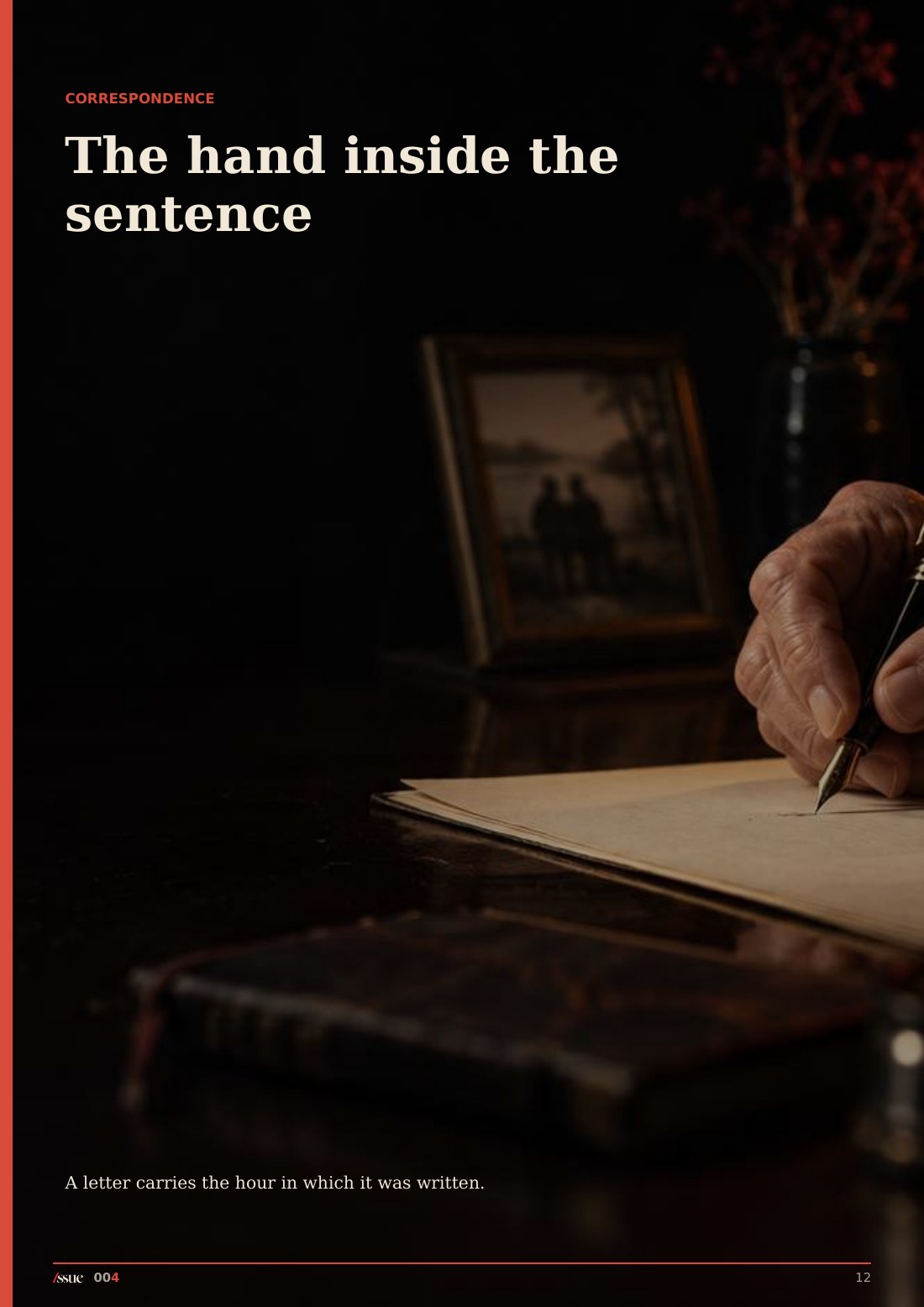
CORRESPONDENCE The hand inside the sentence
A letter carries the hour in which it was written.
Page 13
Read page text
ESSAY The Letter as a Small Room
A message arrives without an envelope. It carries no scent of a room, no fold made by an impatient hand, no place where the writer paused hard enough for the pen to leave a small pool of ink. It may contain love, but the screen has made every message physically equal. A breakup and a grocery list arrive through the same glass. A handwritten letter behaves differently. Before we read it, we encounter an object that has traveled. Someone selected the paper, formed each line, folded it, addressed it, and surrendered it to distance. The letter brings time with it. Its imperfections become information. A word crossed out tells us that another word once stood there. Uneven lines reveal fatigue or urgency. The pressure of the pen suggests confidence, anger, age. None of this proves sincerity, but it restores the body to language. I think of letters as small rooms. When we open one, we enter the hour in which it was written. The writer may no longer be alive. The table may be gone. The country named in the return address may have changed. Yet the hand remains. This is why families keep letters long after they have forgotten passwords to old accounts. Paper is vulnerable to fire and water, but it can survive neglect with astonishing patience. Digital memory depends on systems remaining readable. A letter only asks for light and a pair of eyes. We should write them again, not because the past was better, but because certain feelings deserve an
Page 14
Read page text
ESSAY
The Letter as a Small Room - continued
object. Write to someone you love. Write to the person you were at twenty. Write to the person you may become at seventy. Do not polish every sentence. Leave one correction visible. Date the page. Put it somewhere time can find it.
Page 15
Read page text
FIELD NOTE Write one letter that deserves to exist
Certain feelings deserve an object.
Choose one person. Do not begin with an announcement. Begin with a detail: the weather against the window, the cup beside your hand, the photograph you found in a drawer. Tell the person why they entered your mind. Allow the page to show hesitation. Do not photograph the letter before sending it. Let one version exist, and let it leave you.
Page 16
Read page text
PHOTOGRAPHY Thirty-six chances
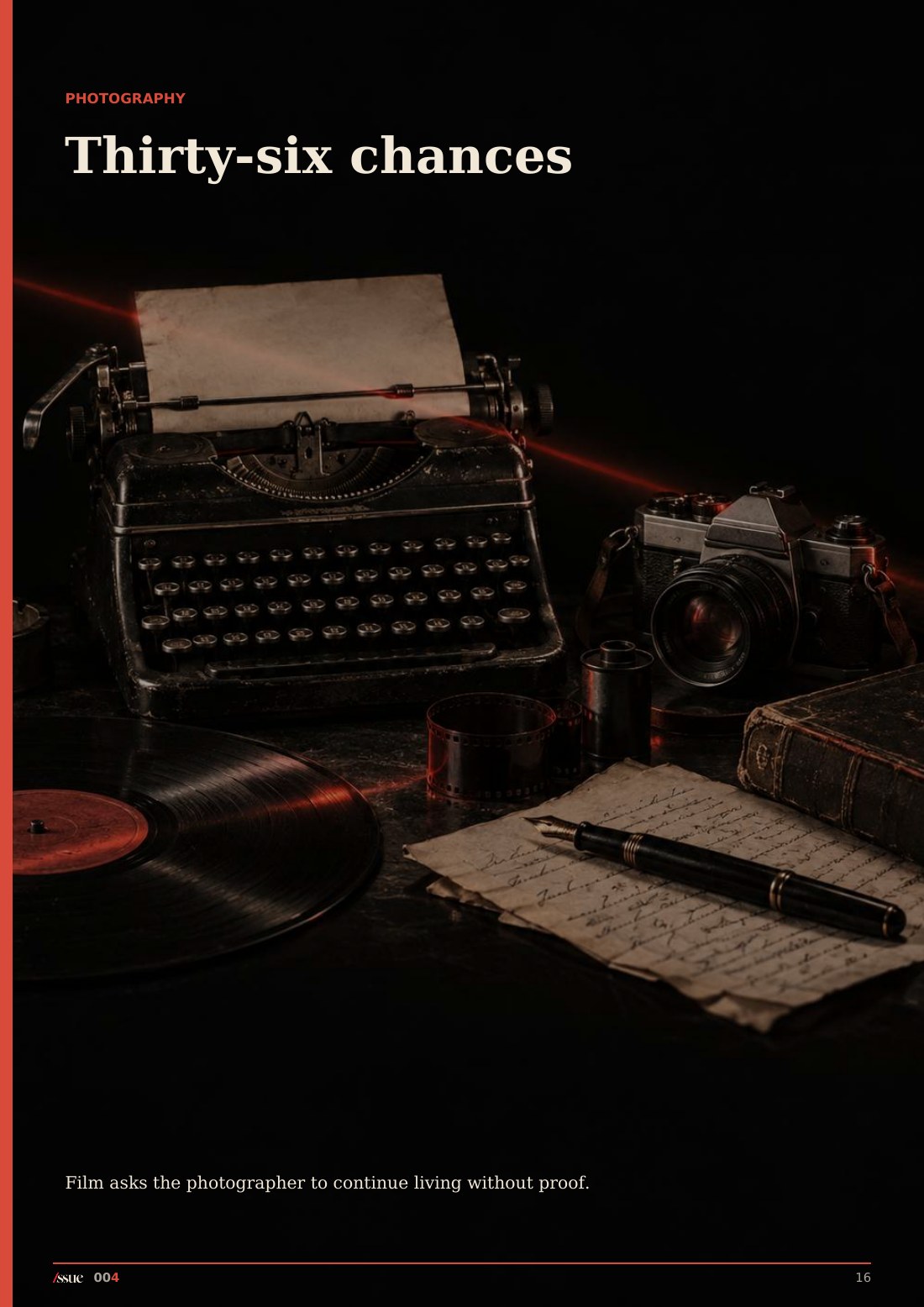
Film asks the photographer to continue living without proof.
Page 17
Read page text
PHOTOGRAPHY Thirty-Six Chances
A digital camera shows us the picture before the moment has finished. Film asks us to continue living without proof. That delay changes the photographer. The eye becomes more responsible. Light must be read rather than rescued later. The frame needs a reason. A mistake costs something, even if the cost is only one of thirty-six chances. Film does not guarantee honesty. No medium does. Photographers have staged, cropped, manipulated, and misunderstood reality since photography began. Yet film preserves a useful separation between seeing and judging. First we make the picture. Later, after the chemical darkness, we discover what we actually noticed. This gap can be uncomfortable. It can also be fertile. Memory edits experience immediately. By the time a roll returns, the photograph meets a story the mind has already begun rewriting. Sometimes the frame agrees with us. Sometimes it exposes what we failed to see. That disagreement is one of photography's gifts. The grain that people describe as warmth is not merely decoration. It reminds us that an image has a surface. Light struck material. Chemistry translated the encounter. The photograph carries evidence of a process, and the process leaves room for accident. In a culture of polished images, accident can feel like truth. I still value digital photography. It makes extraordinary work possible and gives more people access to the act of seeing. The point is
Page 18
Read page text
PHOTOGRAPHY
Thirty-Six Chances - continued
not to crown one medium. The point is to understand how a tool trains attention. A film camera teaches patience, prediction, and acceptance. It asks the photographer to move through the world with an unfinished sentence in the pocket.
Page 19
Read page text
CONTACT SHEET The pictures at the edge
The unfinished frame can tell the most complete truth.
The most revealing image on a contact sheet is often not the one we planned. It may be the frame before the subject arranged a face, or the one after everyone believed the moment had ended. Film preserves these edges because it keeps moving through uncertainty. A contact sheet shows decisions beside mistakes. It records the photographer learning in public.
Page 20
Read page text
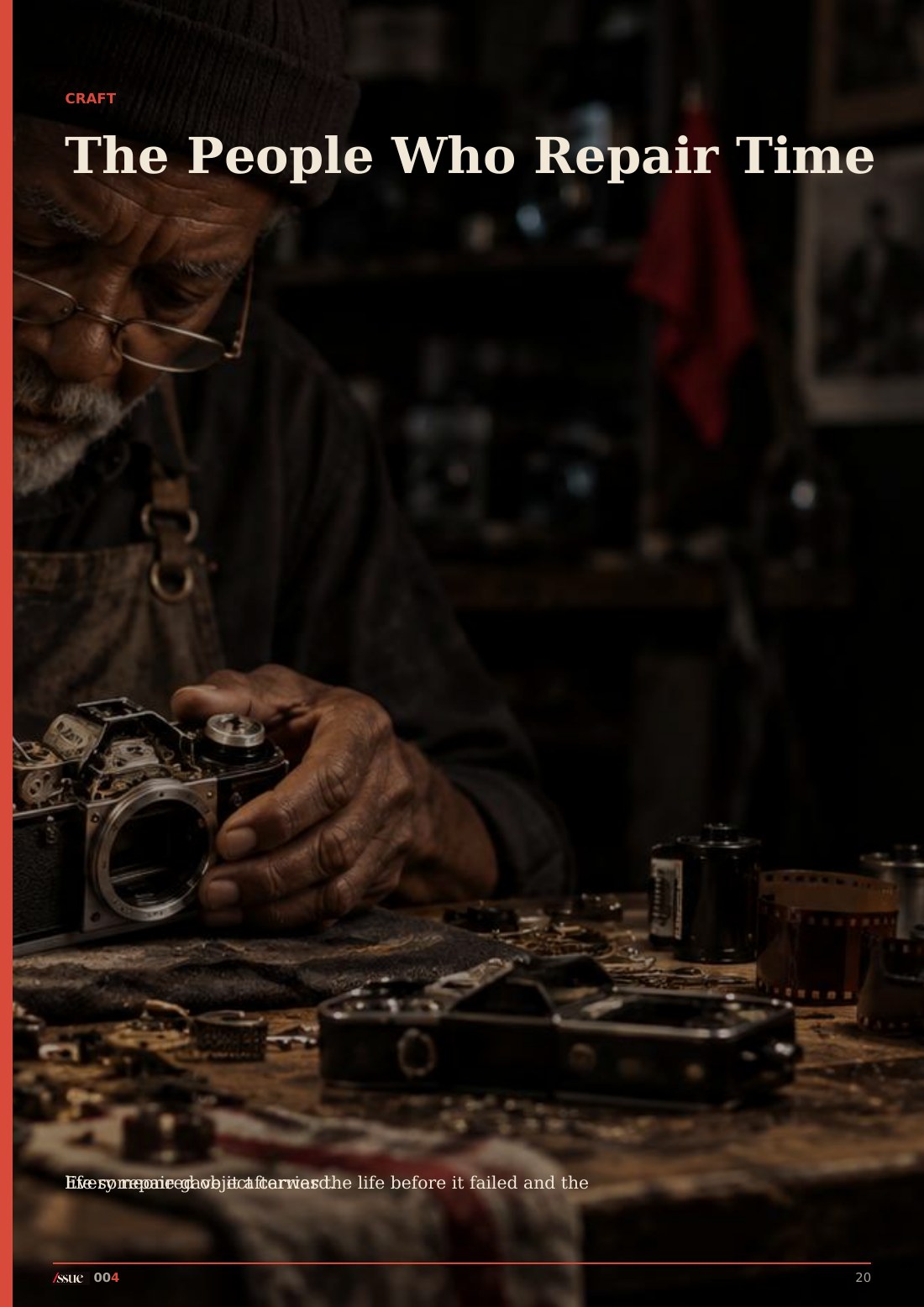
CRAFT The People Who Repair Time
Every repaired object carries the life before it failed and the life someone gave it afterward.
Page 21
Read page text
PROFILE The People Who Repair Time
On the workbench, the camera has lost the dignity of a complete object. Its skin is open. Screws rest in a shallow metal dish. Gears no larger than fingernails wait beside tweezers and oil. The repairer bends toward the mechanism with the concentration of a surgeon and the patience of an archaeologist. Modern products often hide their construction. They arrive sealed, smooth, and silent about how they work. When they fail, replacement feels natural. Repair begins with a different belief: the broken object still contains a future. This belief has economic value, but its emotional value may be greater. To repair something is to resist the idea that usefulness must be perfect and immediate. It is to say that wear does not erase worth. Old cameras make this philosophy visible. Their mechanisms were designed to be opened. A skilled person can hear the difference between a healthy shutter and one that hesitates. Knowledge passes through hands, not merely manuals. Every repaired object carries two histories: the life before it failed and the life someone gave it afterward. That second life does not pretend the break never happened. The evidence may remain in a replaced screw, a polished edge, or a sound restored to its proper rhythm. People are not objects, but perhaps this is why repair moves us. We recognize the hope inside it. We want to believe that damage can become part of function rather than the end of it.
Page 22
Read page text
OBJECT LESSON The dignity of a second life
Wear does not erase worth.
Replacement makes the old object disappear. Repair lets it return with evidence. A polished edge, a different screw, or a slight change in sound becomes a record of care. The repaired object is no longer original in the strict sense. It may be more truthful. It shows that continuity sometimes requires change.
Page 23
Read page text
IDEAS The Human Things a Machine Cannot Replace
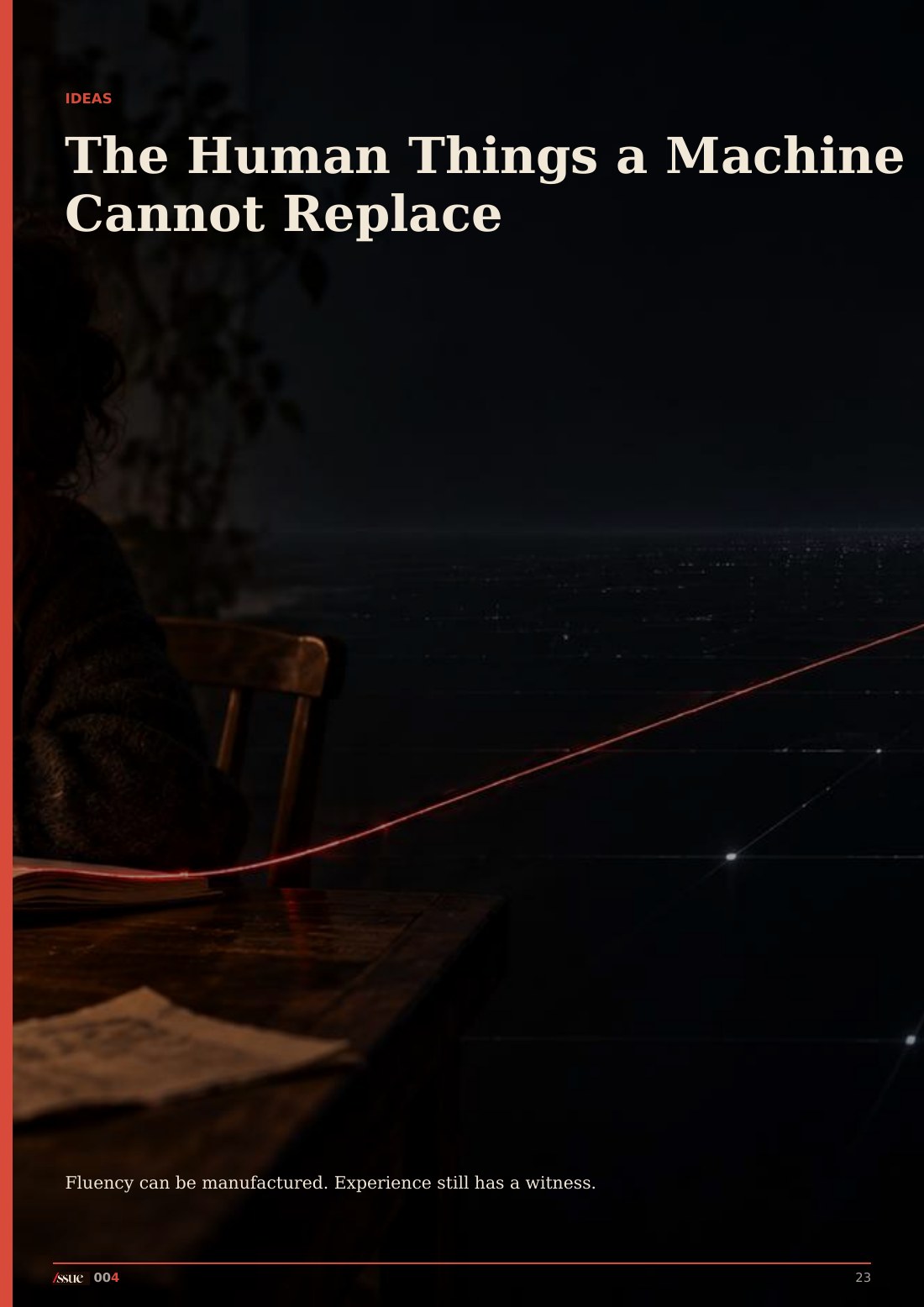
Fluency can be manufactured. Experience still has a witness.
Page 24
Read page text
ESSAY The Human Things a Machine Cannot Replace
A machine can describe rain. It can calculate its speed, identify its chemical composition, and produce a thousand metaphors before the first drop reaches the pavement. But it has never stood beneath it waiting for someone who did not arrive. This distinction does not make the machine useless. It makes the human responsibility clearer. Artificial intelligence can extend imagination, organize research, and help a writer see alternatives. Yet language is more than arrangement. A sentence can carry the price someone paid to understand it. Experience gives words moral weight. Grief is not a vocabulary. Love is not a pattern. Memory is not a database that faithfully returns what entered it. Human memory distorts, protects, and sometimes betrays us. From that imperfection come confession, forgiveness, regret, and art. The machine may imitate the shape of these things. The human being must decide whether the shape has earned its meaning. The danger is not that machines will suddenly become artists and take a chair from us. The danger is that people will accept fluency as wisdom and convenience as truth. We may stop asking who witnessed the event, who bears responsibility, and whose life supplied the material. The future of human creativity will depend less on proving that we can outperform machines than on remembering what
Page 25
Read page text
ESSAY
The Human Things a Machine Cannot Replac
performance cannot measure. Attention matters. Accountability matters. A point of view formed by a particular life matters. The artist's task remains the same: look carefully, choose honestly, and leave behind something that could not have come from indifference.
Page 26
Read page text
NOTEBOOK Seven questions for the age of machines
The human being must decide whether the shape has earned its meaning.
Who witnessed this? Who benefits from it? What experience gave the words their weight? Which part of the work contains risk? What does the maker accept responsibility for? What has been made easier, and what may have become thinner? After the novelty disappears, is there still something worth remembering?
Page 27
Read page text
FICTION The Last Repairman
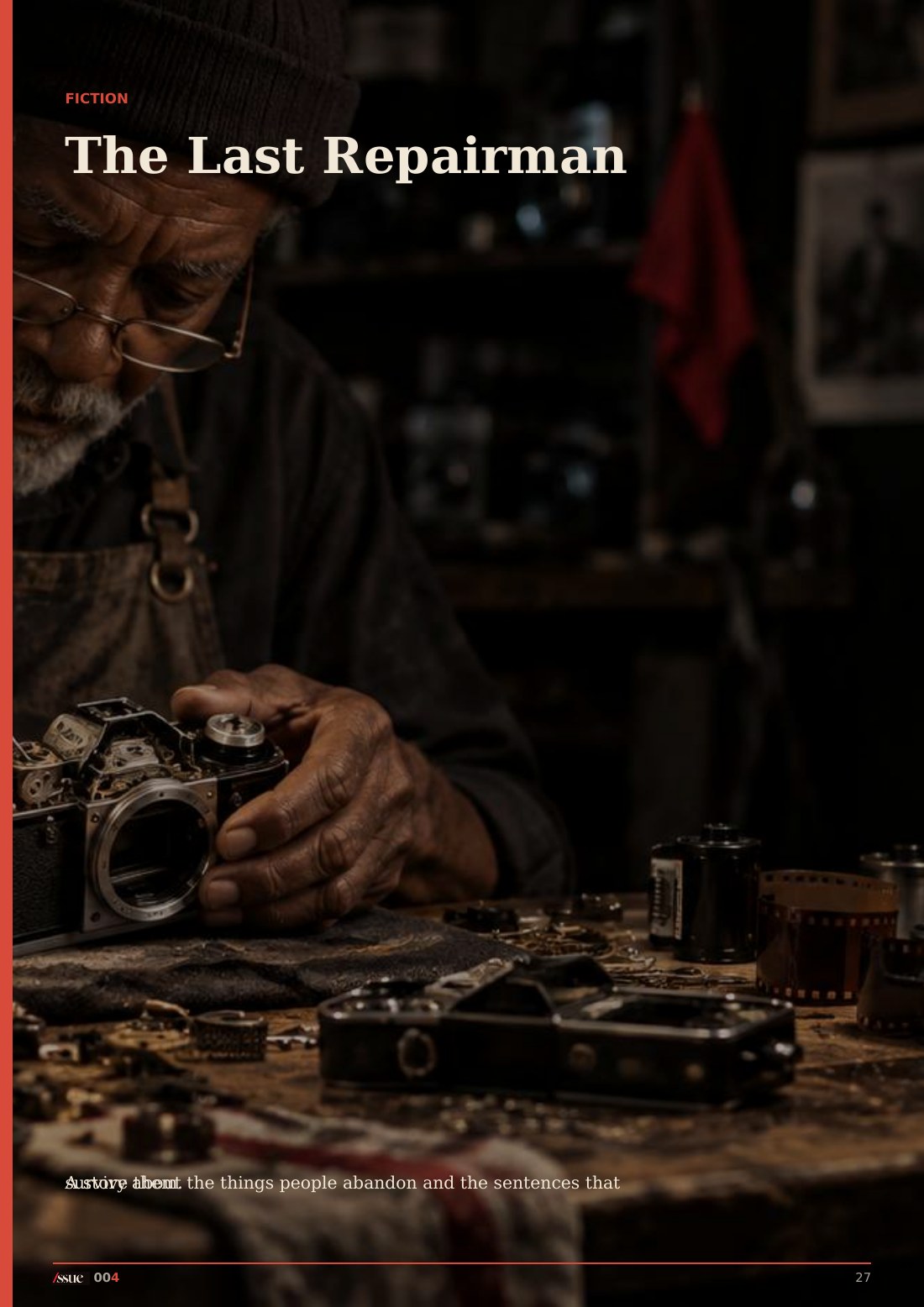
A story about the things people abandon and the sentences that survive them.
Page 28
Read page text
ORIGINAL SHORT STORY The Last Repairman
The last repairman in the city kept no sign above his door. People found him because someone remembered. A woman brought a radio that had belonged to her father. A teacher carried in a projector wrapped in a towel. Once, a boy arrived with a camera recovered from a flooded house. Mr. Vale accepted each object as if it had spoken first. He asked when it stopped working. He asked who had used it. He asked what sound it made before the silence. The customers sometimes laughed. They thought these questions belonged to people, not machines. Mr. Vale knew the difference, but he also knew that objects often failed in the middle of a human story. One winter afternoon, a woman placed a typewriter on his bench. It was small, black, and scarred along one side. The letter E refused to rise. "My mother wrote a novel on this," she said. "Was it published?" "No." "Was it finished?" The woman looked toward the back of the shop where clocks waited without hands. "I don't know." Mr. Vale removed the ribbon cover. Dust had settled inside like gray snow. He pressed the keys slowly. Every letter rose except E. "Leave it with me." That night, after the street went quiet, he opened the machine. A fragment of paper was caught beneath the typebar. He eased it free with tweezers. Four words remained in faded ink: when everything became easy. He placed the fragment beside the typewriter. The repair took three evenings. When the woman returned, Mr.
Page 29
Read page text
ORIGINAL SHORT STORY
The Last Repairman - continued
Vale inserted a clean sheet and struck the repaired key. E appeared, slightly lower than the other letters but unmistakably alive. The woman touched it with one finger. "How much?" He named a price too small for the hours. She paid, then stared at the four words beneath the lamp. "That was hers," she whispered. "Do you know what came next?" he asked. She shook her head. Mr. Vale rolled the clean page upward and moved the machine toward her. For a moment she did nothing. Then she sat at the bench. The first sentence arrived slowly. Its letters were uneven. Two words were crossed out. When she reached the repaired E, the key struck the page with a bright mechanical sound. Mr. Vale turned away and began sorting screws, giving the woman privacy inside the noise. Years later, after the shop closed and the city replaced its last repair district with glass apartments, people still remembered where the door had been. They remembered the room full of unfinished objects. Some claimed Mr. Vale could repair anything. That was never true. What he could do was more modest. He could open what others had abandoned, find the small obstruction, and make room for the story to continue.
Page 30
Read page text
POETRY
INSTRUCTIONS FOR REMEMBERING
Keep one photograph
you cannot improve.
Write a name by hand
before the hand forgets.
Let the record finish
even when the room is empty.
Repair one thing
that costs less to replace.
Leave a sentence
with its scar visible.
When the future arrives,
give it something
that has been touched.
Page 31
Read page text
PRACTICE The Analog Hour
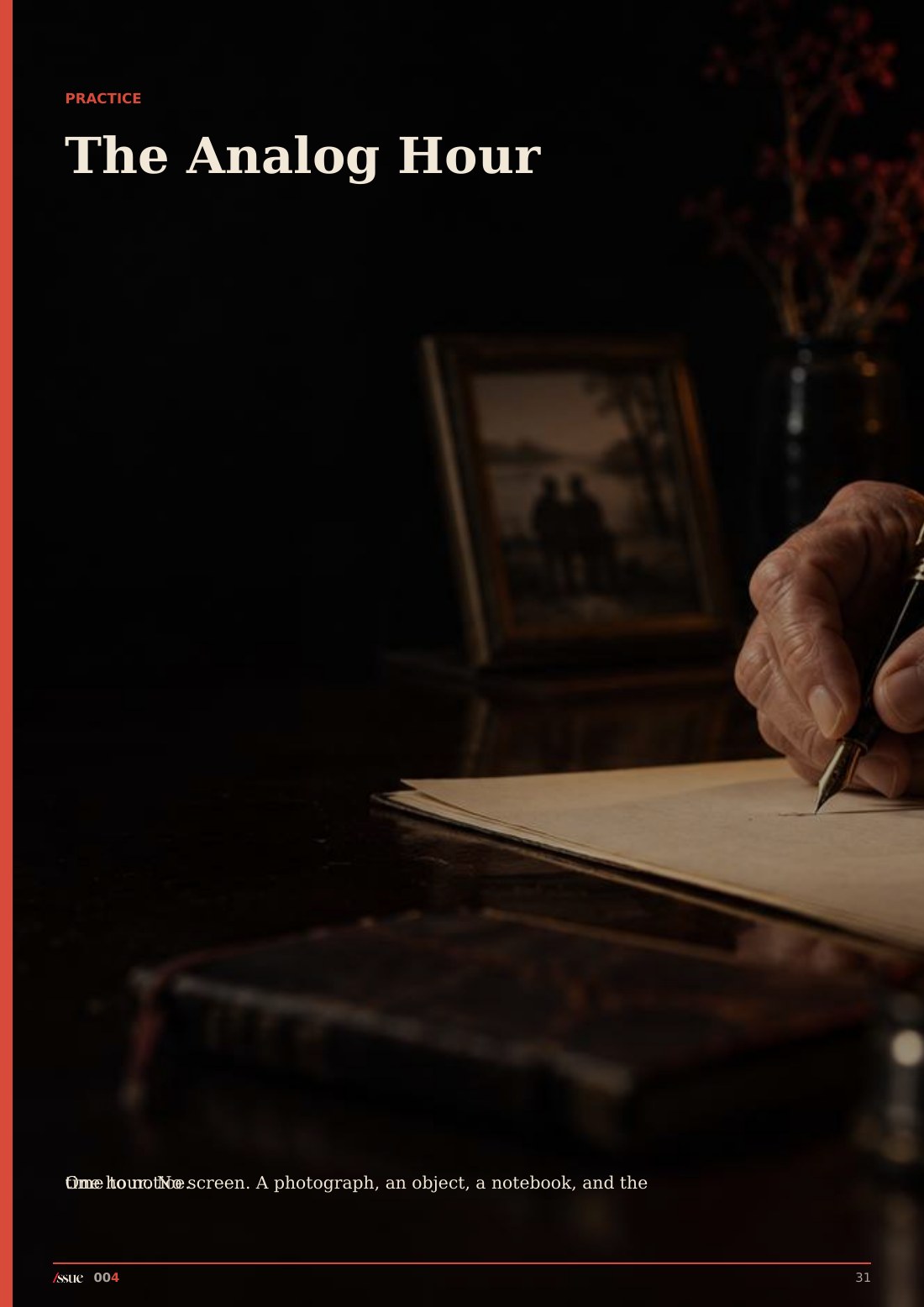
One hour. No screen. A photograph, an object, a notebook, and the time to notice.
Page 32
Read page text
PRACTICE The Analog Hour
Give memory a physical place to occur.
Choose one hour each week and remove every screen from the room. Place a notebook, a pen, one physical photograph, and an object that has been with you for years on a table. Spend ten minutes looking at the photograph without writing. Notice what exists at the edges. Spend ten minutes describing the object without naming it. Then write a letter to someone connected to either memory. Keep the corrections. Date the page. Read it aloud once. Decide whether the letter should be sent, saved, or destroyed. The result matters less than the quality of attention. The hour gives memory a physical place to occur.
Page 33
Read page text
CLOSING NOTE What should survive us?
Leave behind something that has been touched.
Most of what we create will disappear. The question is not how to defeat disappearance. The question is what deserves our care while it is here. Choose one object. Learn how it works. Repair it if you can. Use it long enough for your hand to leave a history. Then pass it to someone who will understand that the marks are part of the gift.
Page 34
Read page text
Page 35
Read page text
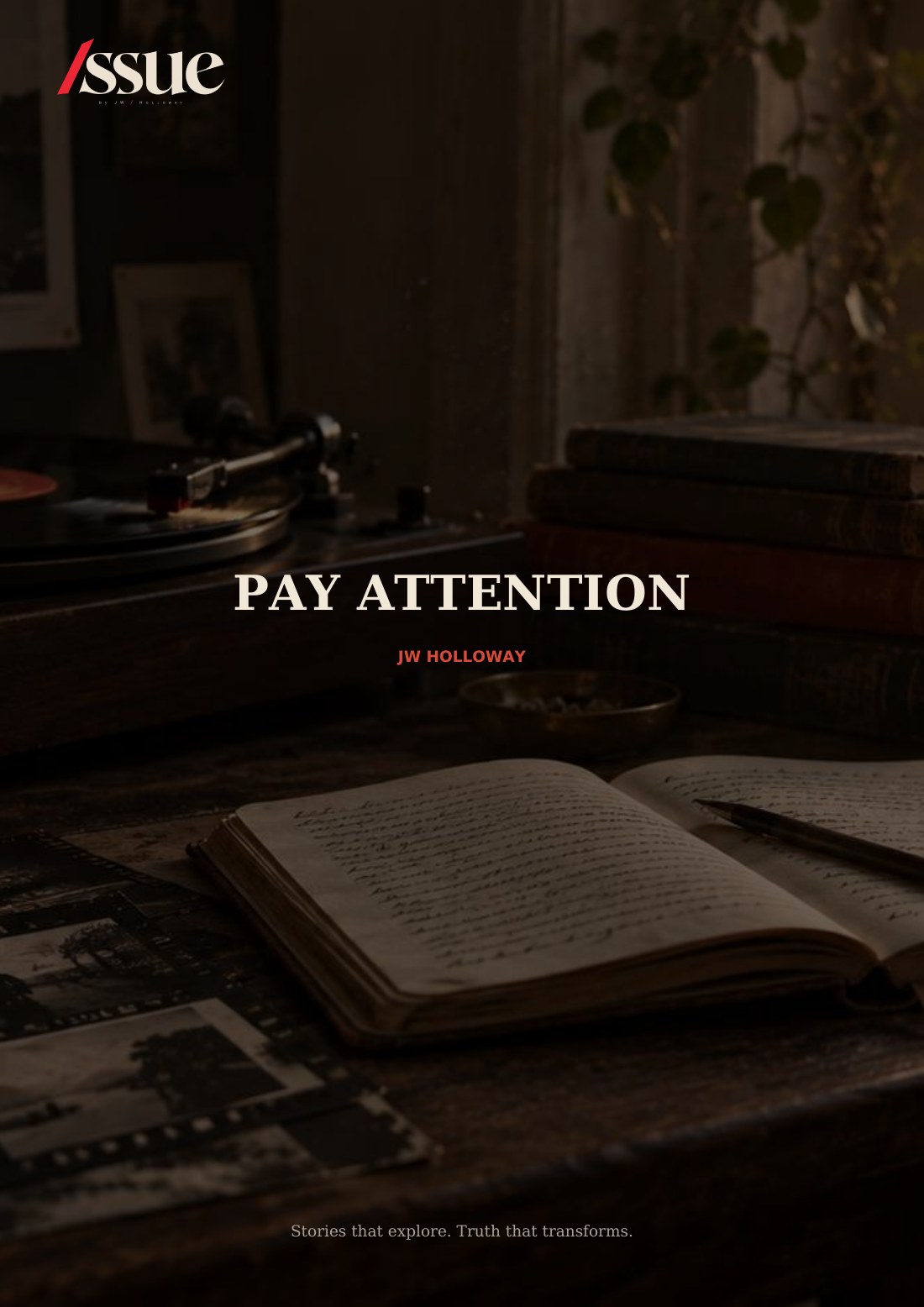
PAY ATTENTION
JW HOLLOWAY
Stories that explore. Truth that transforms.