Page 1
Read page text
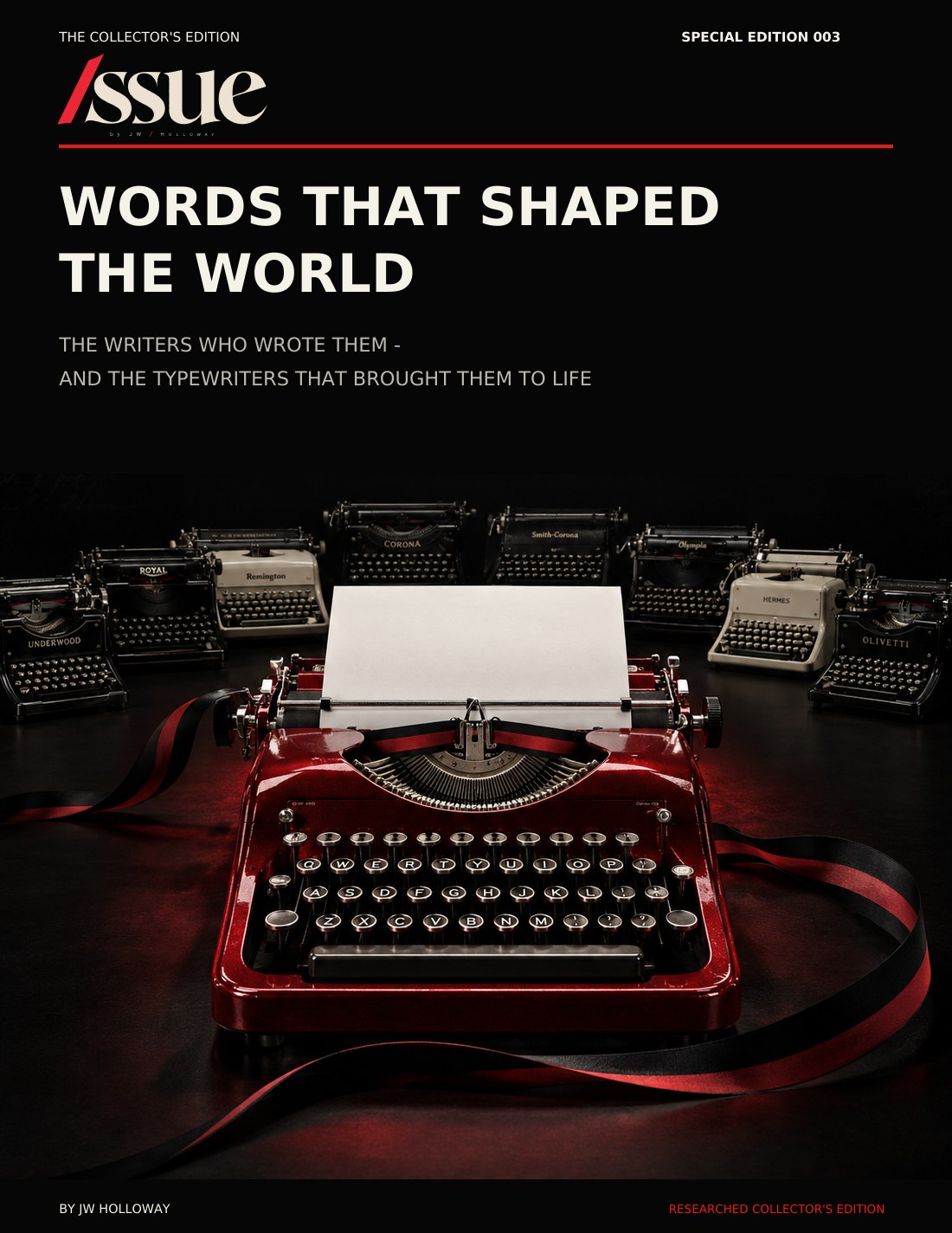
Words That Shaped the World. An Issue magazine edition by J. W. Holloway.
Page 2
Read page text
THE MACHINE IS REAL. THE EVIDENCE MATTERS.
A famous writer may have owned several typewriters. A surviving machine
may be authentic without proving that one exact story passed through it. This
edition keeps those facts separate.
A Exact machine or long-term use authenticated.
A- Strong machine association; incomplete drafting trail.
B Machine use and publication verified; exact manuscript linkage uncertain.
Photographs show genuine historic machines or clearly identified examples of the same model. They are not AI-generated typewriters.
Page 3
Read page text
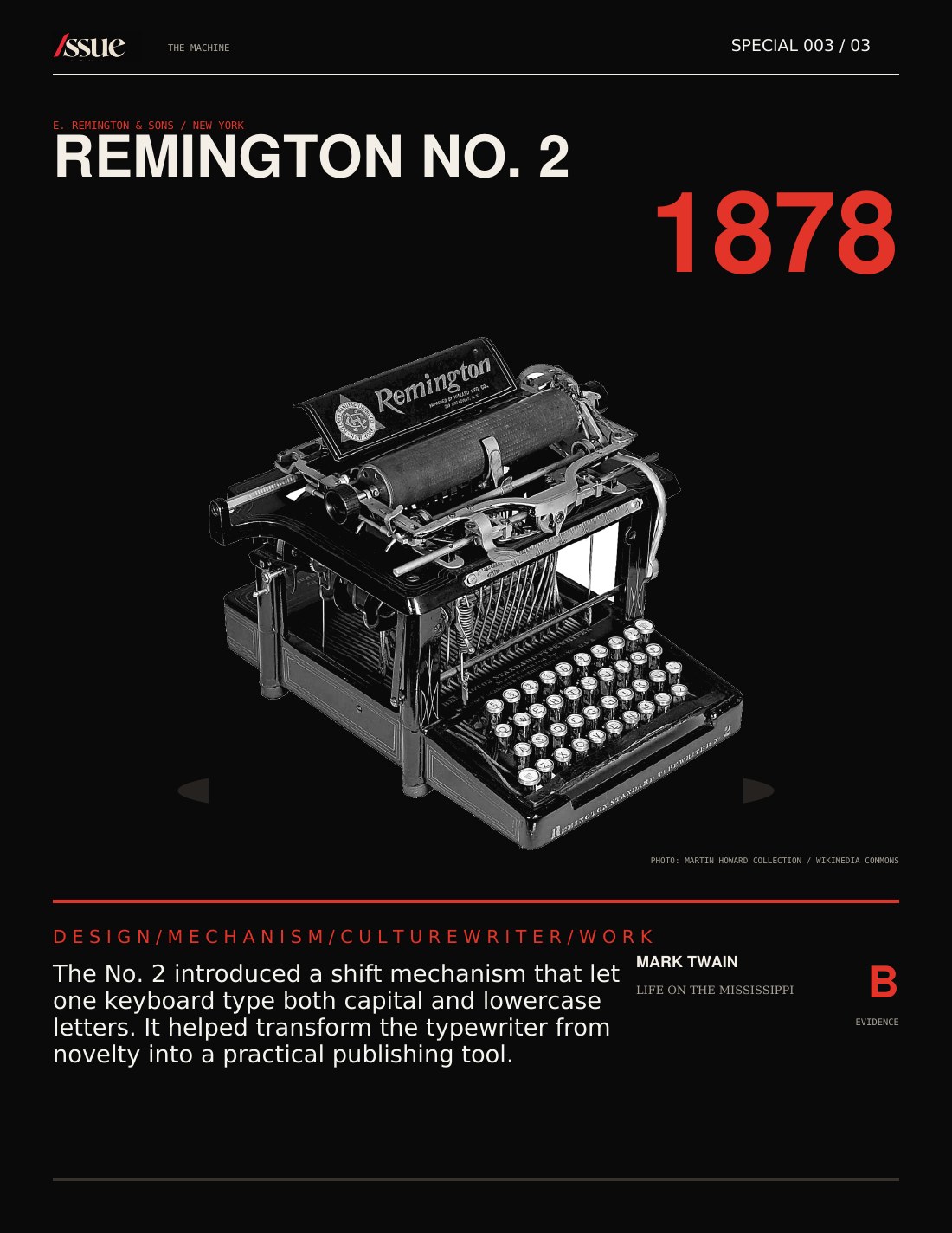
REMINGTON NO. 2
MARK TWAIN
LIFE ON THE MISSISSIPPI B
The No. 2 introduced a shift mechanism that let one keyboard type both capital and lowercase letters. It helped transform the typewriter from novelty into a practical publishing tool.
Page 4
Read page text
MARK TWAIN
LIFE ON THE MISSISSIPPI
Twain was among the earliest major authors associated with the writing machine. A long-circulated account identifies Life on the Mississippi as the first typewritten book manuscript delivered to a publisher.
The Remington No. 2 association is reported by typewriter historians, but the surviving record is disputed; a typist may have prepared the submission copy.
DOCUMENTED CONNECTION
Page 5
Read page text
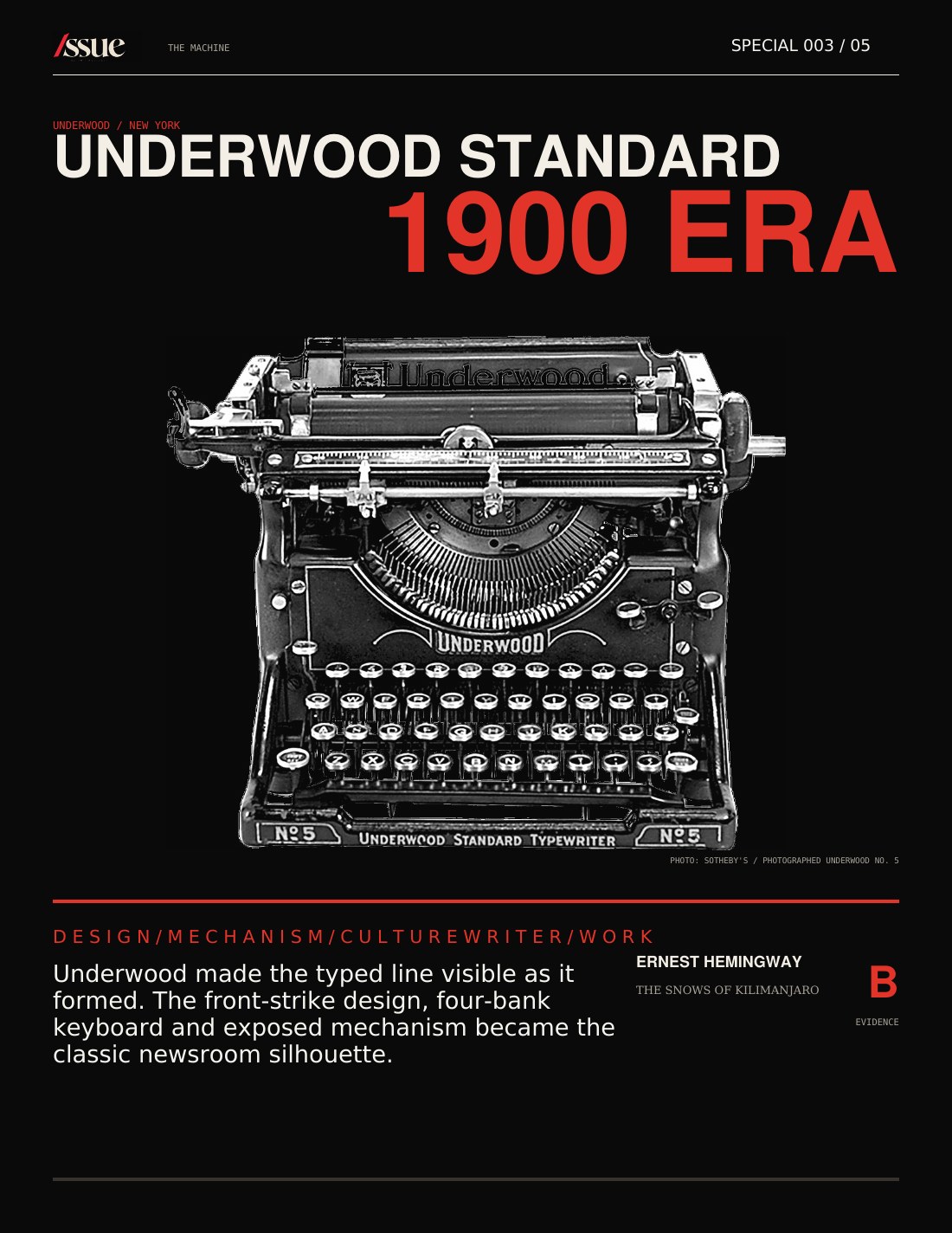
UNDERWOOD STANDARD
1900 ERA
ERNEST HEMINGWAY
THE SNOWS OF KILIMANJARO B
Underwood made the typed line visible as it formed. The front-strike design, four-bank keyboard and exposed mechanism became the classic newsroom silhouette.
Page 6
Read page text
ERNEST HEMINGWAY
THE SNOWS OF KILIMANJARO
Hemingway worked on Underwoods and other portables while moving between journalism and fiction. Esquire published The Snows of Kilimanjaro in its August 1936 issue, one of the defining magazine stories of his career.
Photographs document Hemingway working at an Underwood. No source inspected proves the exact pictured machine produced the final Esquire typescript.
R A
DOCUMENTED CONNECTION
Page 7
Read page text
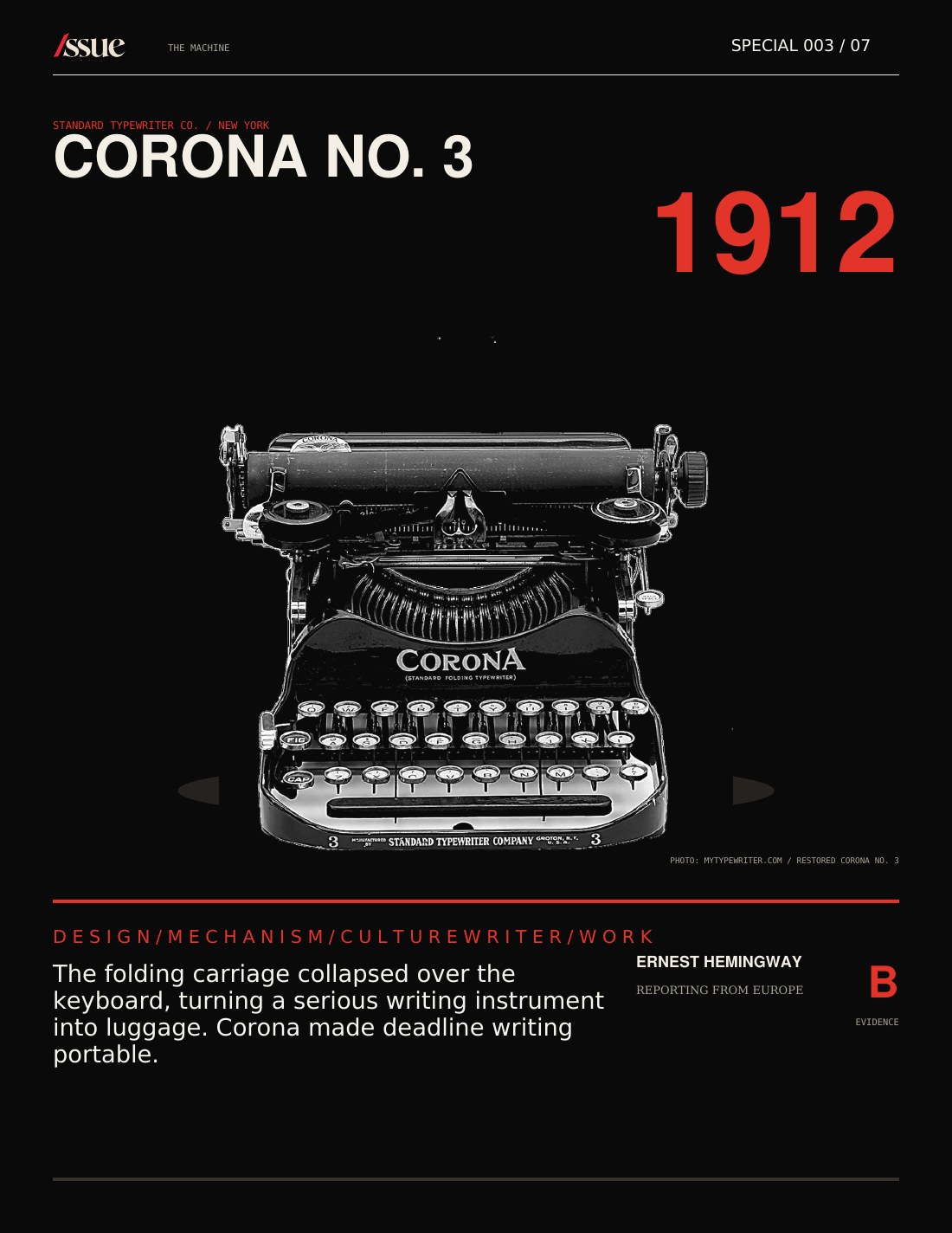
CORONA NO. 3
ERNEST HEMINGWAY
REPORTING FROM EUROPE B
The folding carriage collapsed over the keyboard, turning a serious writing instrument into luggage. Corona made deadline writing portable.
Page 8
Read page text
ERNEST HEMINGWAY
REPORTING FROM EUROPE
Hemingway owned and used a Corona No. 3 during his early years as a foreign correspondent. His dispatches for the Toronto Daily Star from Europe helped form the compressed observational style later heard in his fiction.
The Corona ownership and reporting period are documented. Individual surviving articles cannot always be tied to one exact machine or serial number.
DOCUMENTED CONNECTION
Page 9
Read page text
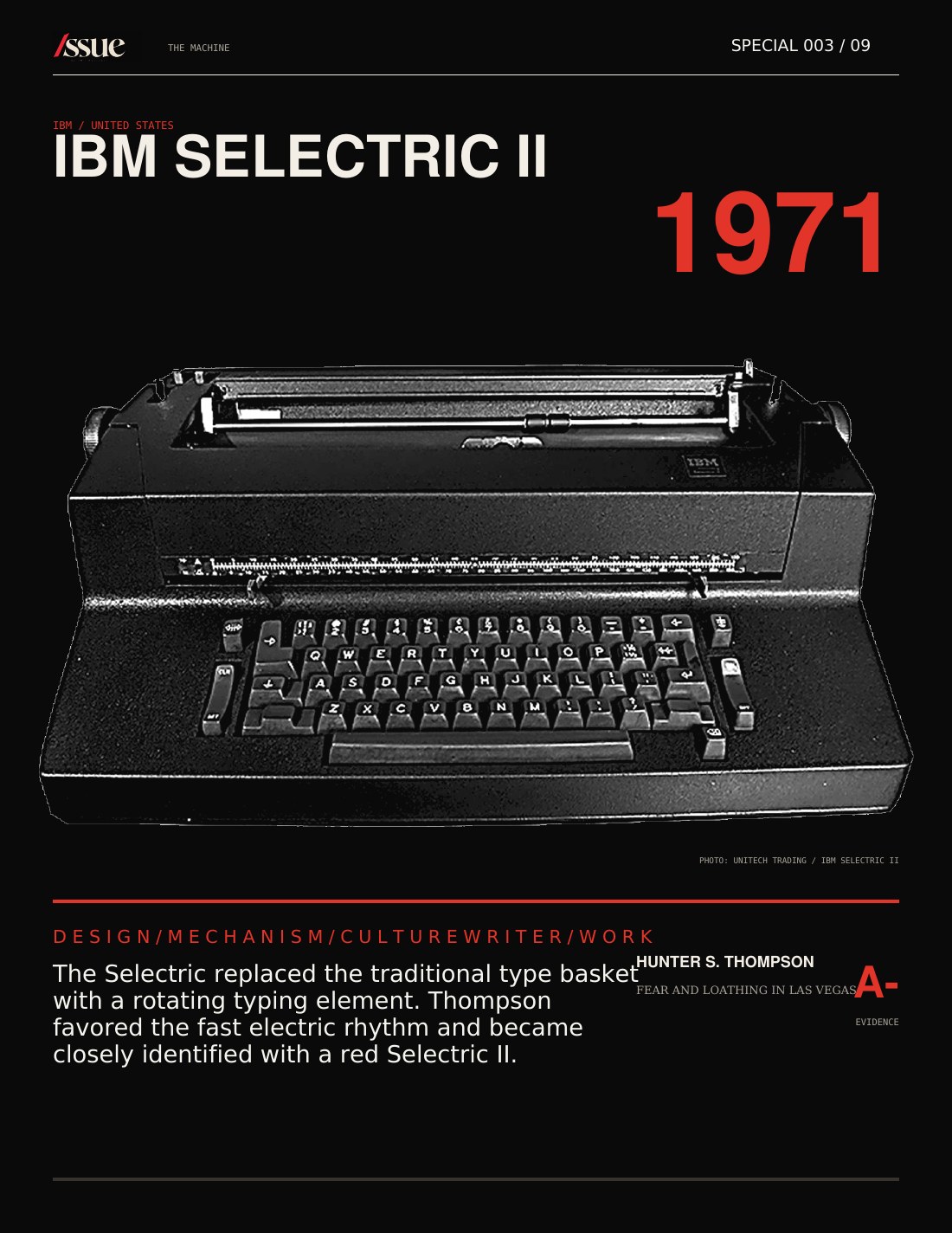
IBM SELECTRIC II
HUNTER S. THOMPSON
FEAR AND LOATHING IN LAS VEGASA-
The Selectric replaced the traditional type basket with a rotating typing element. Thompson favored the fast electric rhythm and became closely identified with a red Selectric II.
Page 10
Read page text
HUNTER S. THOMPSON
FEAR AND LOATHING IN LAS VEGAS
Rolling Stone published Fear and Loathing in Las Vegas in two installments. The work fused reporting, performance and hallucination into the style Thompson called Gonzo journalism.
Thompson's Selectric use is strongly documented, including his red machine. Publication dates are confirmed by Rolling Stone; exact page-by-page drafting history is incomplete.
DOCUMENTED CONNECTION
Page 11
Read page text
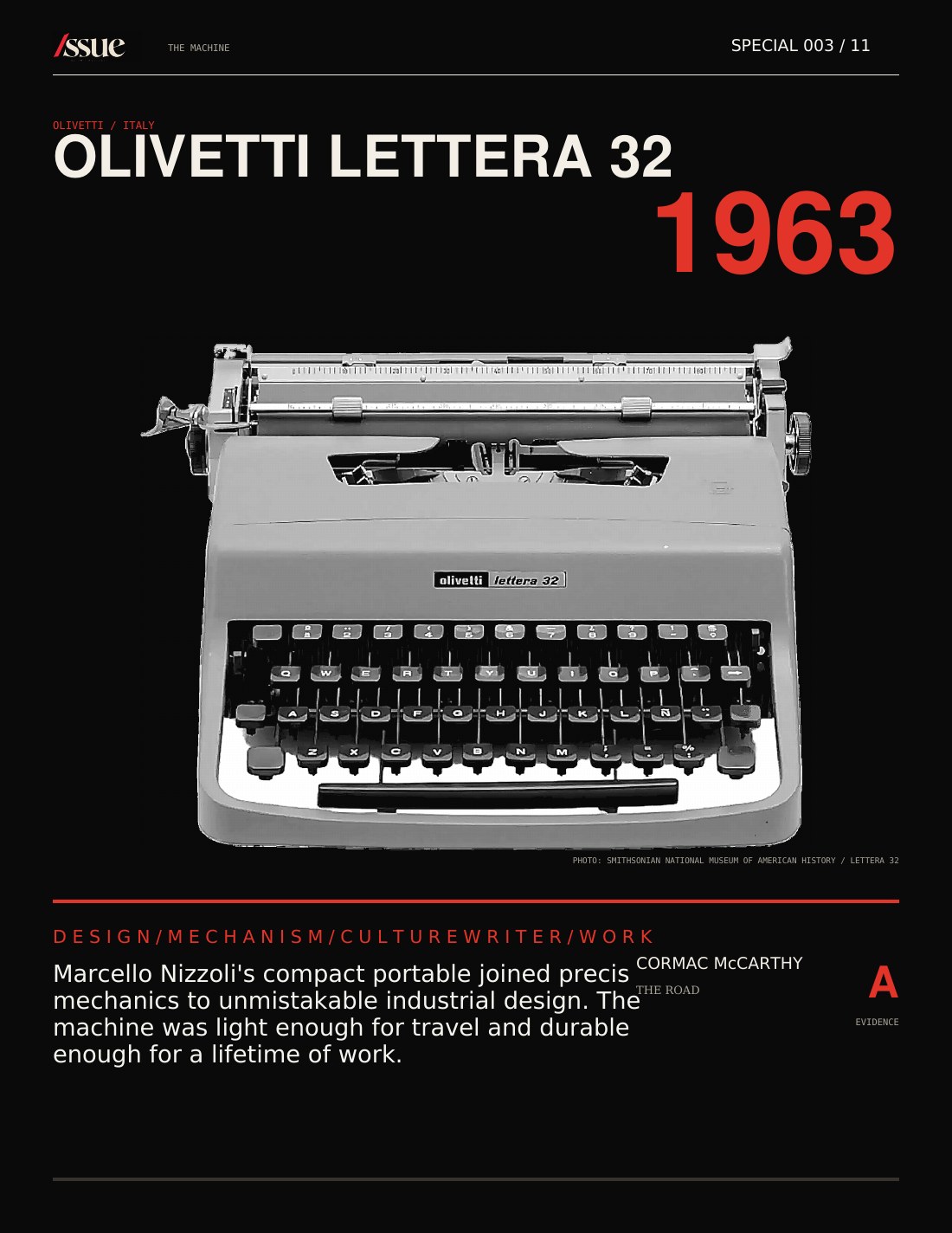
OLIVETTI LETTERA 32
THE ROAD A
Marcello Nizzoli's compact portable joined precis mechanics to unmistakable industrial design. The machine was light enough for travel and durable enough for a lifetime of work.
CORMAC McCARTHY
Page 12
Read page text
CORMAC McCARTHY
THE ROAD
McCarthy bought a used Lettera 32 in 1963 for $50 and said he typed roughly five million words on it. That working life included The Road, his Pulitzer Prize-winning novel.
The author authenticated the machine and its long use. The 2009 Christie's sale and contemporary reporting document the connection.
DOCUMENTED CONNECTION
Page 13
Read page text
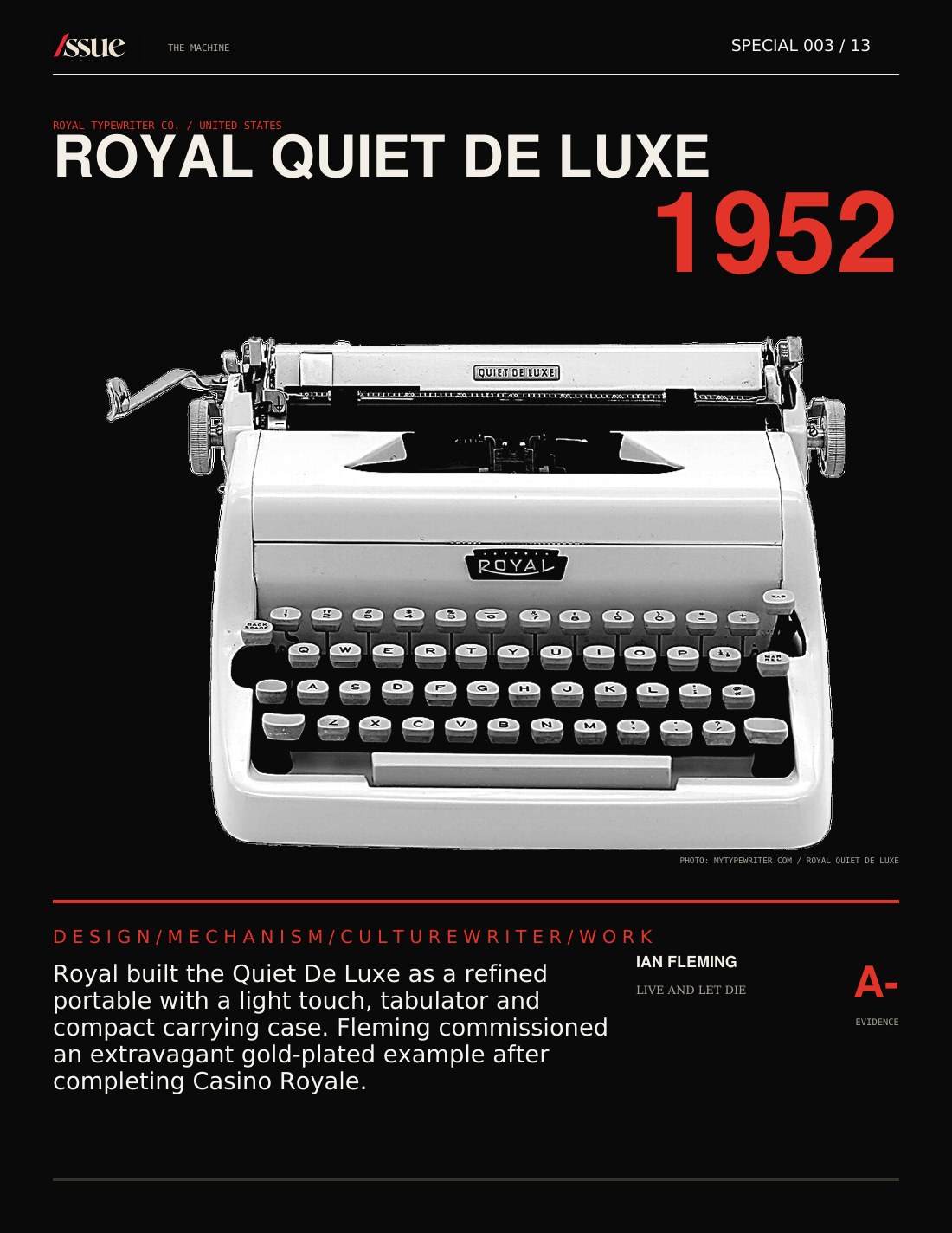
ROYAL QUIET DE LUXE
IAN FLEMING
LIVE AND LET DIE A-
Royal built the Quiet De Luxe as a refined portable with a light touch, tabulator and compact carrying case. Fleming commissioned an extravagant gold-plated example after completing Casino Royale.
Page 14
Read page text
IAN FLEMING
LIVE AND LET DIE
Fleming used the gold Royal for the Bond books that followed his debut. Live and Let Die, the second James Bond novel, was published by Jonathan Cape in London in April 1954.
The gold Royal is authenticated and its use for Fleming's later work is well documented. The exact drafting sequence for every page of this novel is not preserved.
DOCUMENTED CONNECTION
Page 15
Read page text
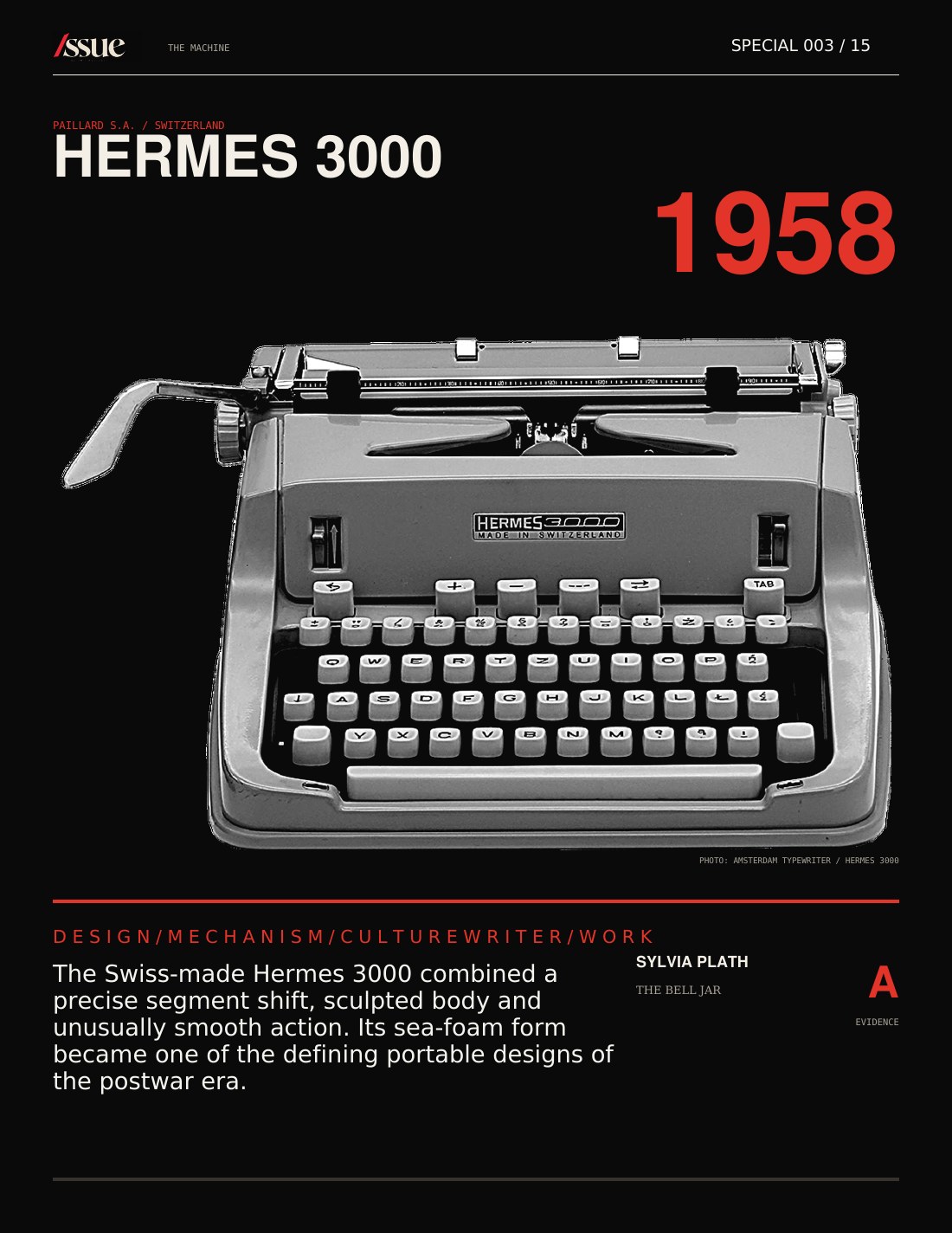
HERMES 3000
SYLVIA PLATH
THE BELL JAR A
The Swiss-made Hermes 3000 combined a precise segment shift, sculpted body and unusually smooth action. Its sea-foam form became one of the defining portable designs of the postwar era.
Page 16
Read page text
SYLVIA PLATH
THE BELL JAR
Plath typed The Bell Jar on a Hermes 3000 in 1962. Published in Britain under the name Victoria Lucas, the novel transformed autobiographical experience into a controlled account of ambition, illness and confinement.
The author's Hermes 3000 was identified as the machine used for The Bell Jar and sold at Bonhams in 2018. The first British edition appeared on 14 January 1963.
DOCUMENTED CONNECTION
Page 17
Read page text
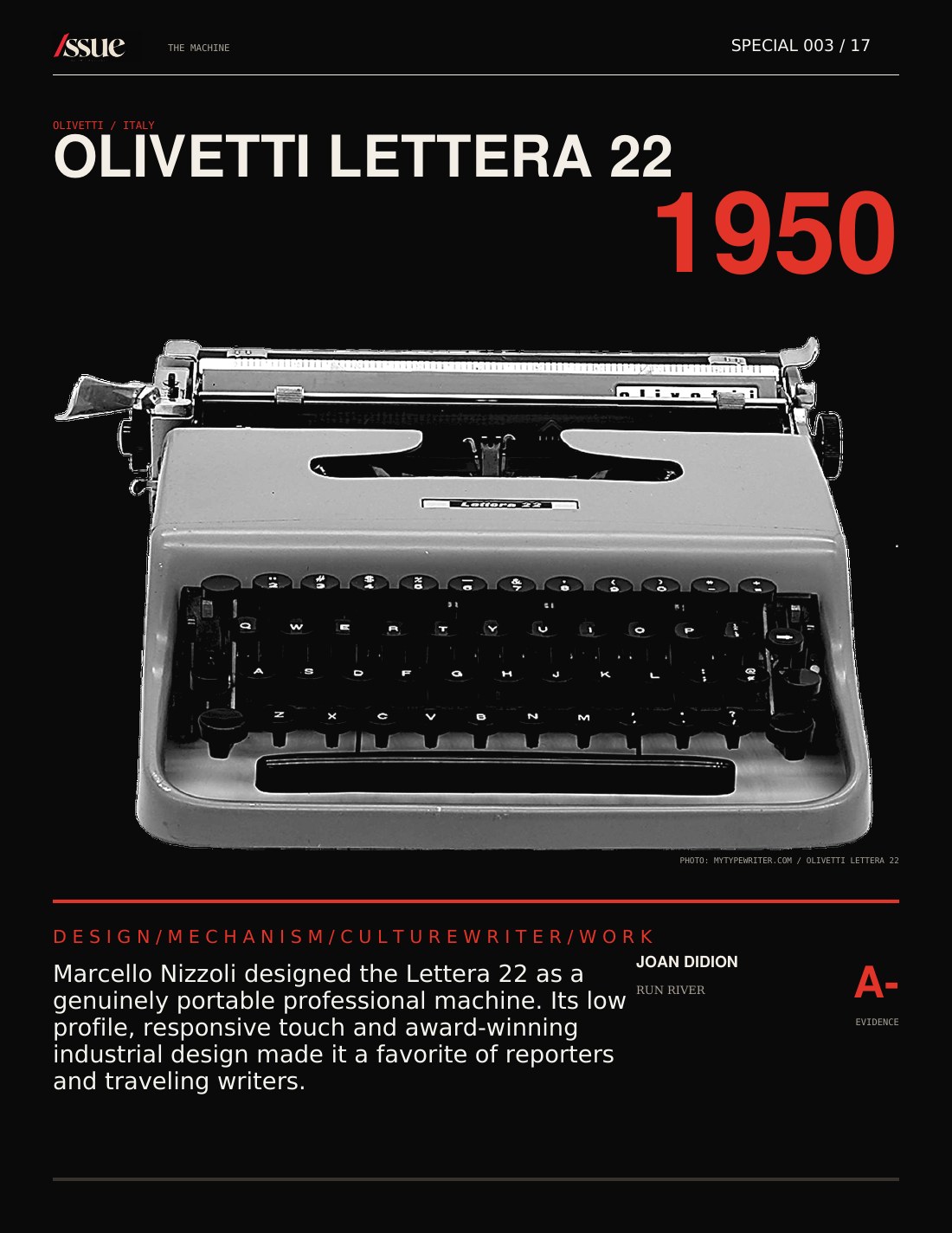
OLIVETTI LETTERA 22
JOAN DIDION
RUN RIVER A-
Marcello Nizzoli designed the Lettera 22 as a genuinely portable professional machine. Its low profile, responsive touch and award-winning industrial design made it a favorite of reporters and traveling writers.
Page 18
Read page text
JOAN DIDION
RUN RIVER
Didion recalled typing her first novel, Run River, on an Olivetti Lettera 22. The book introduced the California landscape, family inheritance and emotional restraint that would continue through her essays and fiction.
Didion personally identified the Lettera 22 as the machine used for her first novel. The surviving record establishes the model, though not a complete page-by-page drafting history.
DOCUMENTED CONNECTION
Page 19
Read page text
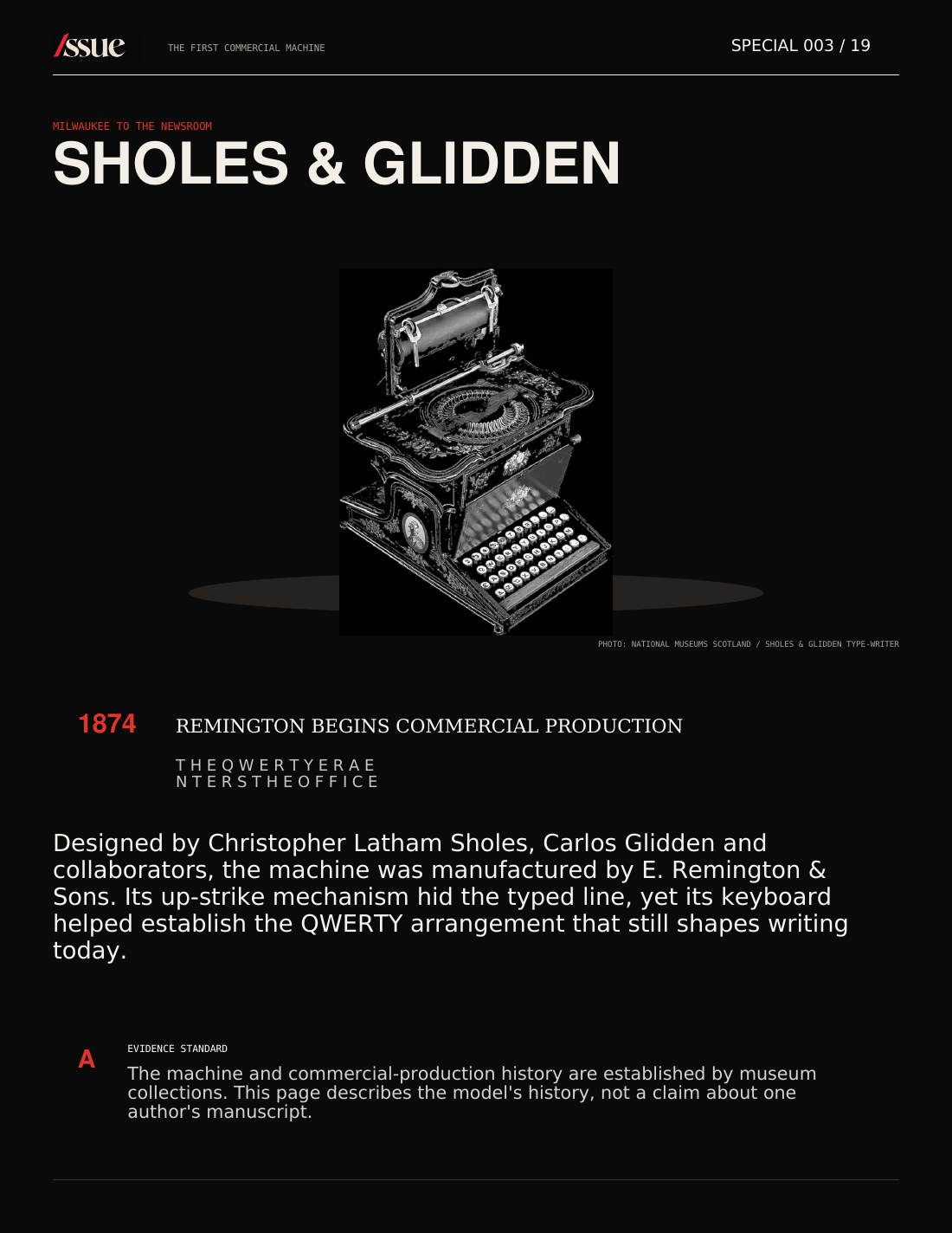
SHOLES & GLIDDEN
REMINGTON BEGINS COMMERCIAL PRODUCTION
Designed by Christopher Latham Sholes, Carlos Glidden and collaborators, the machine was manufactured by E. Remington & Sons. Its up-strike mechanism hid the typed line, yet its keyboard helped establish the QWERTY arrangement that still shapes writing today.
The machine and commercial-production history are established by museum collections. This page describes the model's history, not a claim about one author's manuscript.
Page 20
Read page text
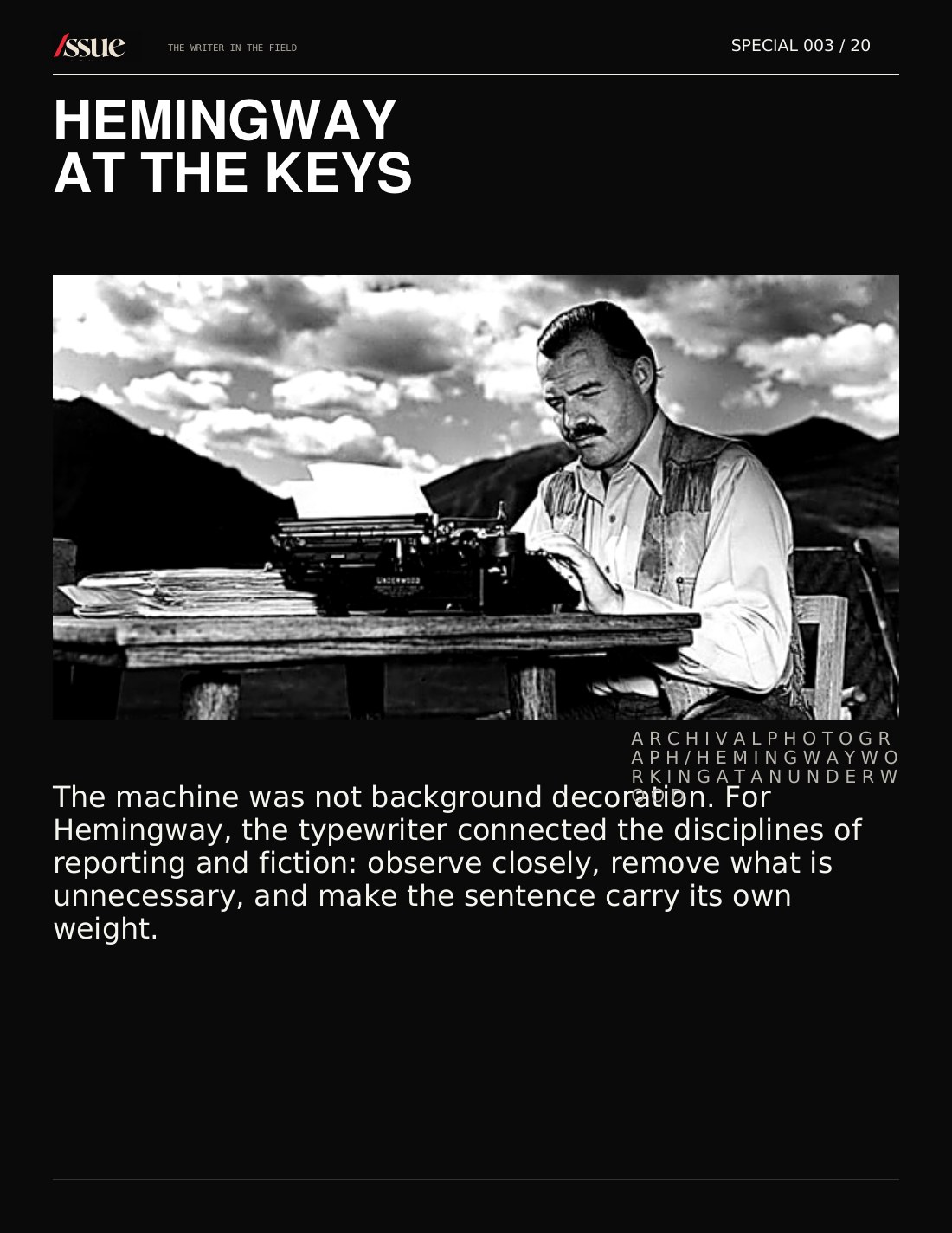
HEMINGWAY AT THE KEYS
The machine was not background decoration. For Hemingway, the typewriter connected the disciplines of reporting and fiction: observe closely, remove what is unnecessary, and make the sentence carry its own weight.
O O D
Page 21
Read page text
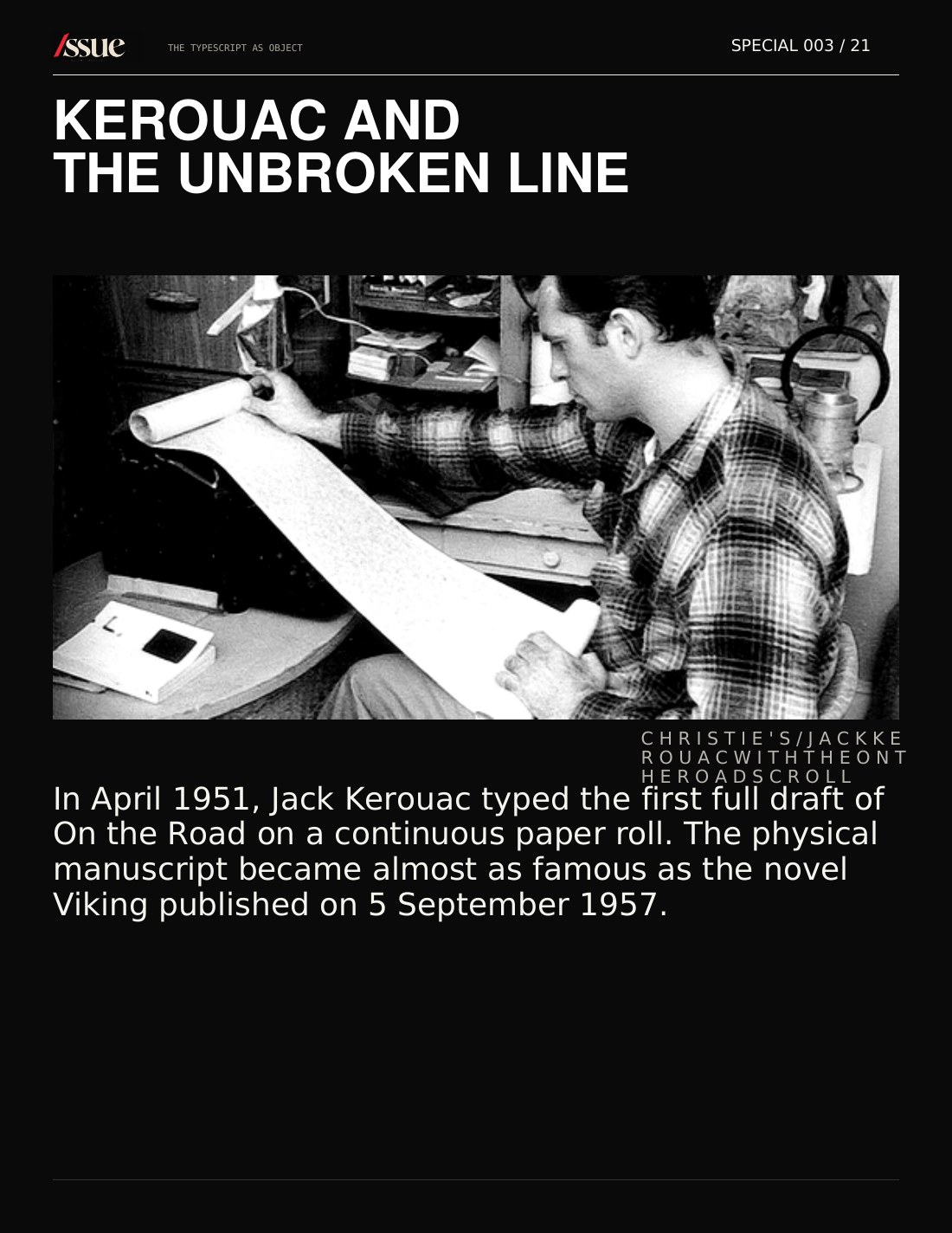
KEROUAC AND THE UNBROKEN LINE
In April 1951, Jack Kerouac typed the first full draft of On the Road on a continuous paper roll. The physical manuscript became almost as famous as the novel Viking published on 5 September 1957.
Page 22
Read page text
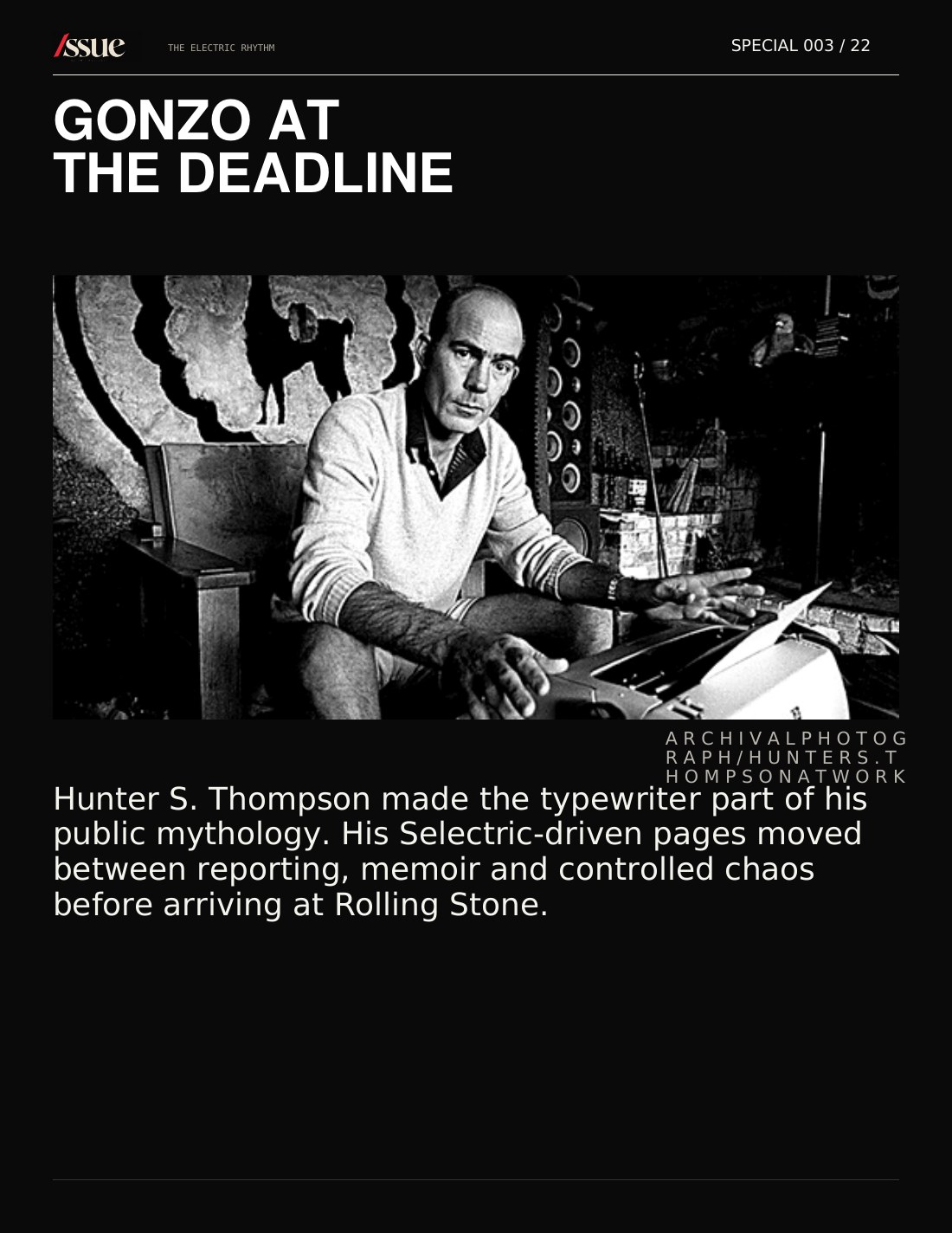
GONZO AT THE DEADLINE
Hunter S. Thompson made the typewriter part of his public mythology. His Selectric-driven pages moved between reporting, memoir and controlled chaos before arriving at Rolling Stone.
Page 23
Read page text
THE DEATH OF CAPTAIN WASKOW
ERNIE PYLE
SCRIPPS-HOWARD NEWSPAPER COLUMN
Writing from Italy, Pyle described soldiers receiving the body of a beloved young company commander. The column rejected abstraction and made the cost of war intimate, physical and immediate. It became his most famous and widely reprinted dispatch.
Pyle's plainspoken observation changed how millions of readers understood the infantryman's war. The piece remains a model of reporting built from witness, restraint and human detail.
WHY IT ENDURES
Pyle's plainspoken observation changed how millions of readers understood the infantryman's war. The piece remains a model of reporting built from witness, restraint and human detail.
Y 1 9 4 4
Page 24
Read page text
THE PENTAGON PAPERS
NEIL SHEEHAN AND THE NEW YORK TIMES TEAM
THE NEW YORK TIMES
The Times began publishing excerpts from a classified Defense Department history of United States decision-making in Vietnam. The Nixon administration sought to stop publication, setting up a defining confrontation over prior restraint.
On 30 June 1971, the U.S. Supreme Court allowed the Times and The Washington Post to continue publishing. The series became a landmark in press freedom and accountability reporting.
The Times began publishing excerpts from a classified Defense Department history of United States decision-making in Vietnam. The Nixon administration sought to stop publication, setting up a defining confrontation over prior restraint.
WHY IT ENDURES
On 30 June 1971, the U.S. Supreme Court allowed the Times and The Washington Post to continue publishing. The series became a landmark in press freedom and accountability reporting.
Page 25
Read page text
FIVE HELD IN PLOT TO BUG
ALFRED E. LEWIS; FOLLOWED BY WOODWARD & BERNSTEIN
THE WASHINGTON POST
The Post's first report identified five men arrested inside Democratic National Committee headquarters. Bob Woodward and Carl Bernstein soon took over the developing story, tracing money, connections and a widening campaign of political espionage.
Persistent, cumulative reporting turned an apparently local burglary into the Watergate investigation, contributing to congressional hearings, criminal convictions and President Nixon's resignation.
The Post's first report identified five men arrested inside Democratic National Committee headquarters. Bob Woodward and Carl Bernstein soon took over the developing story, tracing money, connections and a widening campaign of political espionage.
WHY IT ENDURES
Persistent, cumulative reporting turned an apparently local burglary into the Watergate investigation, contributing to congressional hearings, criminal convictions and President Nixon's resignation.
Page 26
Read page text
TEN DAYS IN A MAD-HOUSE
NELLIE BLY
THE NEW YORK WORLD
Bly feigned mental illness and entered the Women's Lunatic Asylum on Blackwell's Island. Her serialized investigation described cold baths, spoiled food, forced silence and the treatment of women who did not belong there.
The reporting helped secure reforms and made immersive investigation a powerful form of public-interest journalism. Bly demonstrated that a reporter could enter a closed system and force it into public view.
Bly feigned mental illness and entered the Women's Lunatic Asylum on Blackwell's Island. Her serialized investigation described cold baths, spoiled food, forced silence and the treatment of women who did not belong there.
WHY IT ENDURES
The reporting helped secure reforms and made immersive investigation a powerful form of public-interest journalism. Bly demonstrated that a reporter could enter a closed system and force it into public view.
Page 27
Read page text
SHOOTING AN ELEPHANT
GEORGE ORWELL
NEW WRITING, NO. 2
Drawing on his service in colonial Burma, Orwell described a police officer compelled by the watching crowd to kill an elephant he believed no longer dangerous. The event becomes a study of power, performance and moral surrender.
The essay endures because it turns political domination inward: the ruler is also trapped by the role he performs. Its plain narrative carries a devastating argument about empire.
Drawing on his service in colonial Burma, Orwell described a police officer compelled by the watching crowd to kill an elephant he believed no longer dangerous. The event becomes a study of power, performance and moral surrender.
WHY IT ENDURES
The essay endures because it turns political domination inward: the ruler is also trapped by the role he performs. Its plain narrative carries a devastating argument about empire.
Page 28
Read page text
ON SELF-RESPECT
JOAN DIDION
VOGUE
Asked to replace an unusable article in Vogue's layout, Didion wrote an essay about character, responsibility and the private discipline of living with one's choices. Its urgency gave the prose unusual compression.
The essay became a signature example of Didion's exact, controlled voice: personal without confession, severe without losing vulnerability, and built for the unforgiving dimensions of a magazine page.
Asked to replace an unusable article in Vogue's layout, Didion wrote an essay about character, responsibility and the private discipline of living with one's choices. Its urgency gave the prose unusual compression.
WHY IT ENDURES
The essay became a signature example of Didion's exact, controlled voice: personal without confession, severe without losing vulnerability, and built for the unforgiving dimensions of a magazine page.
Page 29
Read page text
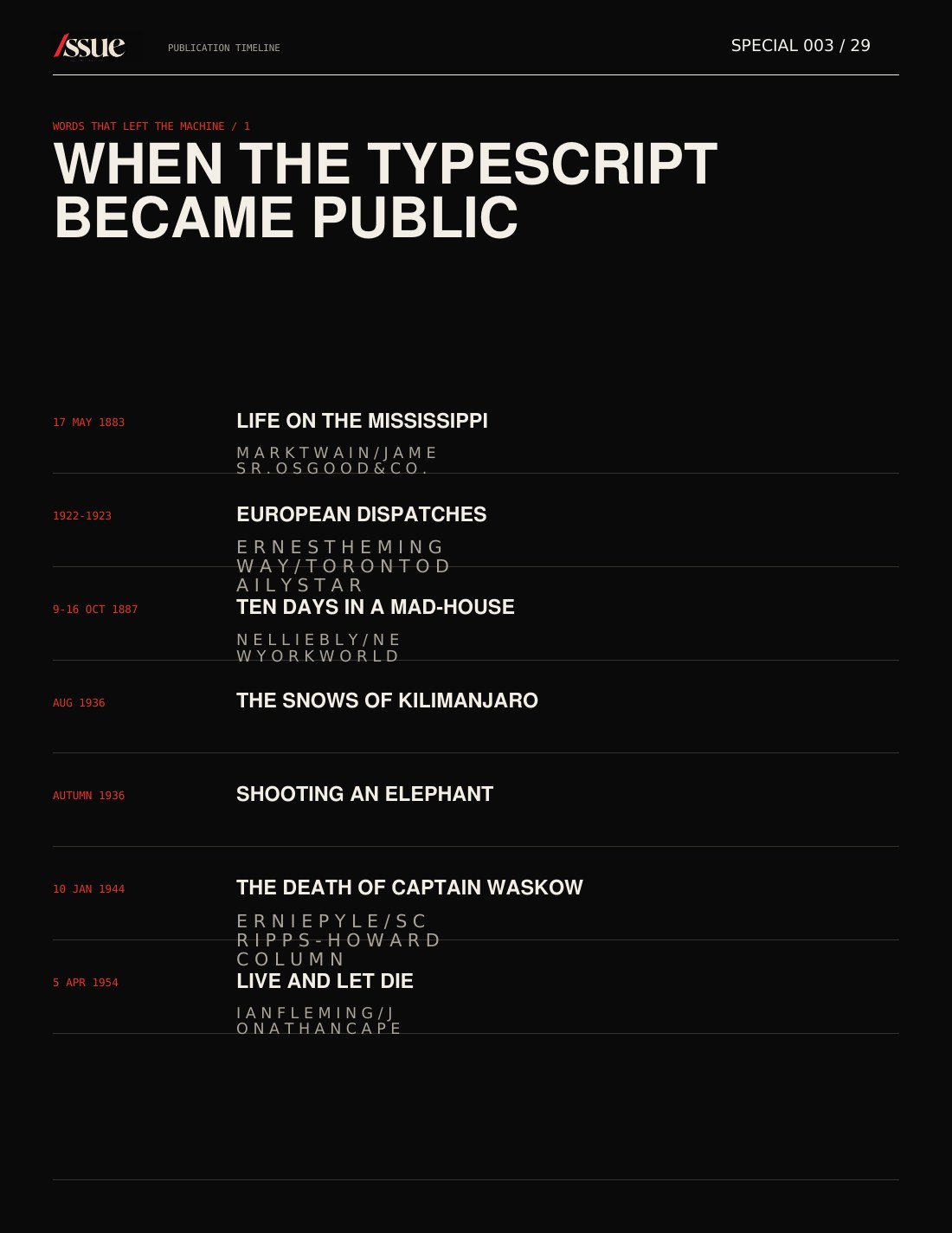
WHEN THE TYPESCRIPT BECAME PUBLIC
LIFE ON THE MISSISSIPPI
EUROPEAN DISPATCHES
TEN DAYS IN A MAD-HOUSE
THE SNOWS OF KILIMANJARO
SHOOTING AN ELEPHANT
THE DEATH OF CAPTAIN WASKOW
LIVE AND LET DIE
Page 30
Read page text
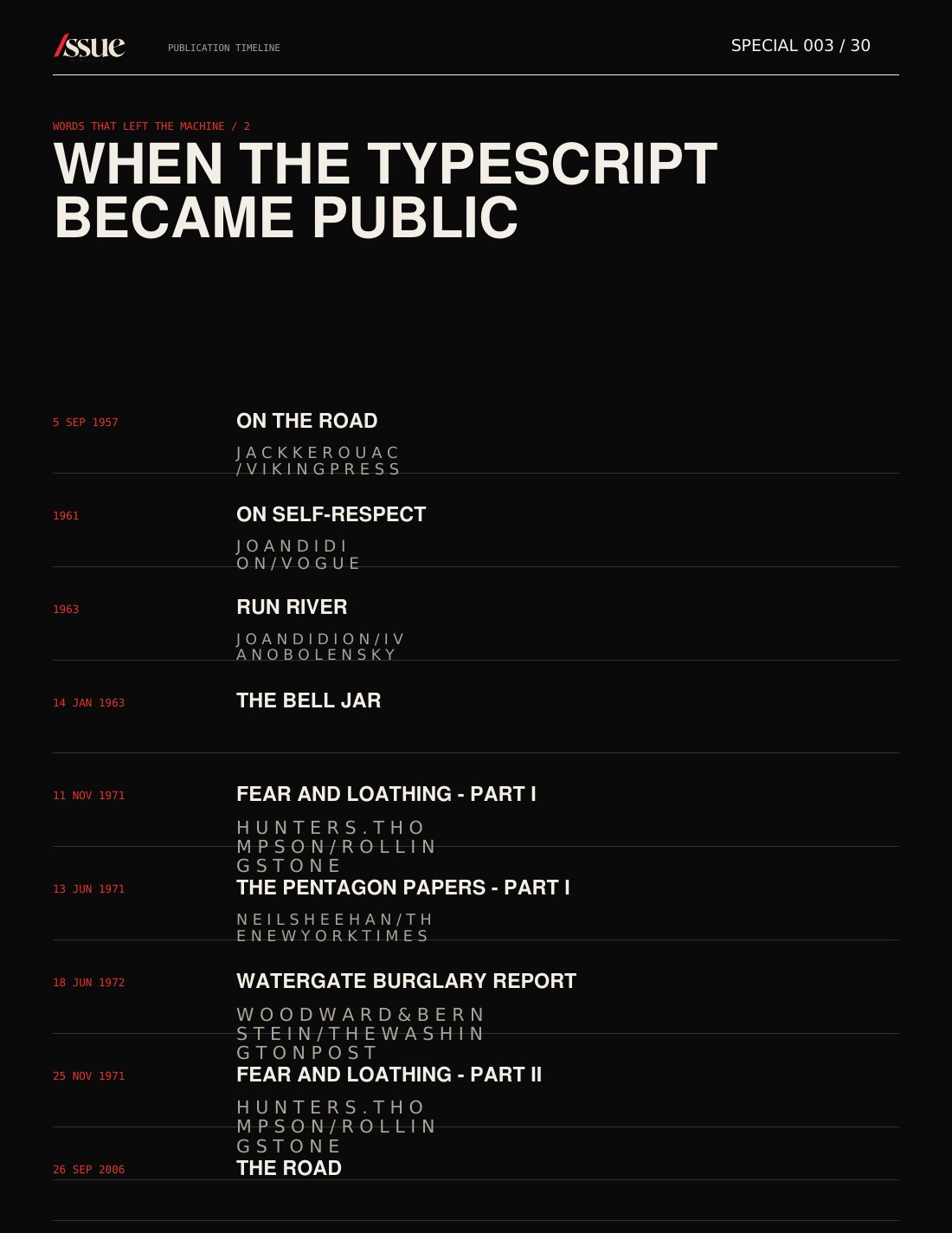
WHEN THE TYPESCRIPT BECAME PUBLIC
ON THE ROAD
ON SELF-RESPECT
RUN RIVER
THE BELL JAR
FEAR AND LOATHING - PART I
THE PENTAGON PAPERS - PART I
WATERGATE BURGLARY REPORT
FEAR AND LOATHING - PART II
THE ROAD
Page 31
Read page text
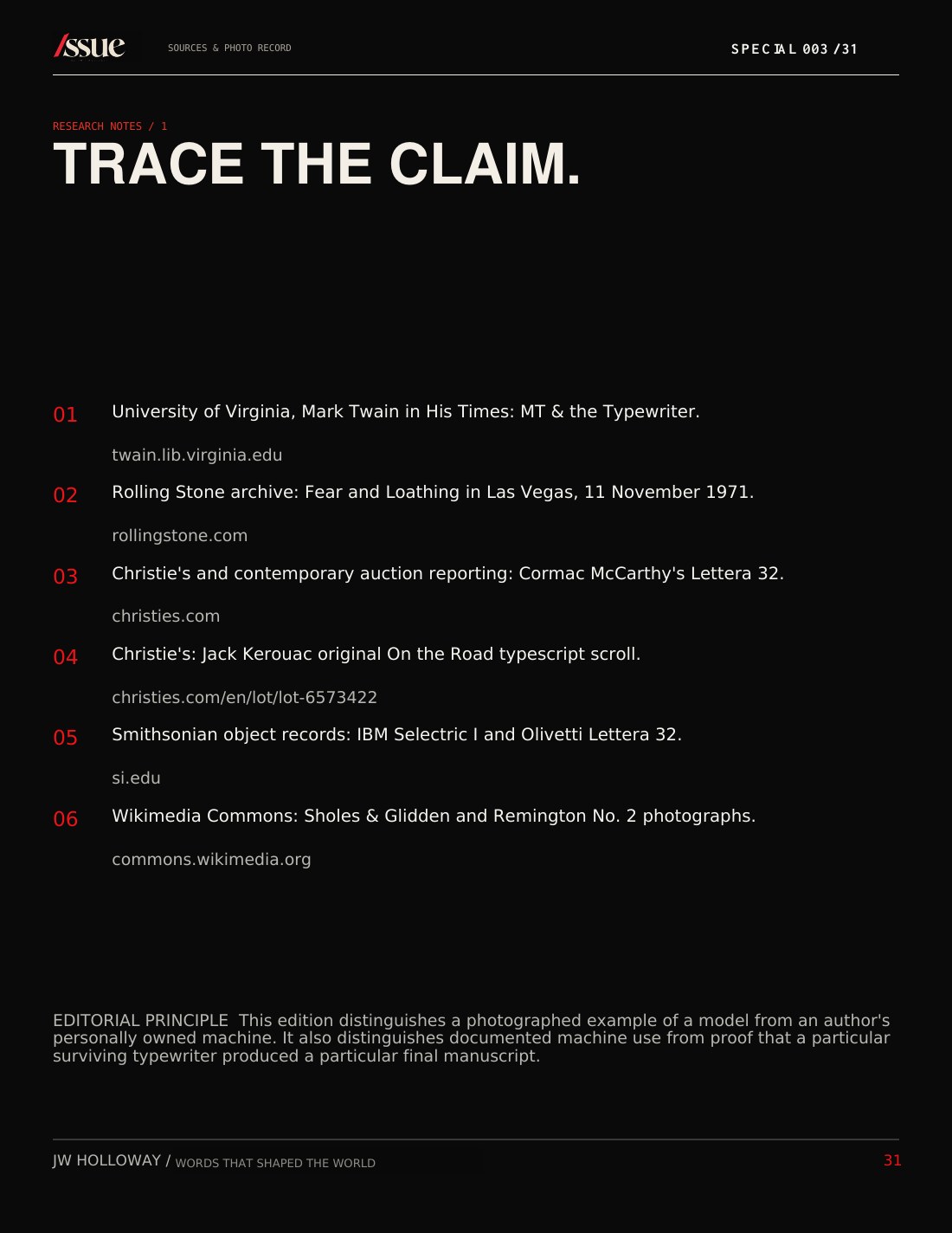
TRACE THE CLAIM.
University of Virginia, Mark Twain in His Times: MT & the Typewriter.
Rolling Stone archive: Fear and Loathing in Las Vegas, 11 November 1971.
Christie's and contemporary auction reporting: Cormac McCarthy's Lettera 32.
Christie's: Jack Kerouac original On the Road typescript scroll.
Smithsonian object records: IBM Selectric I and Olivetti Lettera 32.
Wikimedia Commons: Sholes & Glidden and Remington No. 2 photographs.
University of Virginia, Mark Twain in His Times: MT & the Typewriter.
twain.lib.virginia.edu
Rolling Stone archive: Fear and Loathing in Las Vegas, 11 November 1971.
rollingstone.com
Christie's and contemporary auction reporting: Cormac McCarthy's Lettera 32.
christies.com
Christie's: Jack Kerouac original On the Road typescript scroll.
christies.com/en/lot/lot-6573422
Smithsonian object records: IBM Selectric I and Olivetti Lettera 32.
si.edu
Wikimedia Commons: Sholes & Glidden and Remington No. 2 photographs.
commons.wikimedia.org
EDITORIAL PRINCIPLE This edition distinguishes a photographed example of a model from an author's personally owned machine. It also distinguishes documented machine use from proof that a particular surviving typewriter produced a particular final manuscript.
JW HOLLOWAY / THE WRITING MACHINE
Page 32
Read page text
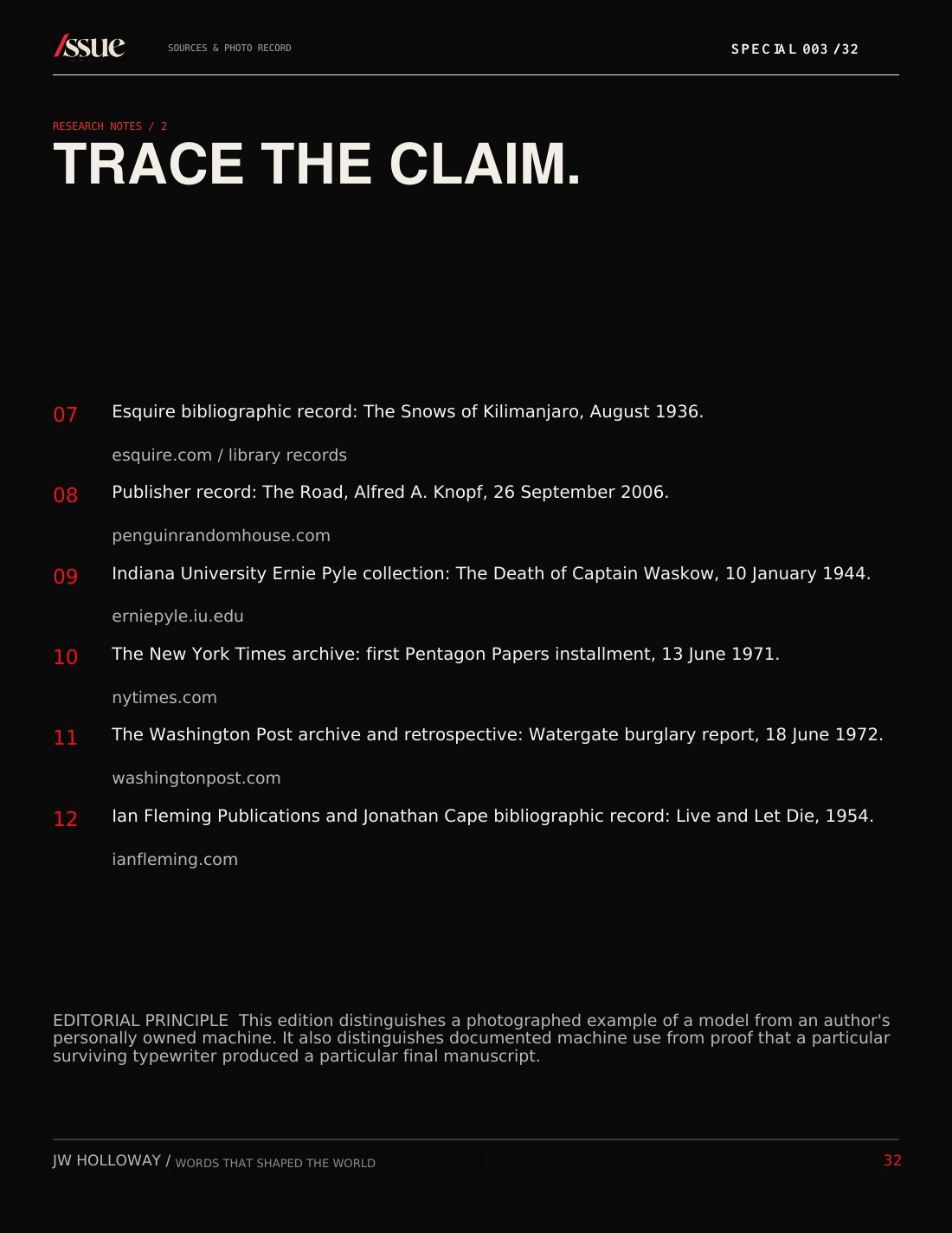
TRACE THE CLAIM.
Esquire bibliographic record: The Snows of Kilimanjaro, August 1936.
Publisher record: The Road, Alfred A. Knopf, 26 September 2006.
Indiana University Ernie Pyle collection: The Death of Captain Waskow, 10 January 1944.
The New York Times archive: first Pentagon Papers installment, 13 June 1971.
The Washington Post archive and retrospective: Watergate burglary report, 18 June 1972.
Ian Fleming Publications and Jonathan Cape bibliographic record: Live and Let Die, 1954.
Esquire bibliographic record: The Snows of Kilimanjaro, August 1936.
esquire.com / library records
Publisher record: The Road, Alfred A. Knopf, 26 September 2006.
penguinrandomhouse.com
Indiana University Ernie Pyle collection: The Death of Captain Waskow, 10 January 1944.
erniepyle.iu.edu
The New York Times archive: first Pentagon Papers installment, 13 June 1971.
nytimes.com
The Washington Post archive and retrospective: Watergate burglary report, 18 June 1972.
washingtonpost.com
Ian Fleming Publications and Jonathan Cape bibliographic record: Live and Let Die, 1954.
ianfleming.com
EDITORIAL PRINCIPLE This edition distinguishes a photographed example of a model from an author's personally owned machine. It also distinguishes documented machine use from proof that a particular surviving typewriter produced a particular final manuscript.
JW HOLLOWAY / THE WRITING MACHINE
Page 33
Read page text
TRACE THE CLAIM.
Library of Congress newspaper records: Nellie Bly and Ten Days in a Mad-House, 1887.
The Orwell Foundation bibliography: Shooting an Elephant, New Writing, 1936.
Vogue archive: Joan Didion, On Self-Respect, 1961.
Bonhams auction record and contemporary reporting: Sylvia Plath's Hermes 3000 and The Bell Jar.
Joan Didion, Where I Was From: recollection of typing Run River on an Olivetti Lettera 22.
Library of Congress newspaper records: Nellie Bly and Ten Days in a Mad-House, 1887.
loc.gov
The Orwell Foundation bibliography: Shooting an Elephant, New Writing, 1936.
orwellfoundation.com
Vogue archive: Joan Didion, On Self-Respect, 1961.
vogue.com
Bonhams auction record and contemporary reporting: Sylvia Plath's Hermes 3000 and The Bell Jar.
bonhams.com
Joan Didion, Where I Was From: recollection of typing Run River on an Olivetti Lettera 22.
archive and publisher records
EDITORIAL PRINCIPLE This edition distinguishes a photographed example of a model from an author's personally owned machine. It also distinguishes documented machine use from proof that a particular surviving typewriter produced a particular final manuscript.
JW HOLLOWAY / THE WRITING MACHINE
Page 34
Read page text
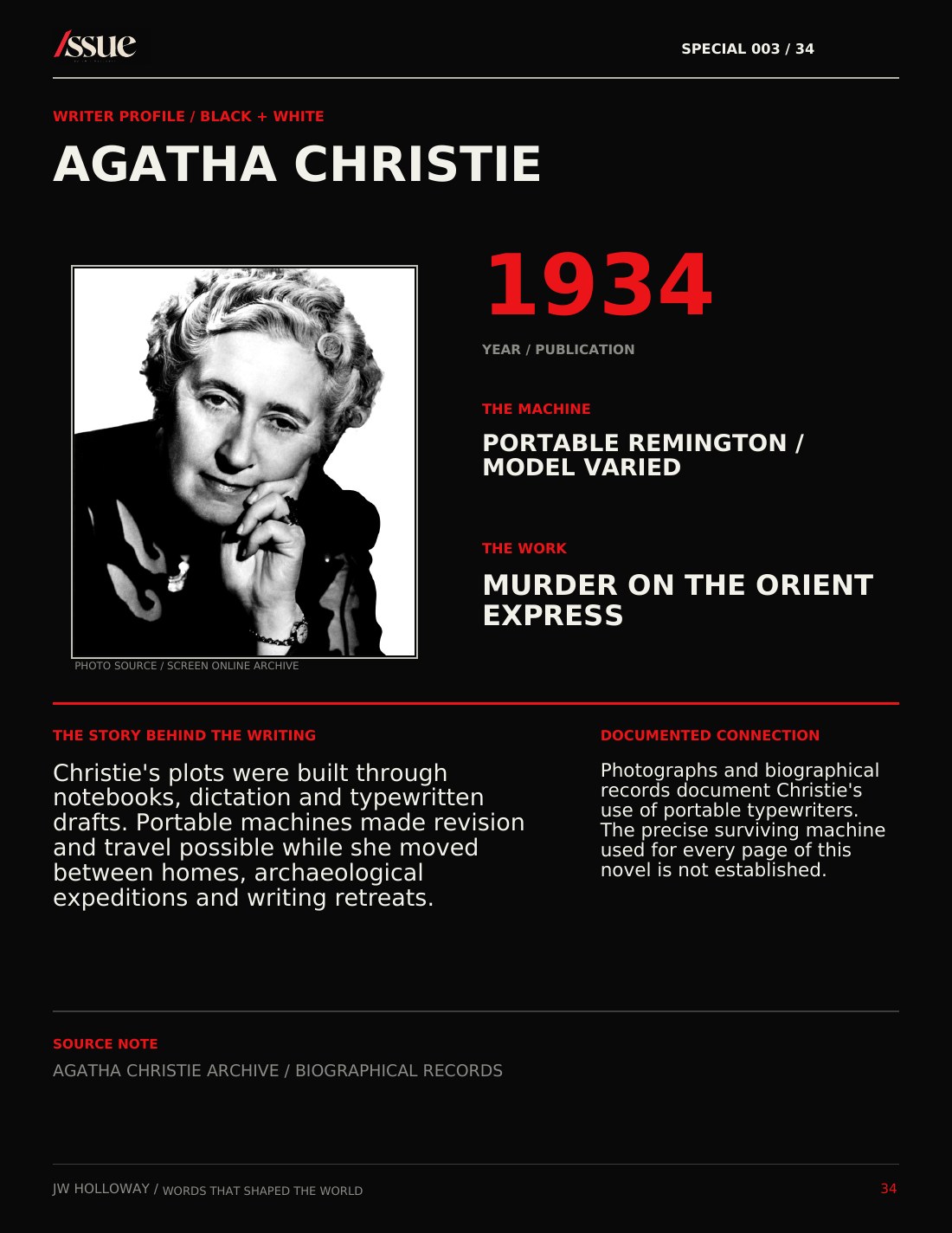
WRITER PROFILE / BLACK + WHITE AGATHA CHRISTIE
PHOTO SOURCE / SCREEN ONLINE ARCHIVE
YEAR / PUBLICATION
THE MACHINE
PORTABLE REMINGTON / MODEL VARIED
THE WORK MURDER ON THE ORIENT EXPRESS
THE STORY BEHIND THE WRITING
Christie's plots were built through notebooks, dictation and typewritten drafts. Portable machines made revision and travel possible while she moved between homes, archaeological expeditions and writing retreats.
DOCUMENTED CONNECTION
Photographs and biographical records document Christie's use of portable typewriters. The precise surviving machine used for every page of this novel is not established.
SOURCE NOTE
AGATHA CHRISTIE ARCHIVE / BIOGRAPHICAL RECORDS
Page 35
Read page text
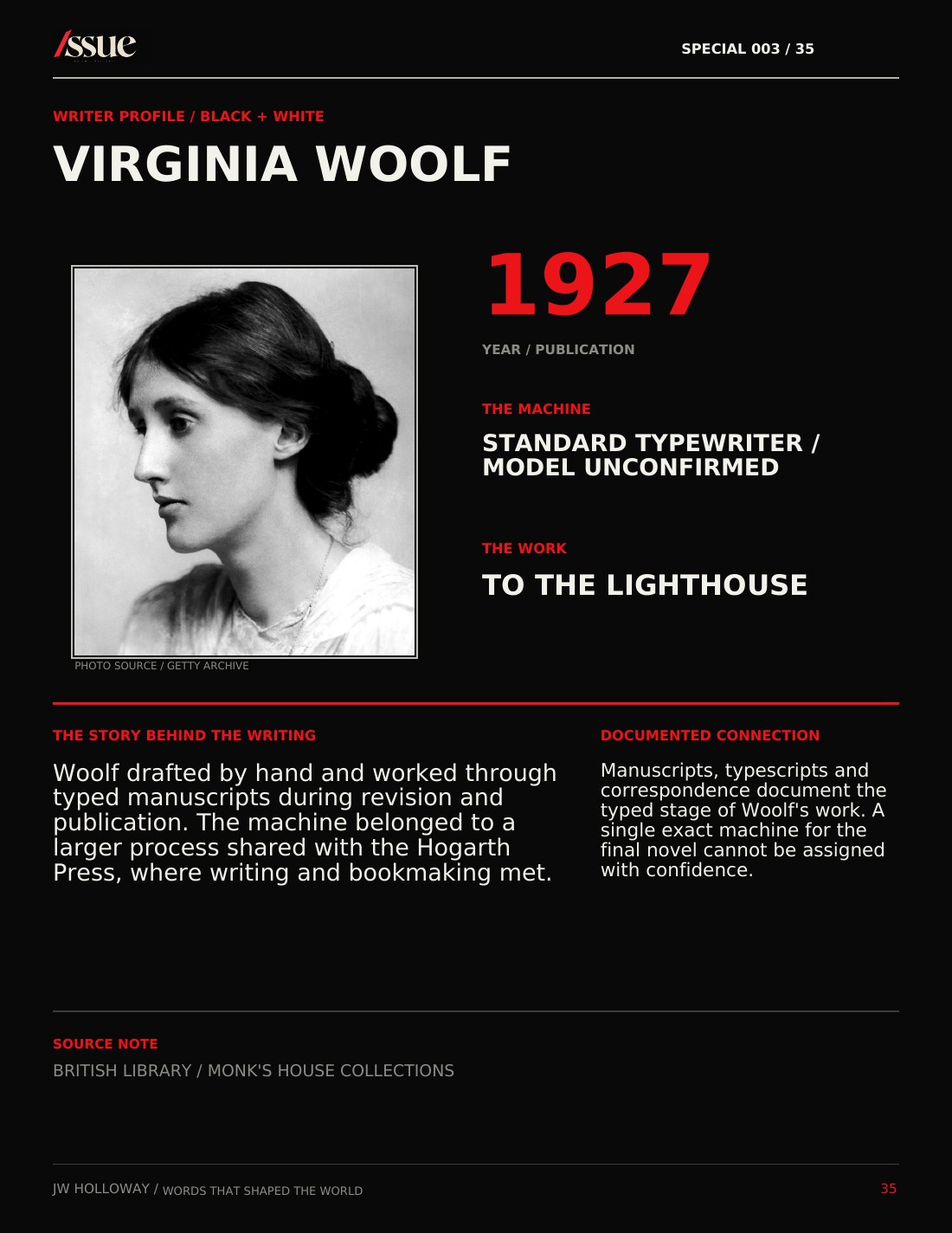
WRITER PROFILE / BLACK + WHITE VIRGINIA WOOLF
PHOTO SOURCE / GETTY ARCHIVE
YEAR / PUBLICATION
THE MACHINE
STANDARD TYPEWRITER / MODEL UNCONFIRMED
THE WORK TO THE LIGHTHOUSE
THE STORY BEHIND THE WRITING
Woolf drafted by hand and worked through typed manuscripts during revision and publication. The machine belonged to a larger process shared with the Hogarth Press, where writing and bookmaking met.
DOCUMENTED CONNECTION
Manuscripts, typescripts and correspondence document the typed stage of Woolf's work. A single exact machine for the final novel cannot be assigned with confidence.
SOURCE NOTE
BRITISH LIBRARY / MONK'S HOUSE COLLECTIONS
Page 36
Read page text
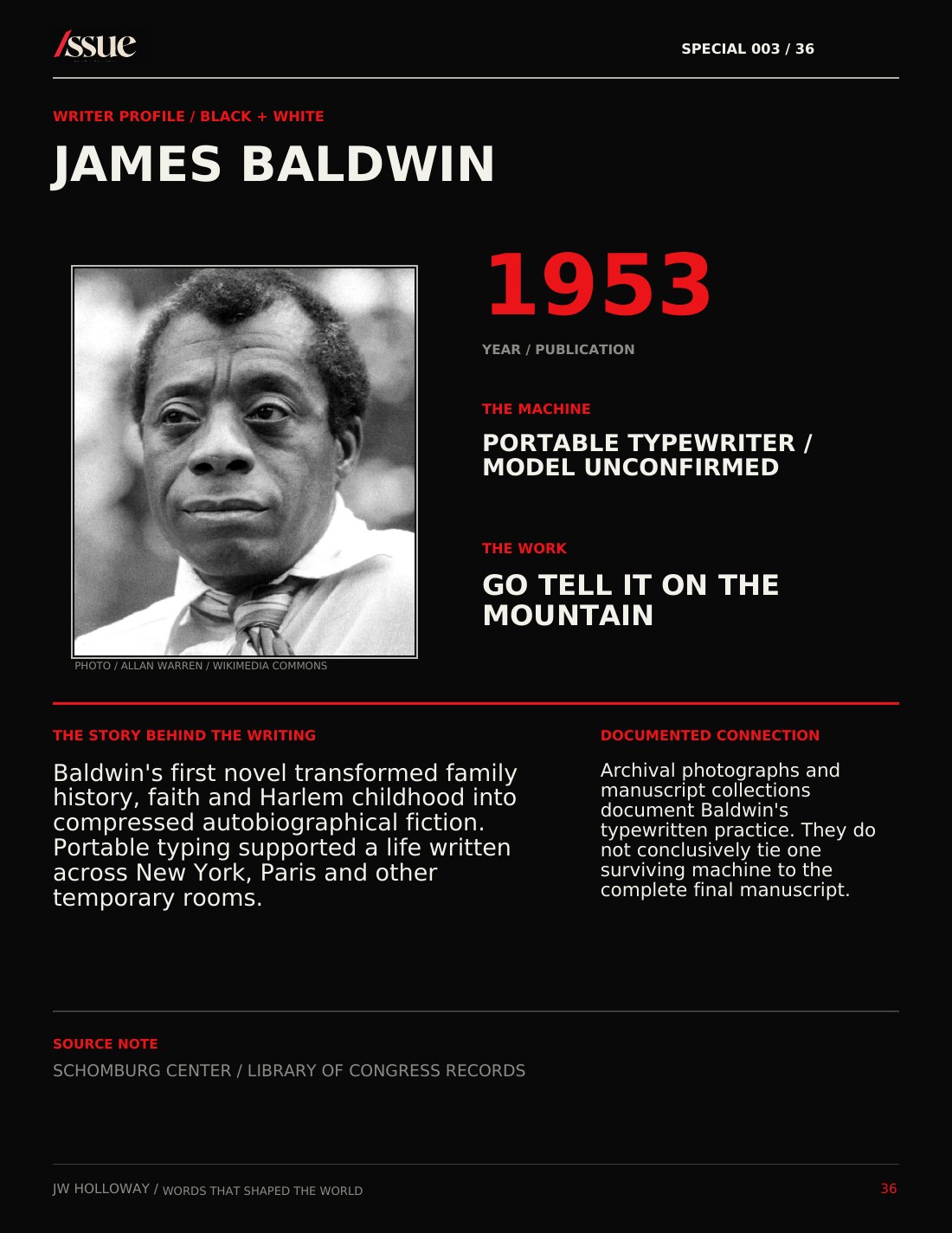
WRITER PROFILE / BLACK + WHITE JAMES BALDWIN
PHOTO / ALLAN WARREN / WIKIMEDIA COMMONS
YEAR / PUBLICATION
THE MACHINE
PORTABLE TYPEWRITER / MODEL UNCONFIRMED
THE WORK GO TELL IT ON THE MOUNTAIN
THE STORY BEHIND THE WRITING
Baldwin's first novel transformed family history, faith and Harlem childhood into compressed autobiographical fiction. Portable typing supported a life written across New York, Paris and other temporary rooms.
DOCUMENTED CONNECTION
Archival photographs and manuscript collections document Baldwin's typewritten practice. They do not conclusively tie one surviving machine to the complete final manuscript.
SOURCE NOTE
SCHOMBURG CENTER / LIBRARY OF CONGRESS RECORDS
Page 37

Read page text
WRITER PROFILE / BLACK + WHITE TONI MORRISON
PHOTO SOURCE / WASHINGTON POST ARCHIVE
YEAR / PUBLICATION
THE MACHINE
ELECTRIC TYPEWRITER / MODEL UNCONFIRMED
THE WORK BELOVED
THE STORY BEHIND THE WRITING
Morrison wrote around the demands of editing, teaching and family life, often working before dawn. Drafts and revisions reveal a deliberate architecture behind the novel's fractured memory and haunting voice.
DOCUMENTED CONNECTION
The Toni Morrison Papers preserve drafts, typescripts and editorial evidence. Public records do not establish one exact machine for every stage of Beloved.
SOURCE NOTE
PRINCETON UNIVERSITY LIBRARY / TONI MORRISON PAPERS
Page 38
Read page text
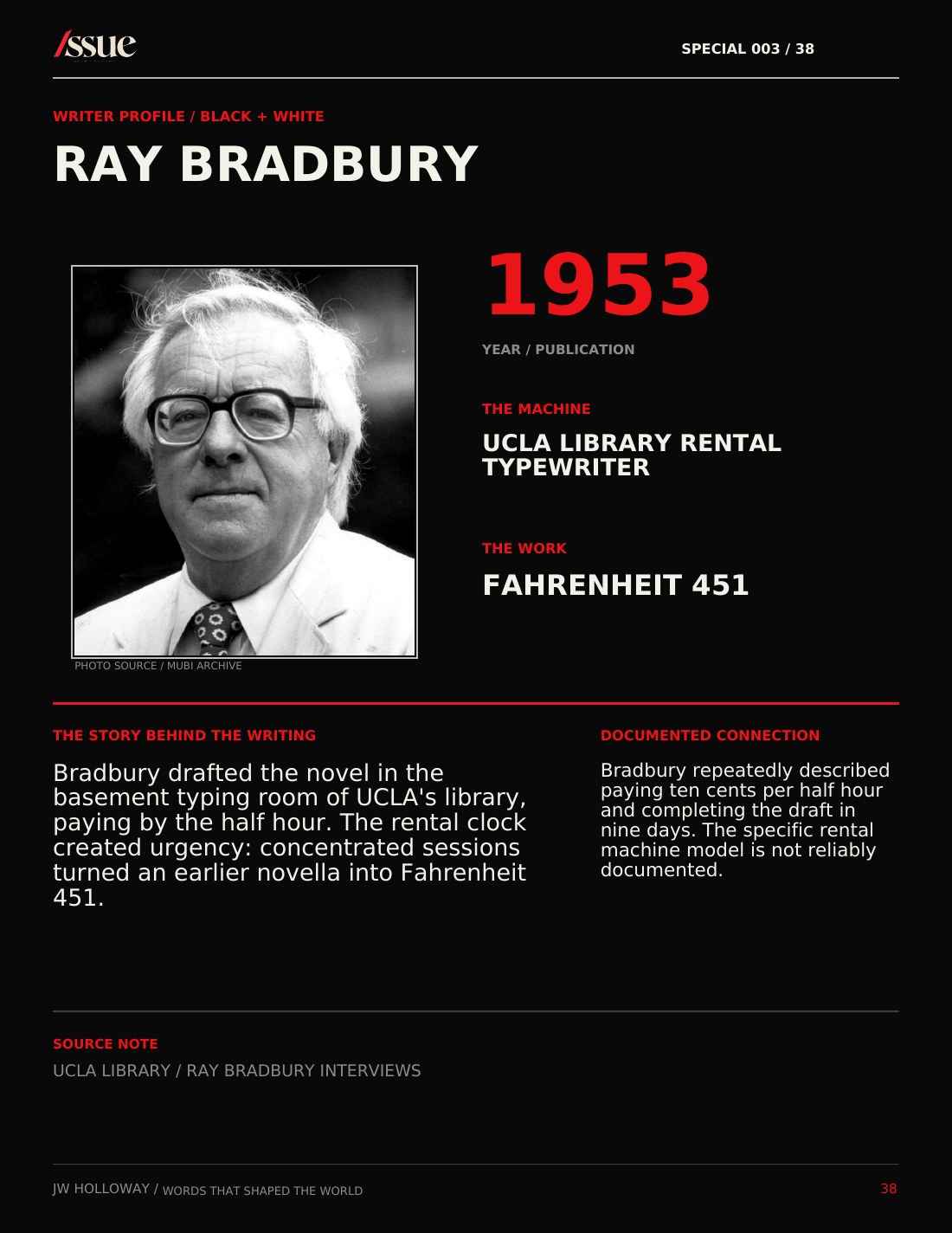
WRITER PROFILE / BLACK + WHITE RAY BRADBURY
PHOTO SOURCE / MUBI ARCHIVE
YEAR / PUBLICATION
THE MACHINE
UCLA LIBRARY RENTAL TYPEWRITER
THE WORK FAHRENHEIT 451
THE STORY BEHIND THE WRITING
Bradbury drafted the novel in the basement typing room of UCLA's library, paying by the half hour. The rental clock created urgency: concentrated sessions turned an earlier novella into Fahrenheit 451.
DOCUMENTED CONNECTION
Bradbury repeatedly described paying ten cents per half hour and completing the draft in nine days. The specific rental machine model is not reliably documented.
SOURCE NOTE
UCLA LIBRARY / RAY BRADBURY INTERVIEWS
Page 39
Read page text
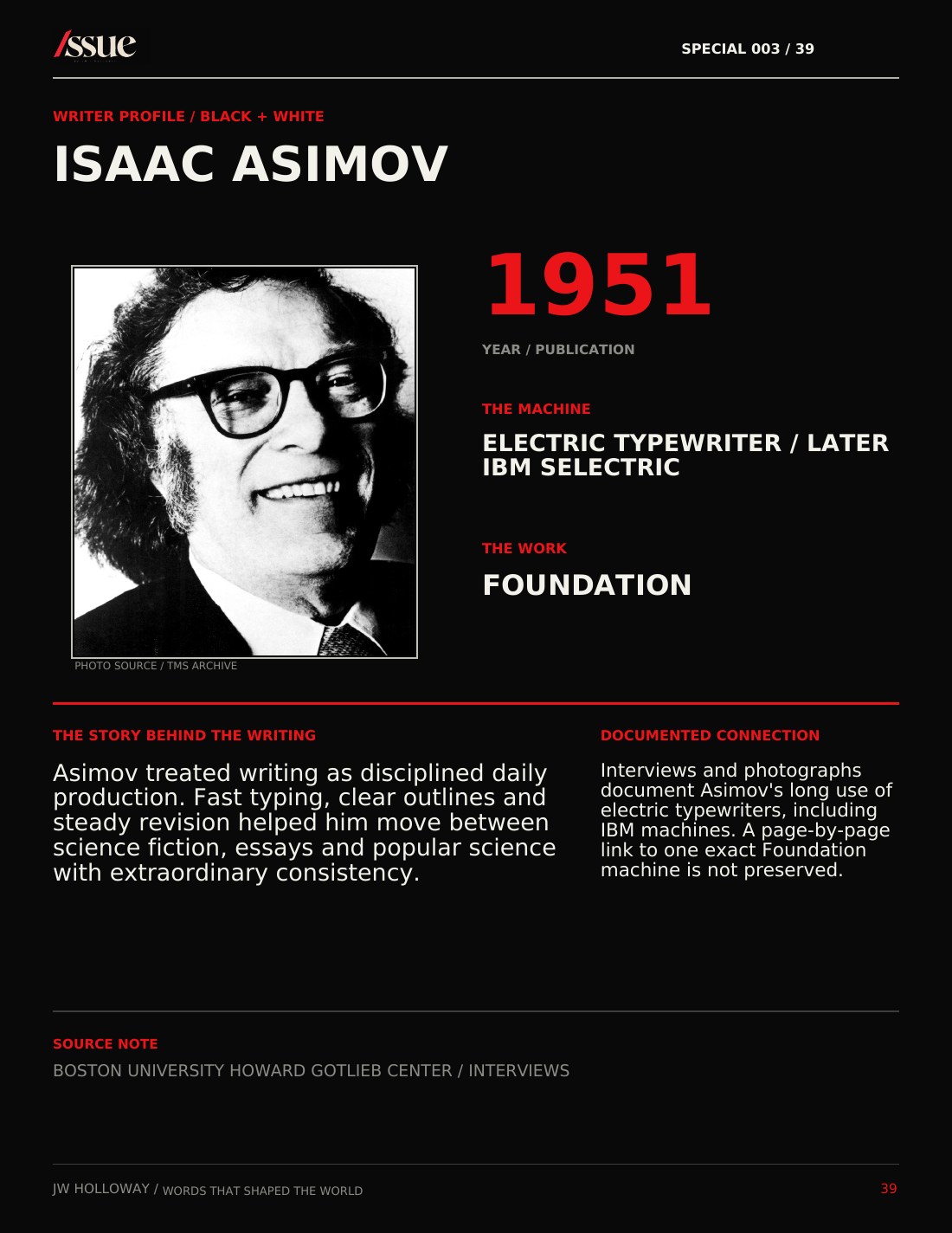
WRITER PROFILE / BLACK + WHITE ISAAC ASIMOV
PHOTO SOURCE / TMS ARCHIVE
YEAR / PUBLICATION
THE MACHINE
ELECTRIC TYPEWRITER / LATER IBM SELECTRIC
THE WORK FOUNDATION
THE STORY BEHIND THE WRITING
Asimov treated writing as disciplined daily production. Fast typing, clear outlines and steady revision helped him move between science fiction, essays and popular science with extraordinary consistency.
DOCUMENTED CONNECTION
Interviews and photographs document Asimov's long use of electric typewriters, including IBM machines. A page-by-page link to one exact Foundation machine is not preserved.
SOURCE NOTE
BOSTON UNIVERSITY HOWARD GOTLIEB CENTER / INTERVIEWS