Page 1
Read page text
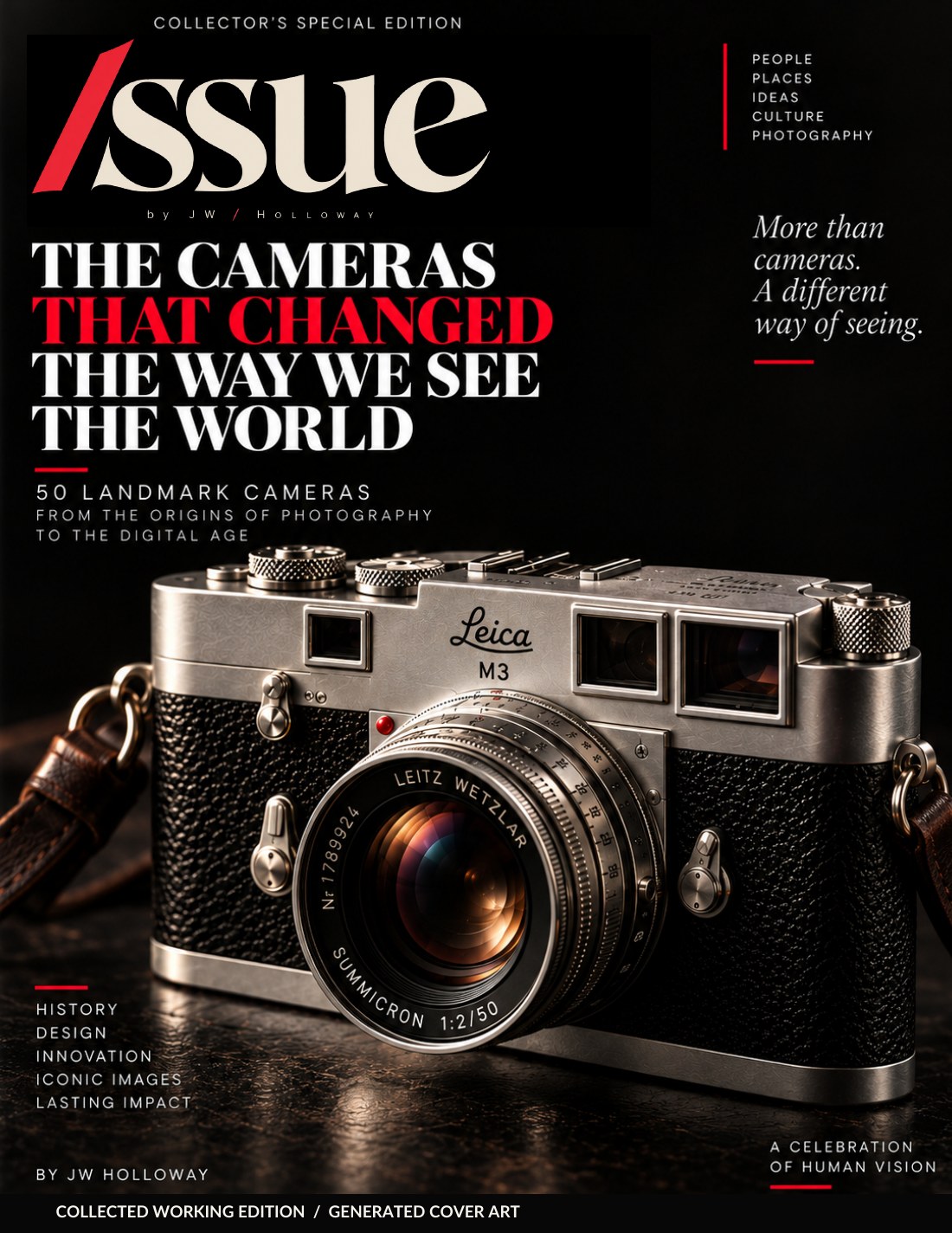
The Cameras That Changed the Way We See the World. An Issue magazine edition by J. W. Holloway.
Page 2
Read page text
This volume gathers the material already prepared for your collector's edition. It includes ten illustrated camera features with companion scene pages, forty additional text-only profiles, and a camera-obscura prologue.
Each picture story now opens with a year or period and unfolds as a fictional scene. The dates identify imagined settings, not when a photograph was taken.
Important: the camera pictures and period-style scenes are generated illustrations, not authenticated photographs. There are no verified historical capture dates for these images.
Camera facts remain the unverified material from the earlier draft. This is a collected working edition, not the final researched or print-certified publication.
A collection you can read.
50 camera profiles. One visual identity.
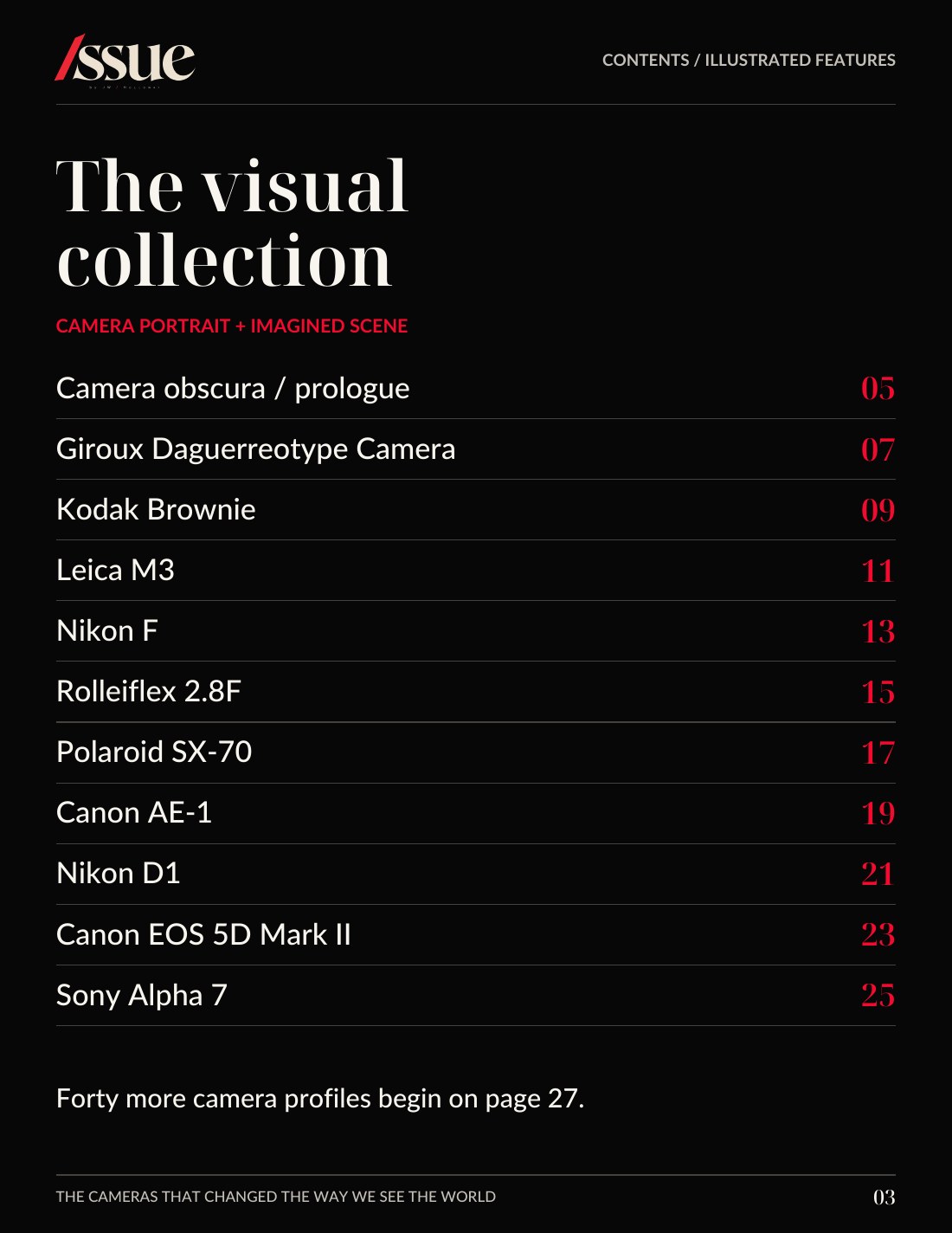
Page 3
Read page text
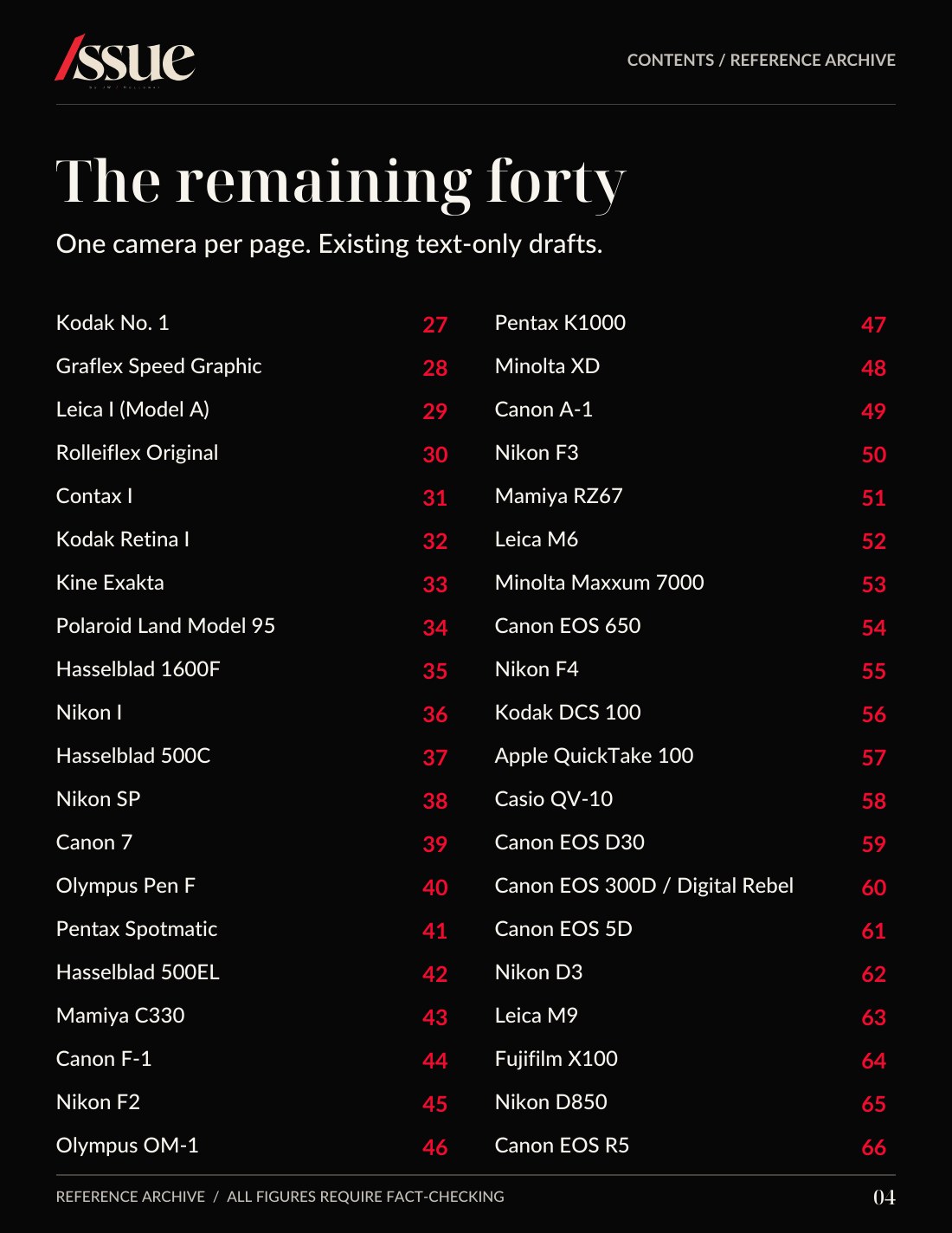
Page 4
Read page text
Page 5
Read page text
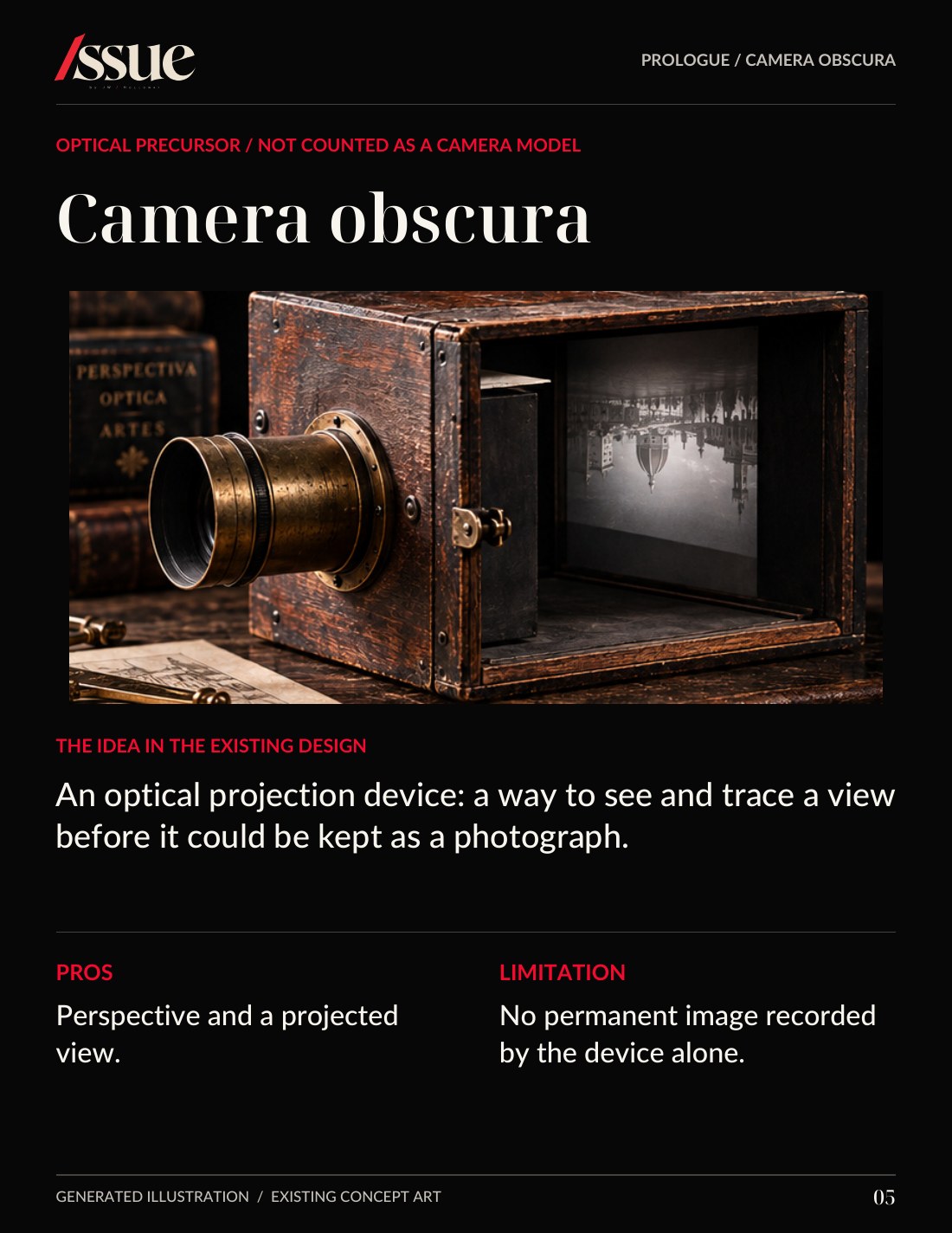
OPTICAL PRECURSOR / NOT COUNTED AS A CAMERA MODEL Camera obscura
THE IDEA IN THE EXISTING DESIGN
An optical projection device: a way to see and trace a view before it could be kept as a photograph.
PROS LIMITATION
Perspective and a projected view.
No permanent image recorded by the device alone.
Page 6
Read page text
IMAGINED SETTING c. 1550
The world, upside down
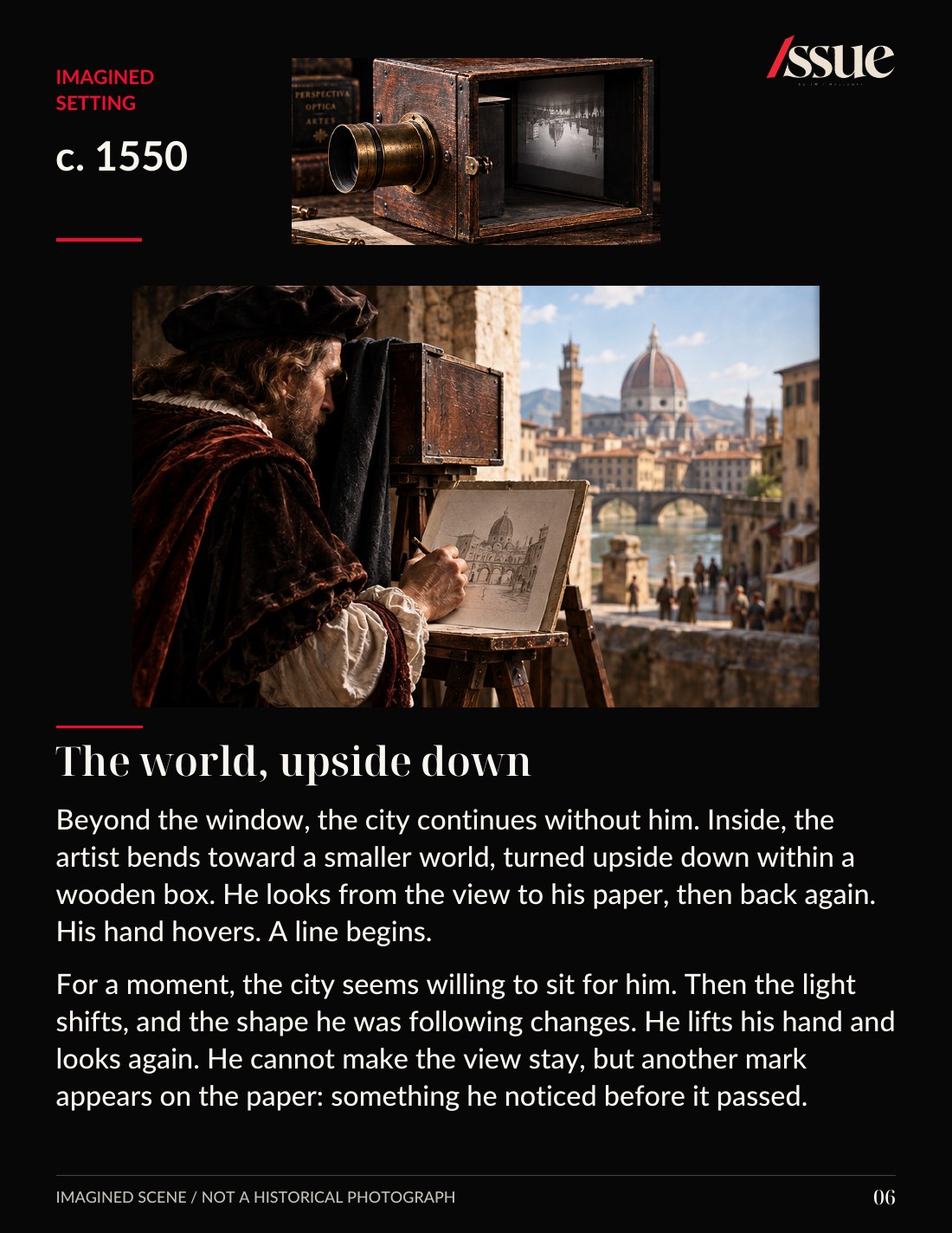
Beyond the window, the city continues without him. Inside, the artist bends toward a smaller world, turned upside down within a wooden box. He looks from the view to his paper, then back again. His hand hovers. A line begins.
For a moment, the city seems willing to sit for him. Then the light shifts, and the shape he was following changes. He lifts his hand and looks again. He cannot make the view stay, but another mark appears on the paper: something he noticed before it passed.
Page 7
Read page text
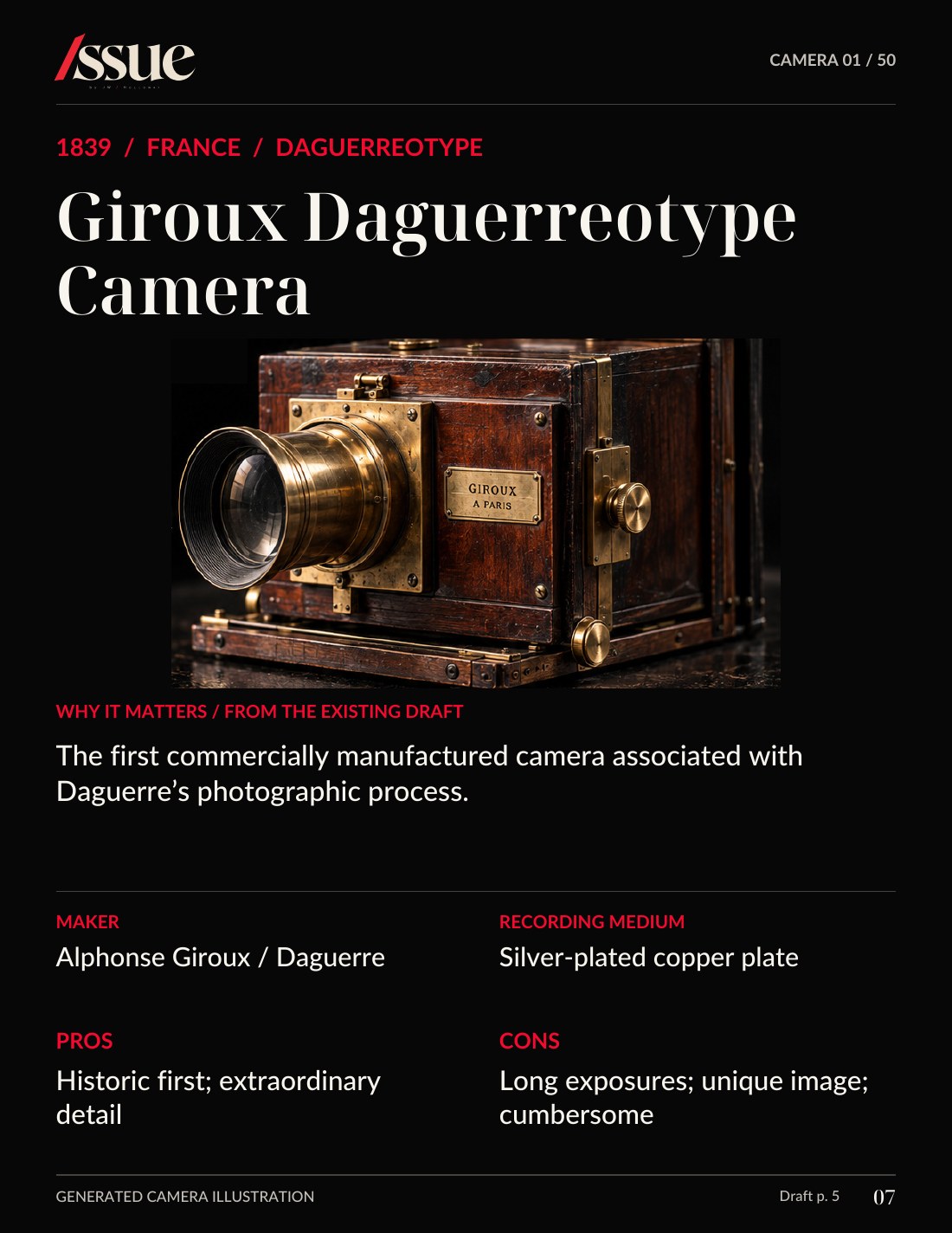
1839 / FRANCE / DAGUERREOTYPE Giroux Daguerreotype Camera
WHY IT MATTERS / FROM THE EXISTING DRAFT
The first commercially manufactured camera associated with Daguerre’s photographic process.
MAKER RECORDING MEDIUM Alphonse Giroux / Daguerre Silver-plated copper plate
PROS CONS
Historic first; extraordinary detail
Long exposures; unique image; cumbersome
Page 8
Read page text
IMAGINED SETTING c. 1840
A face worth waiting for
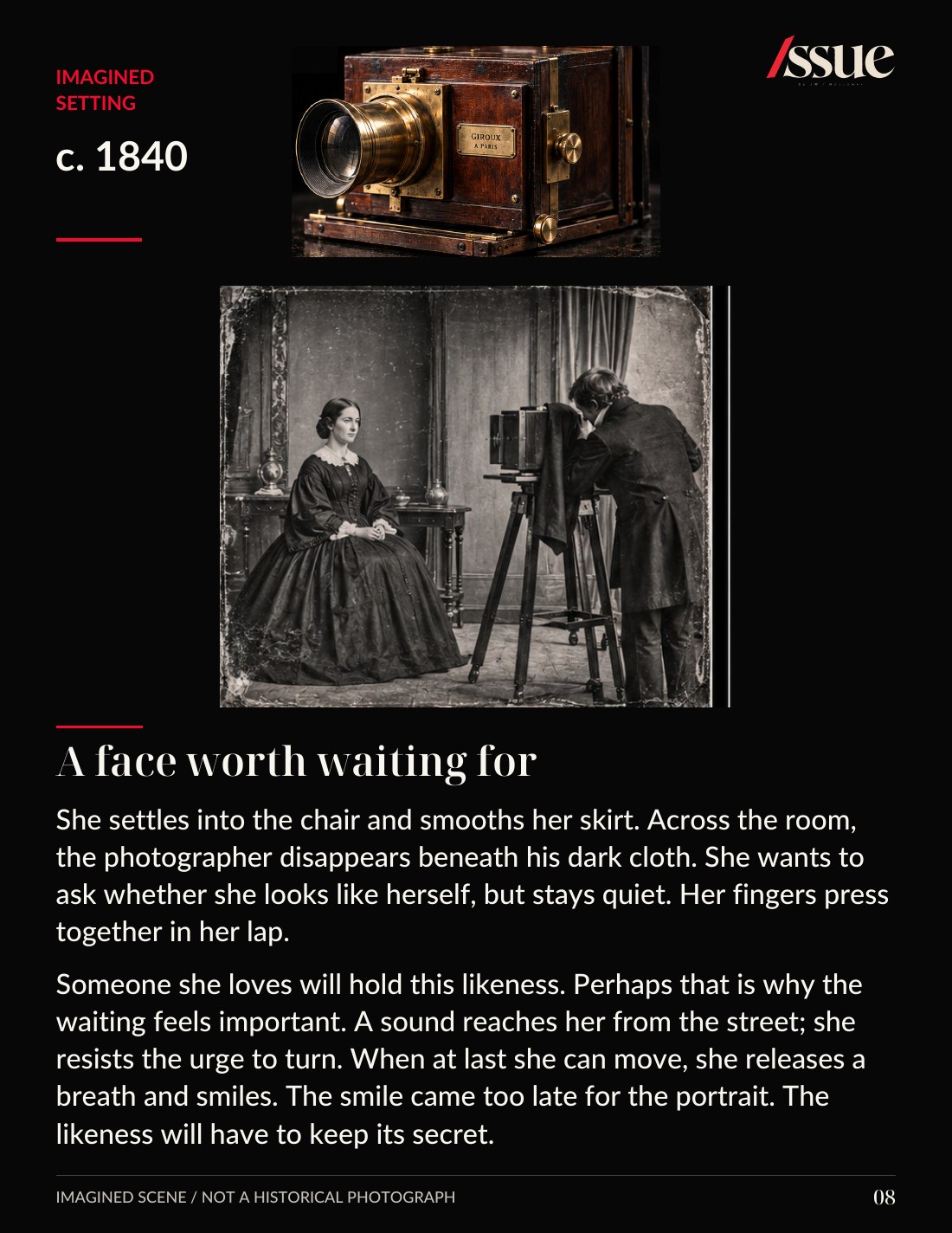
She settles into the chair and smooths her skirt. Across the room, the photographer disappears beneath his dark cloth. She wants to ask whether she looks like herself, but stays quiet. Her fingers press together in her lap.
Someone she loves will hold this likeness. Perhaps that is why the waiting feels important. A sound reaches her from the street; she resists the urge to turn. When at last she can move, she releases a breath and smiles. The smile came too late for the portrait. The likeness will have to keep its secret.
Page 9
Read page text
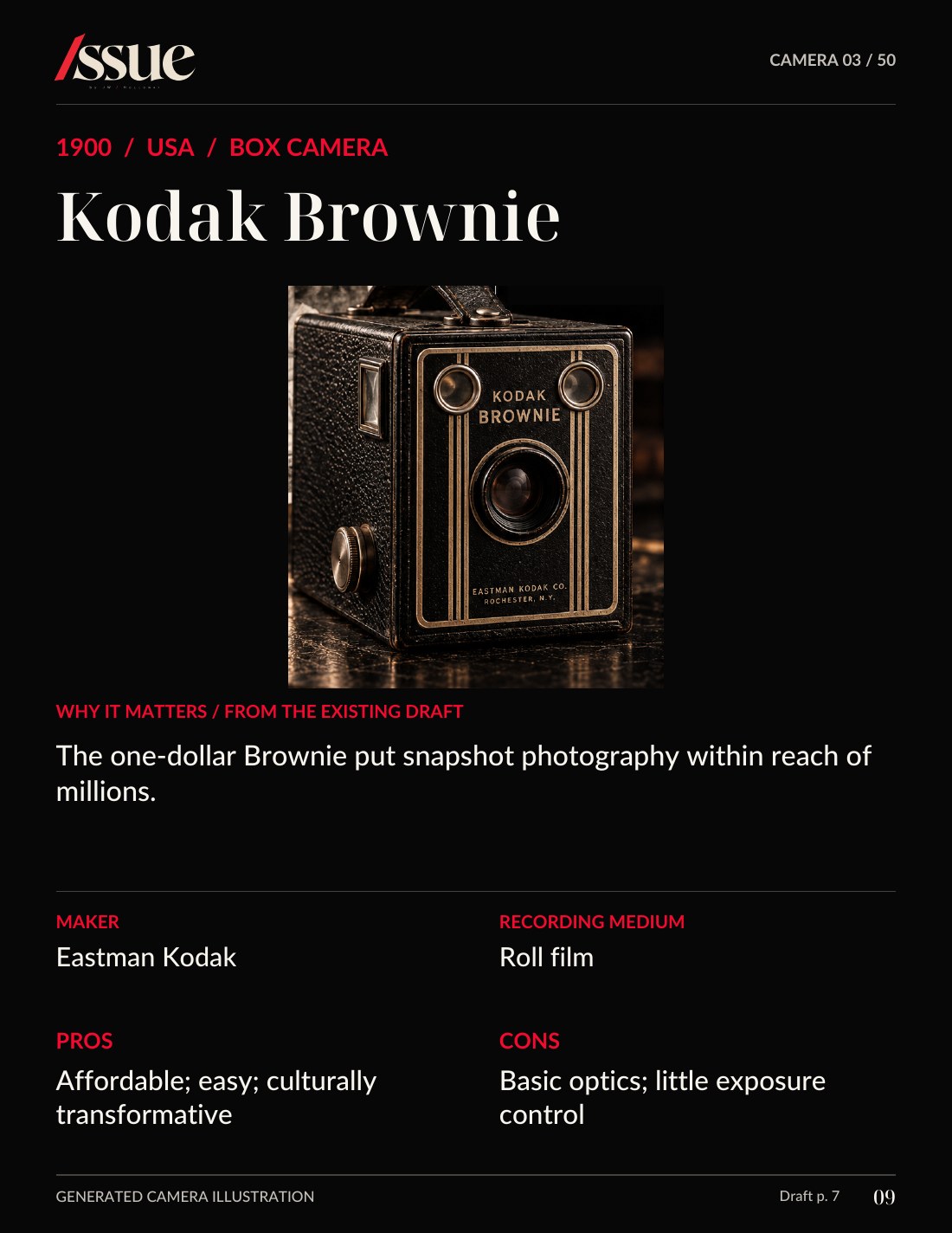
1900 / USA / BOX CAMERA Kodak Brownie
WHY IT MATTERS / FROM THE EXISTING DRAFT
The one-dollar Brownie put snapshot photography within reach of millions.
MAKER RECORDING MEDIUM Eastman Kodak Roll film
PROS CONS
Affordable; easy; culturally transformative
Basic optics; little exposure control
Page 10
Read page text
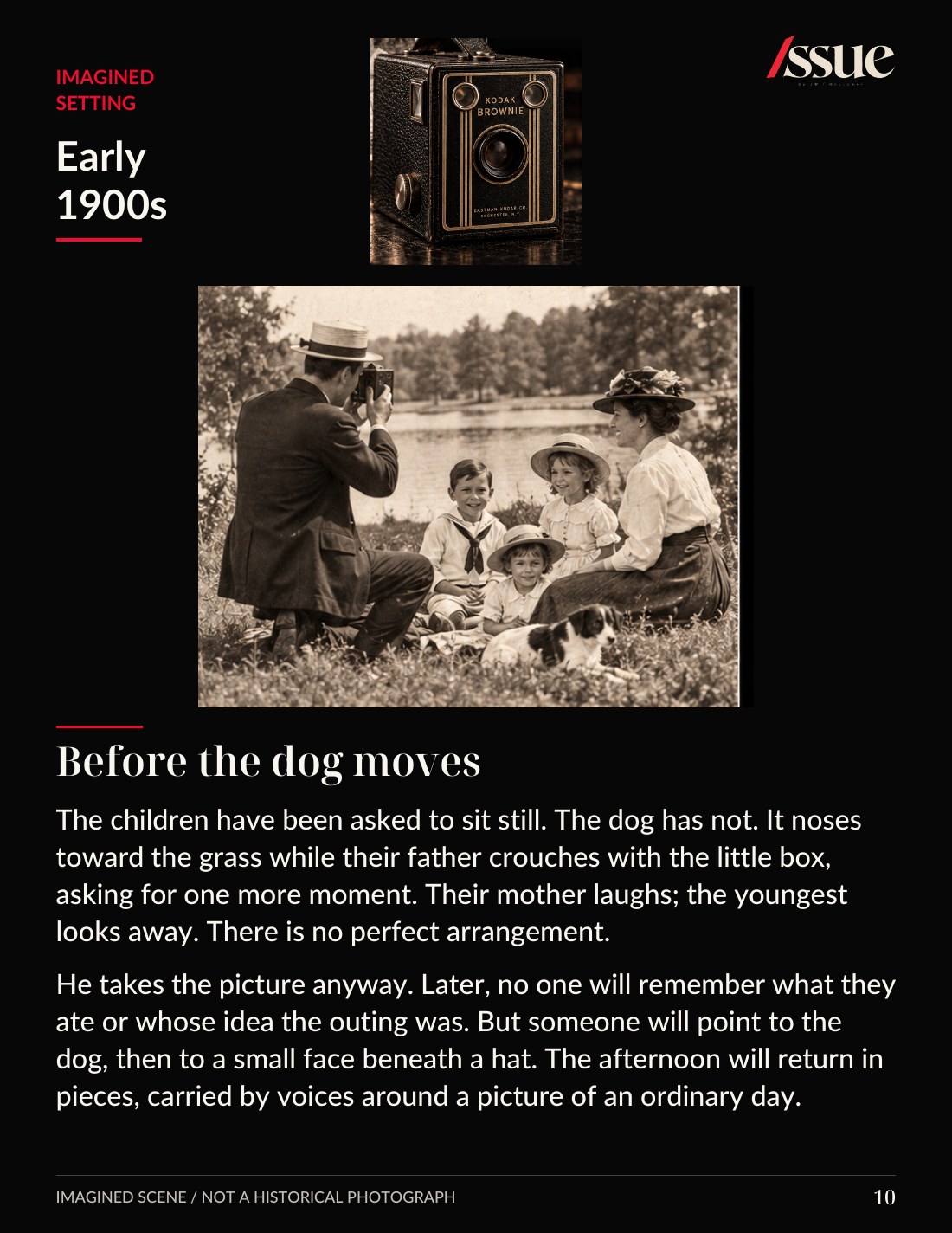
IMAGINED SETTING Early 1900s
Before the dog moves
The children have been asked to sit still. The dog has not. It noses toward the grass while their father crouches with the little box, asking for one more moment. Their mother laughs; the youngest looks away. There is no perfect arrangement.
He takes the picture anyway. Later, no one will remember what they ate or whose idea the outing was. But someone will point to the dog, then to a small face beneath a hat. The afternoon will return in pieces, carried by voices around a picture of an ordinary day.
Page 11
Read page text
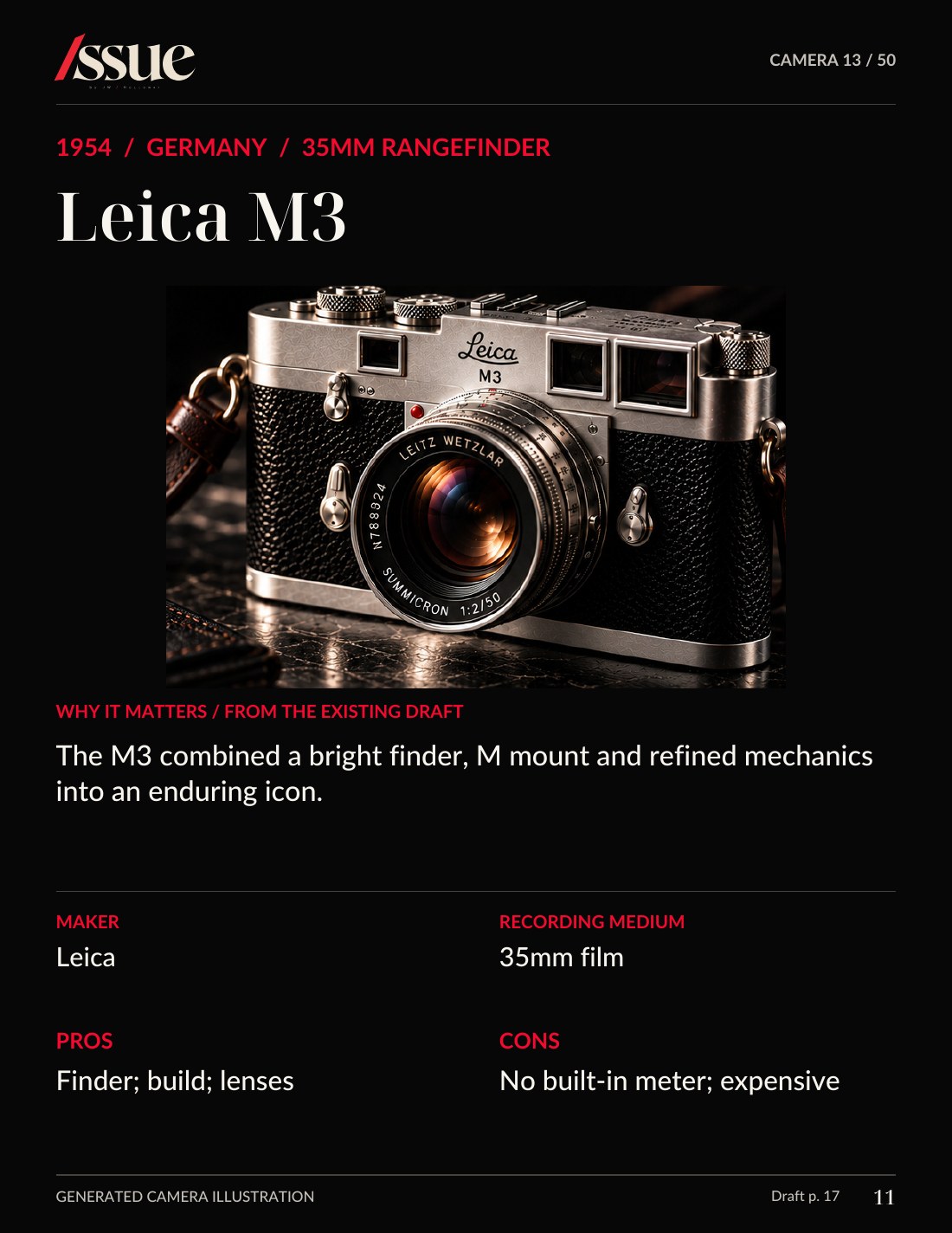
1954 / GERMANY / 35MM RANGEFINDER Leica M3
WHY IT MATTERS / FROM THE EXISTING DRAFT
The M3 combined a bright finder, M mount and refined mechanics into an enduring icon.
MAKER RECORDING MEDIUM Leica 35mm film
PROS CONS
Finder; build; lenses No built-in meter; expensive
Page 12
Read page text
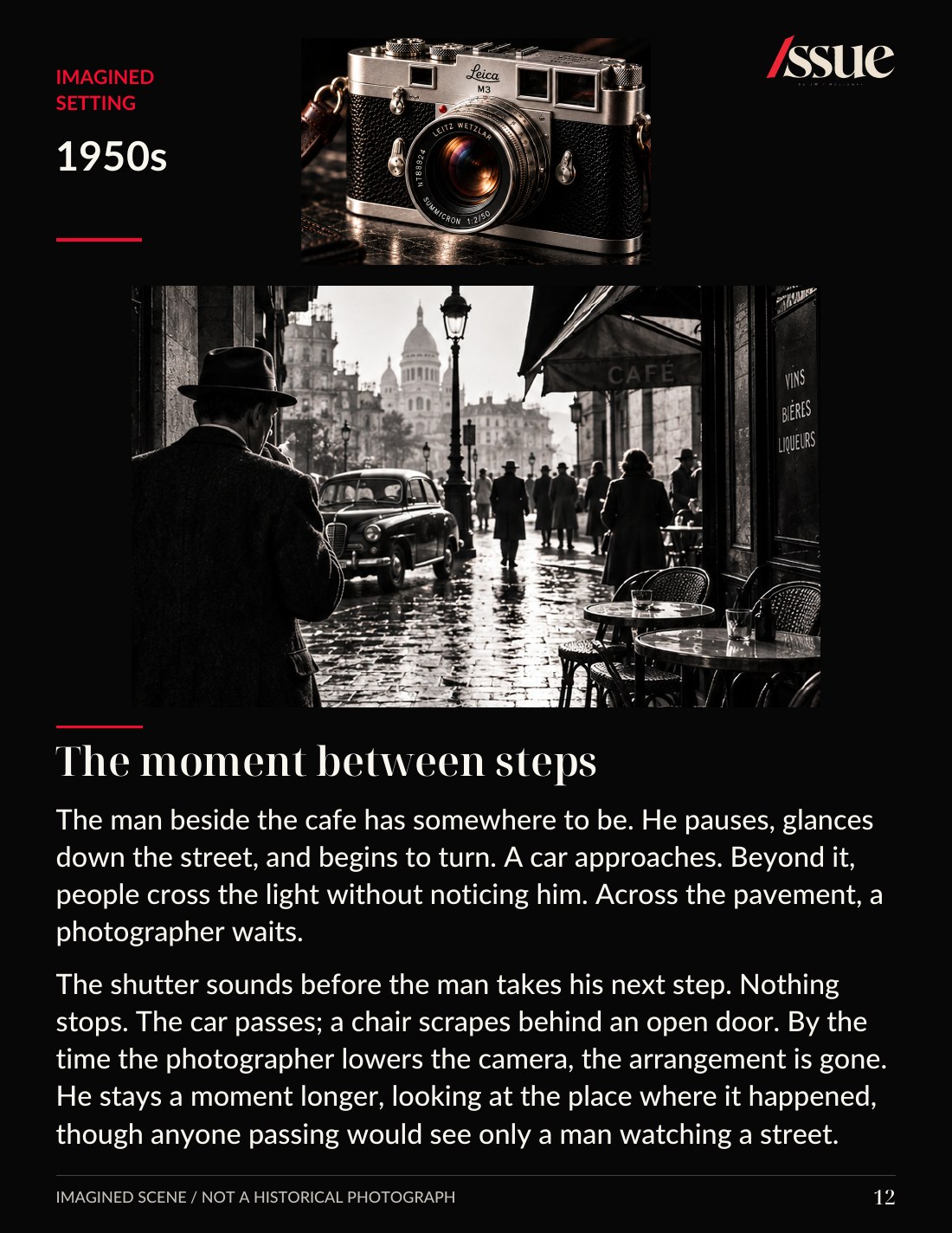
IMAGINED SETTING 1950s
The moment between steps
The man beside the cafe has somewhere to be. He pauses, glances down the street, and begins to turn. A car approaches. Beyond it, people cross the light without noticing him. Across the pavement, a photographer waits.
The shutter sounds before the man takes his next step. Nothing stops. The car passes; a chair scrapes behind an open door. By the time the photographer lowers the camera, the arrangement is gone. He stays a moment longer, looking at the place where it happened, though anyone passing would see only a man watching a street.
Page 13
Read page text
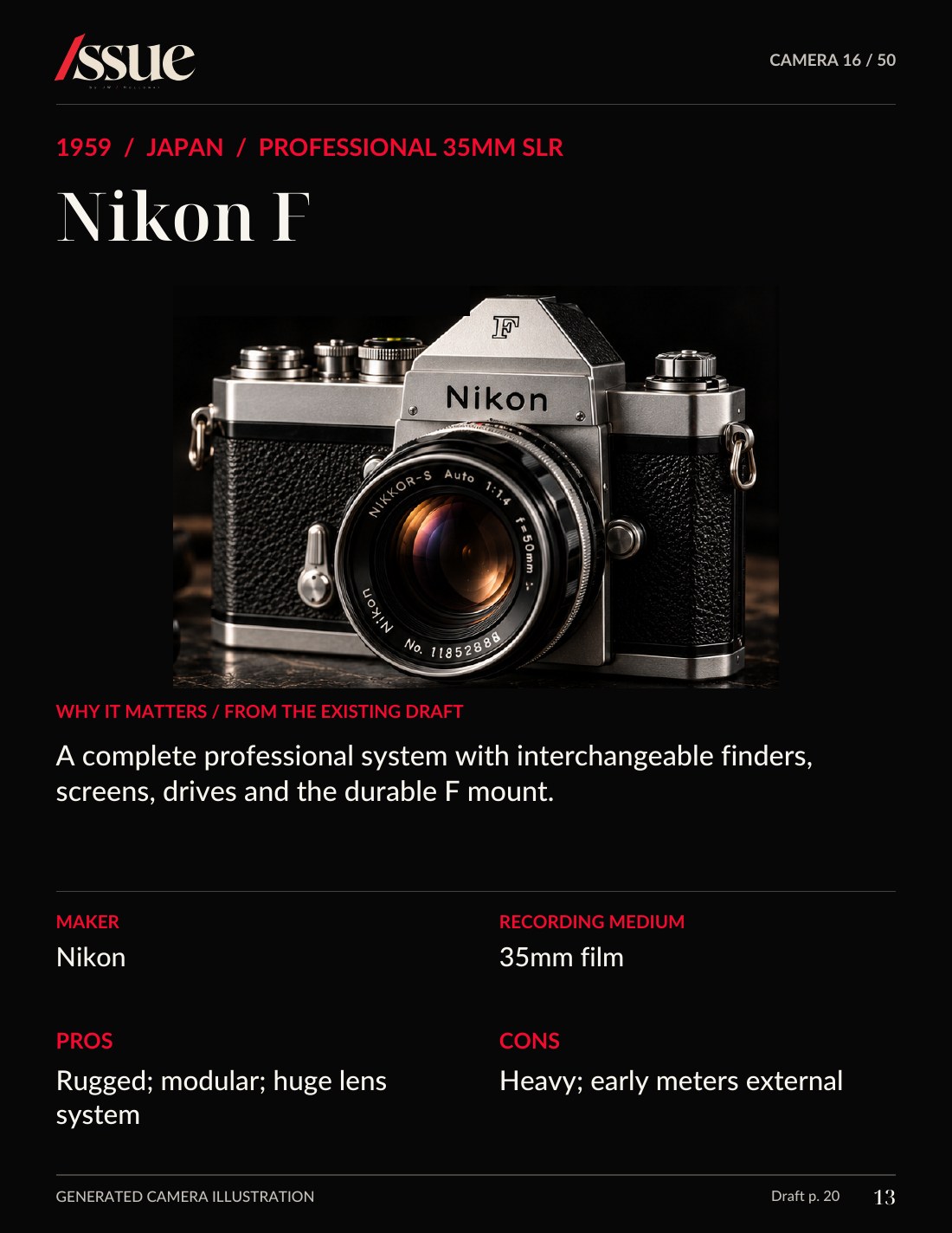
1959 / JAPAN / PROFESSIONAL 35MM SLR Nikon F
WHY IT MATTERS / FROM THE EXISTING DRAFT
A complete professional system with interchangeable finders, screens, drives and the durable F mount.
MAKER RECORDING MEDIUM Nikon 35mm film
PROS CONS
Rugged; modular; huge lens system
Heavy; early meters external
Page 14
Read page text
IMAGINED SETTING 1960s
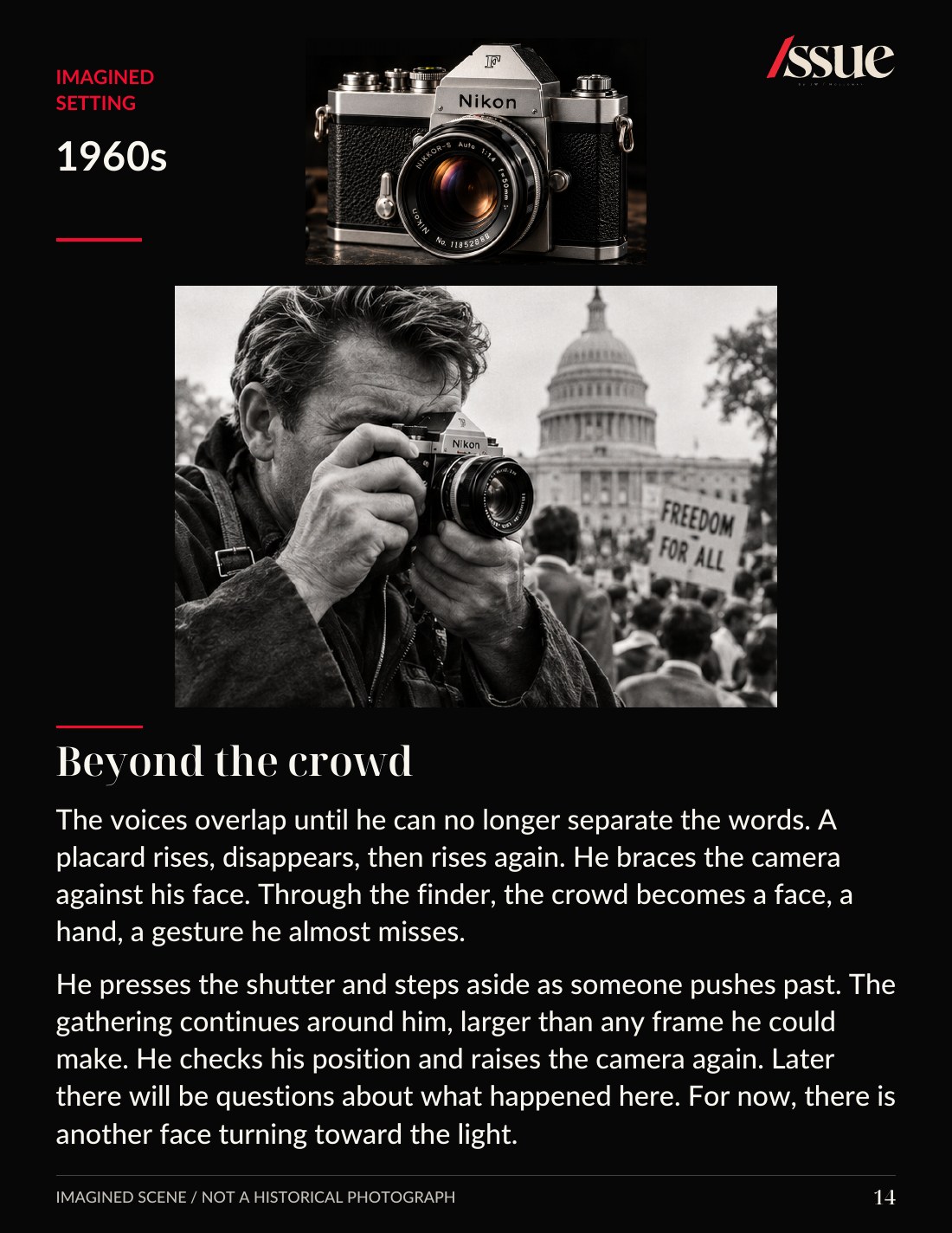
Beyond the crowd
The voices overlap until he can no longer separate the words. A placard rises, disappears, then rises again. He braces the camera against his face. Through the finder, the crowd becomes a face, a hand, a gesture he almost misses.
He presses the shutter and steps aside as someone pushes past. The gathering continues around him, larger than any frame he could make. He checks his position and raises the camera again. Later there will be questions about what happened here. For now, there is another face turning toward the light.
Page 15
Read page text
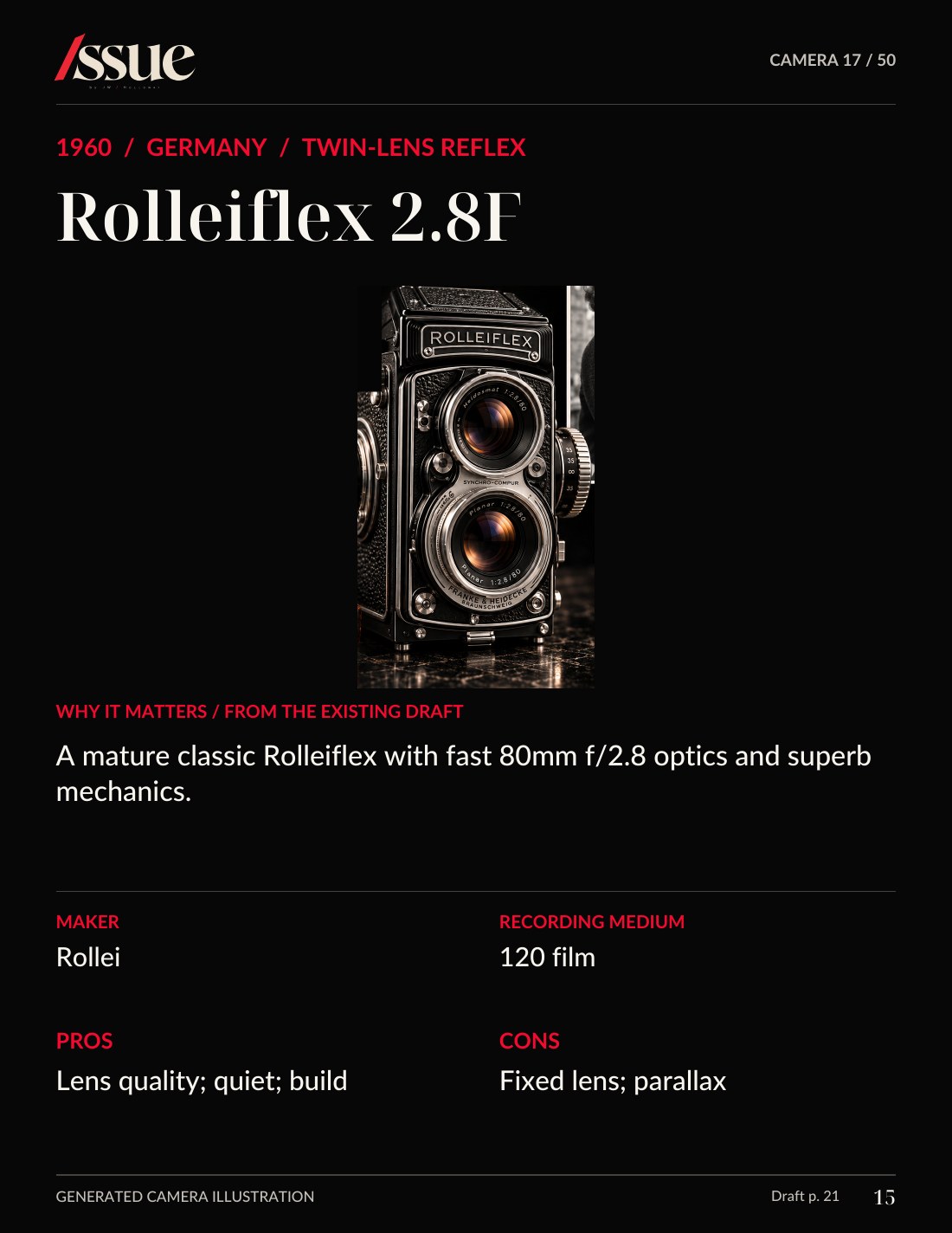
1960 / GERMANY / TWIN-LENS REFLEX Rolleiflex 2.8F
WHY IT MATTERS / FROM THE EXISTING DRAFT
A mature classic Rolleiflex with fast 80mm f/2.8 optics and superb mechanics.
MAKER RECORDING MEDIUM Rollei 120 film
PROS CONS
Lens quality; quiet; build Fixed lens; parallax
Page 16
Read page text
IMAGINED SETTING c. 1960
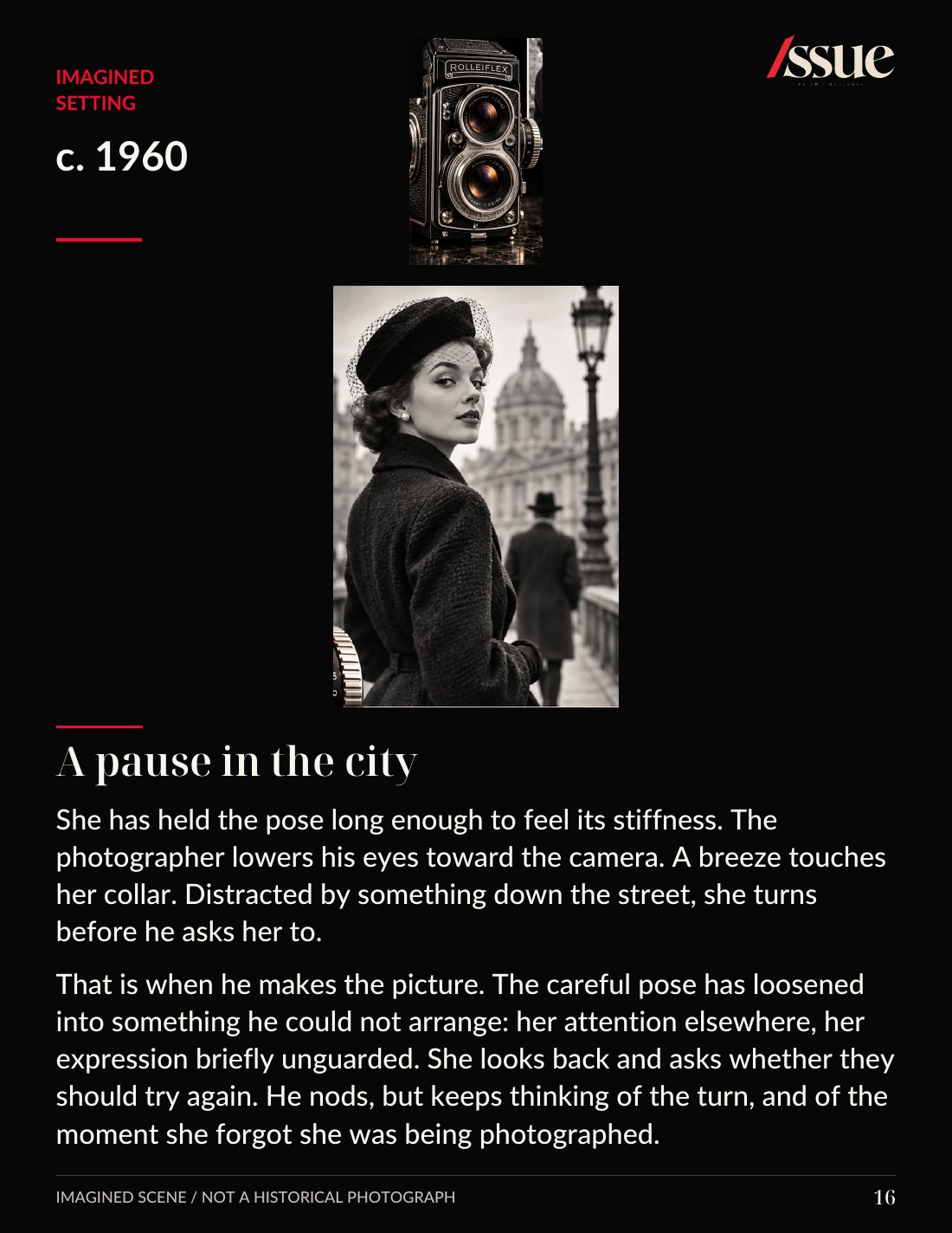
A pause in the city
She has held the pose long enough to feel its stiffness. The photographer lowers his eyes toward the camera. A breeze touches her collar. Distracted by something down the street, she turns before he asks her to.
That is when he makes the picture. The careful pose has loosened into something he could not arrange: her attention elsewhere, her expression briefly unguarded. She looks back and asks whether they should try again. He nods, but keeps thinking of the turn, and of the moment she forgot she was being photographed.
Page 17
Read page text
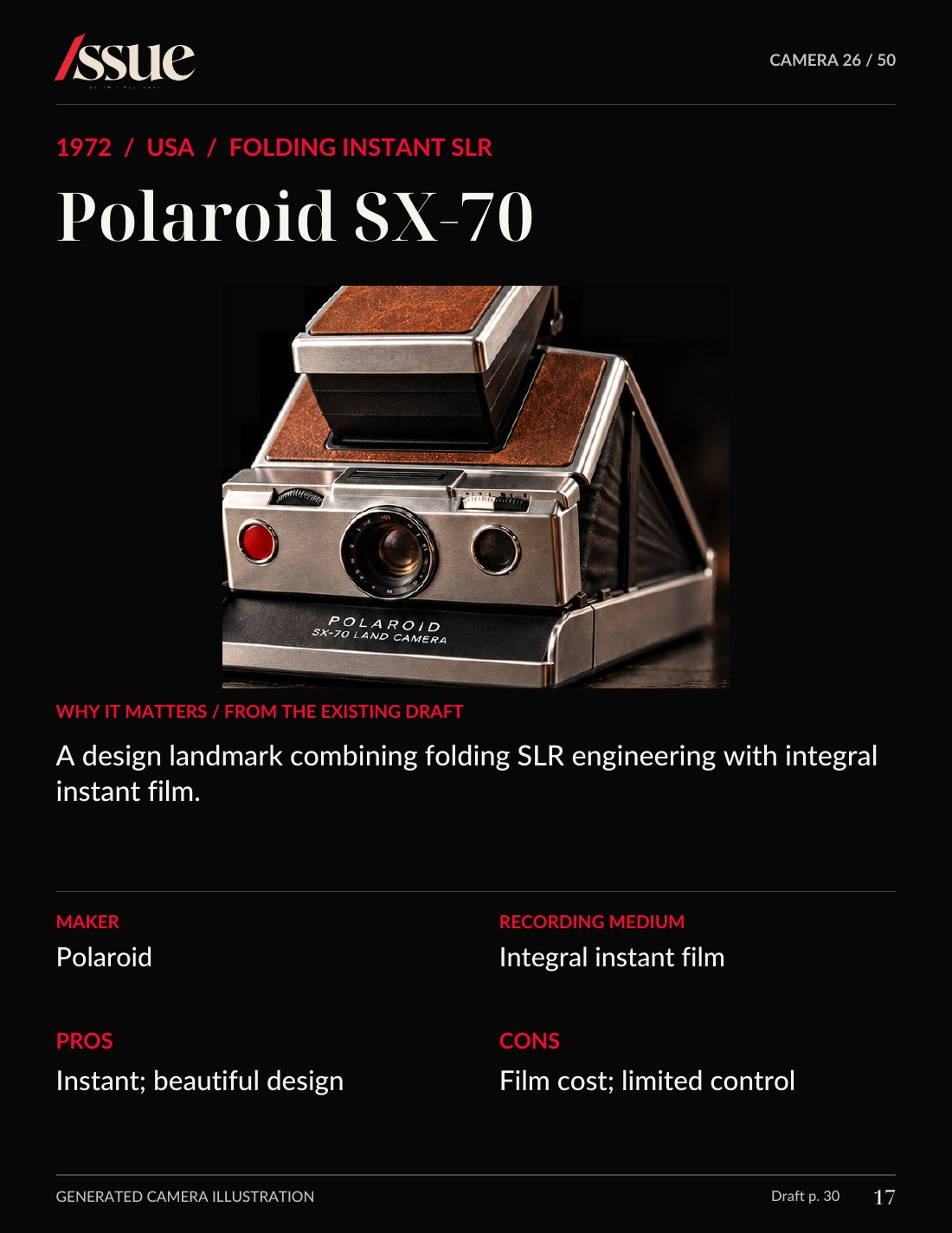
1972 / USA / FOLDING INSTANT SLR Polaroid SX-70
WHY IT MATTERS / FROM THE EXISTING DRAFT
A design landmark combining folding SLR engineering with integral instant film.
MAKER RECORDING MEDIUM Polaroid Integral instant film
PROS CONS
Instant; beautiful design Film cost; limited control
Page 18
Read page text
IMAGINED SETTING 1970s
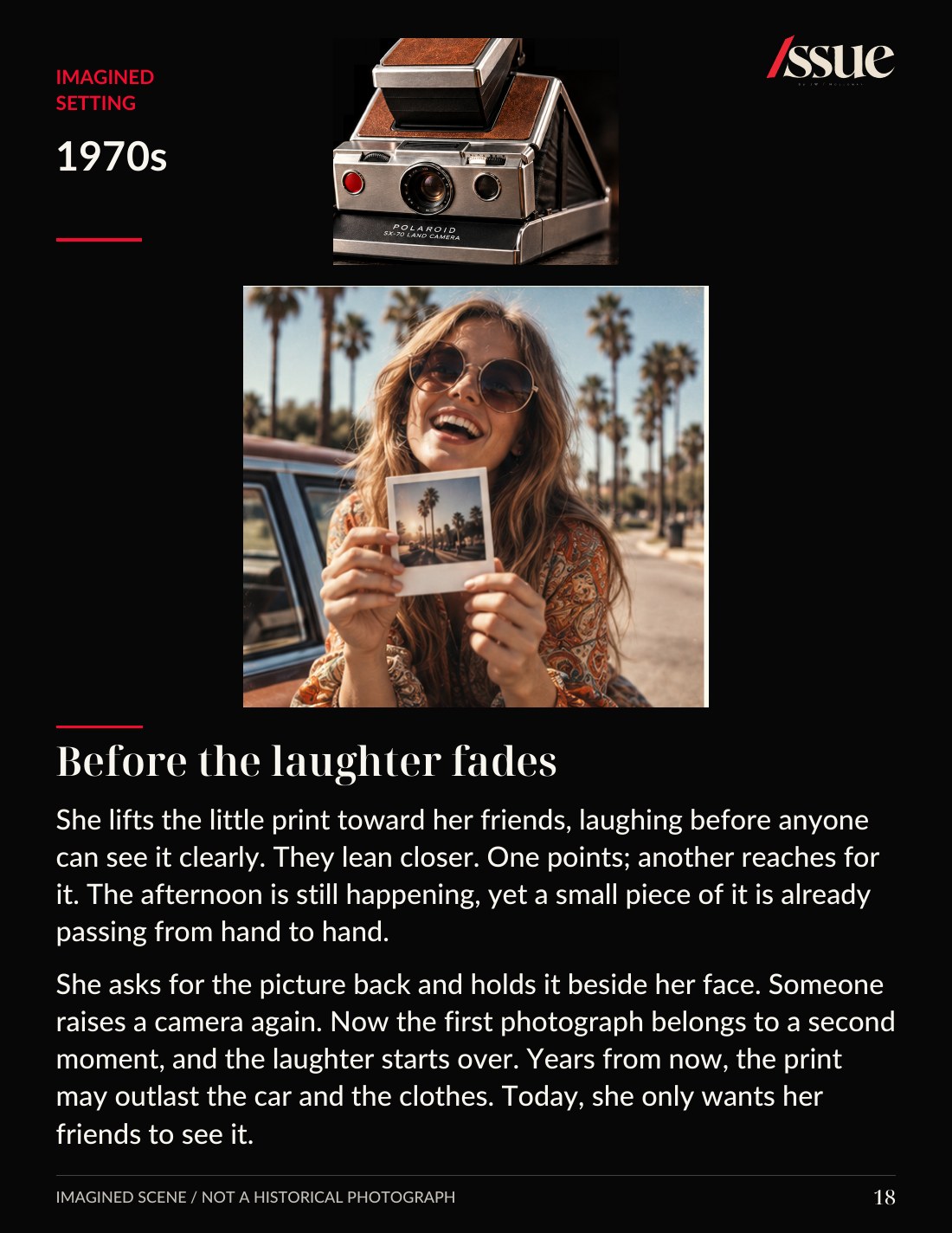
Before the laughter fades
She lifts the little print toward her friends, laughing before anyone can see it clearly. They lean closer. One points; another reaches for it. The afternoon is still happening, yet a small piece of it is already passing from hand to hand.
She asks for the picture back and holds it beside her face. Someone raises a camera again. Now the first photograph belongs to a second moment, and the laughter starts over. Years from now, the print may outlast the car and the clothes. Today, she only wants her friends to see it.
Page 19
Read page text
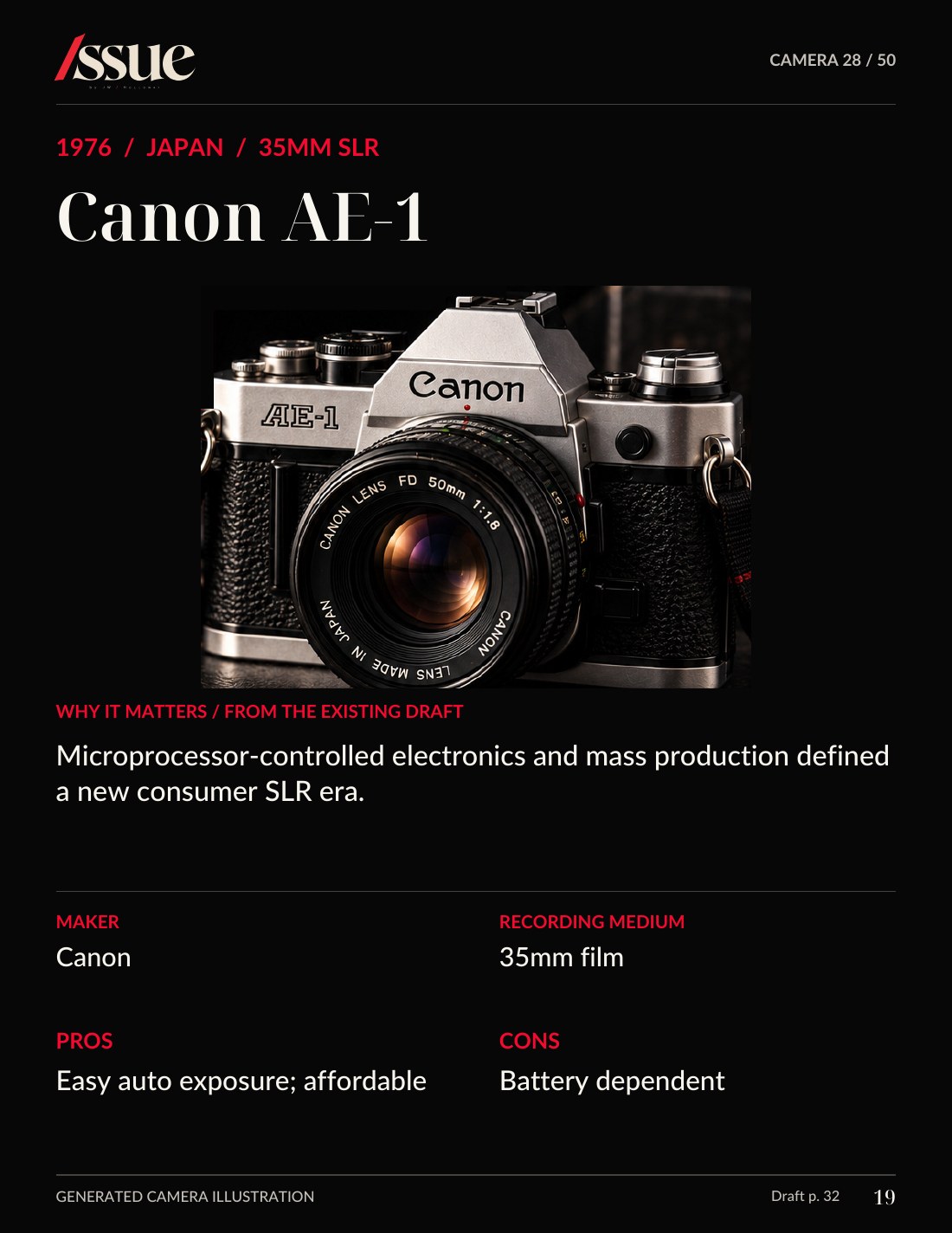
1976 / JAPAN / 35MM SLR Canon AE-1
WHY IT MATTERS / FROM THE EXISTING DRAFT
Microprocessor-controlled electronics and mass production defined a new consumer SLR era.
MAKER RECORDING MEDIUM Canon 35mm film
PROS CONS
Easy auto exposure; affordable Battery dependent
Page 20
Read page text
IMAGINED SETTING Late 1970s
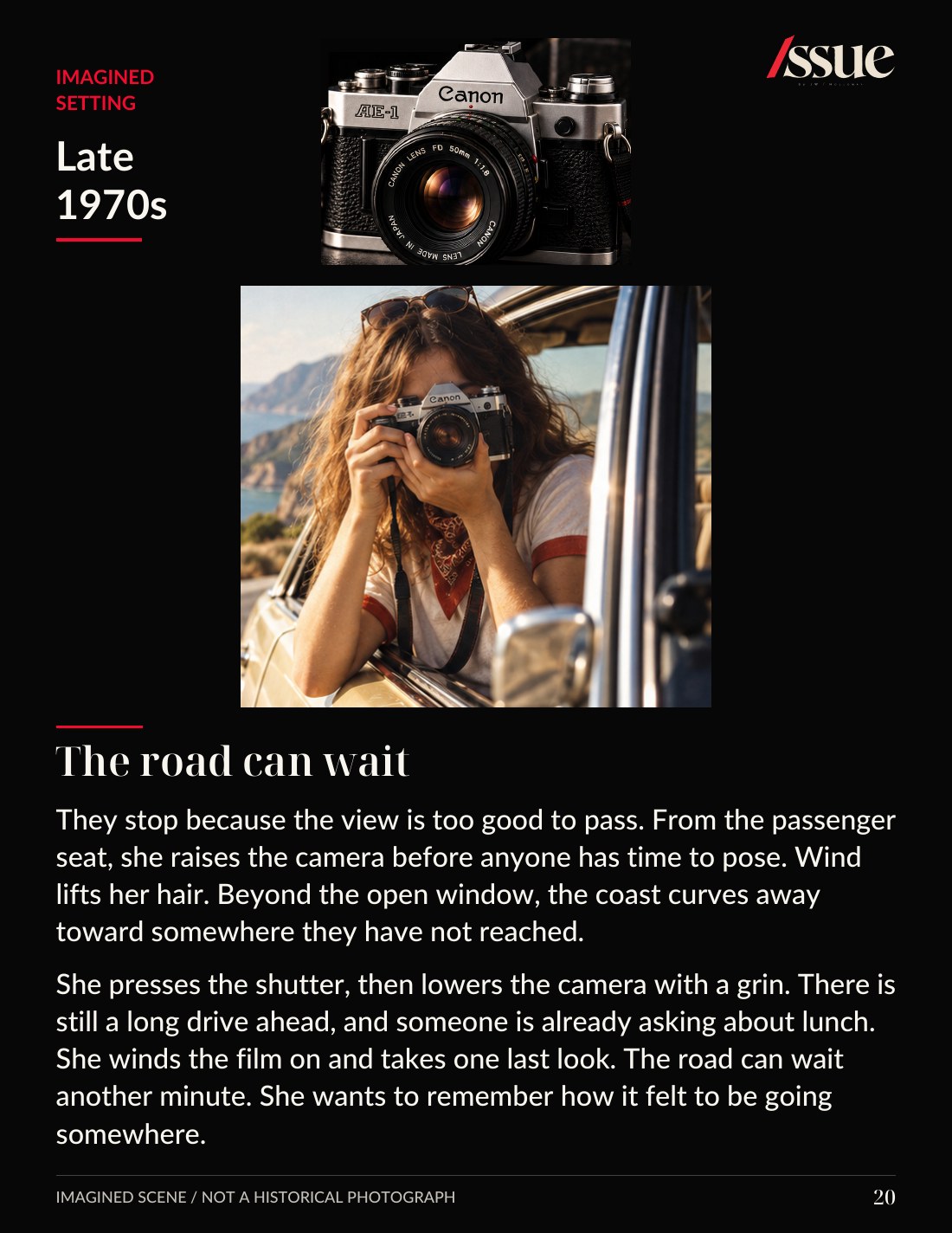
The road can wait
They stop because the view is too good to pass. From the passenger seat, she raises the camera before anyone has time to pose. Wind lifts her hair. Beyond the open window, the coast curves away toward somewhere they have not reached.
She presses the shutter, then lowers the camera with a grin. There is still a long drive ahead, and someone is already asking about lunch. She winds the film on and takes one last look. The road can wait another minute. She wants to remember how it felt to be going somewhere.
Page 21
Read page text
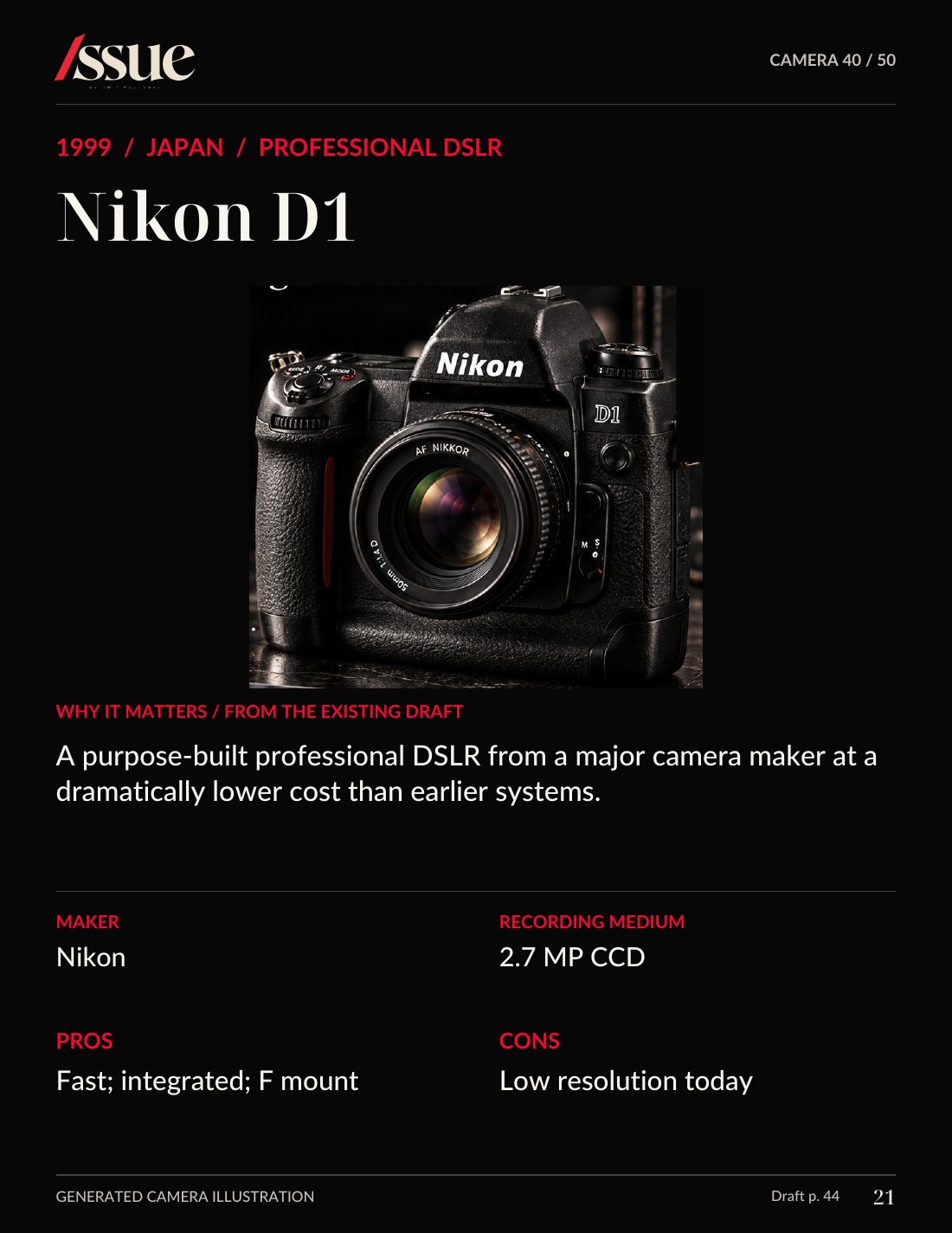
1999 / JAPAN / PROFESSIONAL DSLR Nikon D1
WHY IT MATTERS / FROM THE EXISTING DRAFT
A purpose-built professional DSLR from a major camera maker at a dramatically lower cost than earlier systems.
MAKER RECORDING MEDIUM Nikon 2.7 MP CCD
PROS CONS
Fast; integrated; F mount Low resolution today
Page 22
Read page text
IMAGINED SETTING c. 2000
One stride from forever
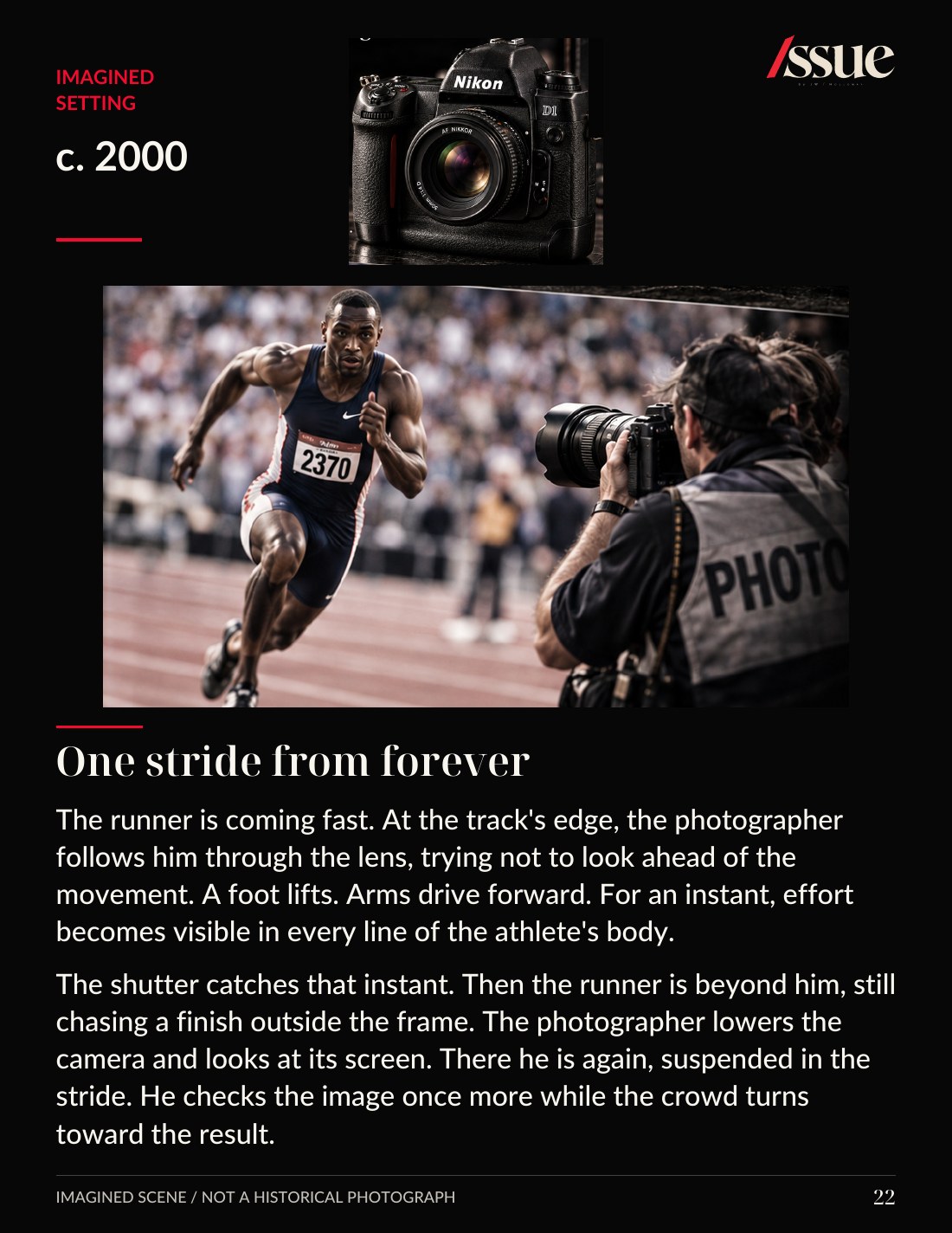
The runner is coming fast. At the track's edge, the photographer follows him through the lens, trying not to look ahead of the movement. A foot lifts. Arms drive forward. For an instant, effort becomes visible in every line of the athlete's body.
The shutter catches that instant. Then the runner is beyond him, still chasing a finish outside the frame. The photographer lowers the camera and looks at its screen. There he is again, suspended in the stride. He checks the image once more while the crowd turns toward the result.
Page 23
Read page text
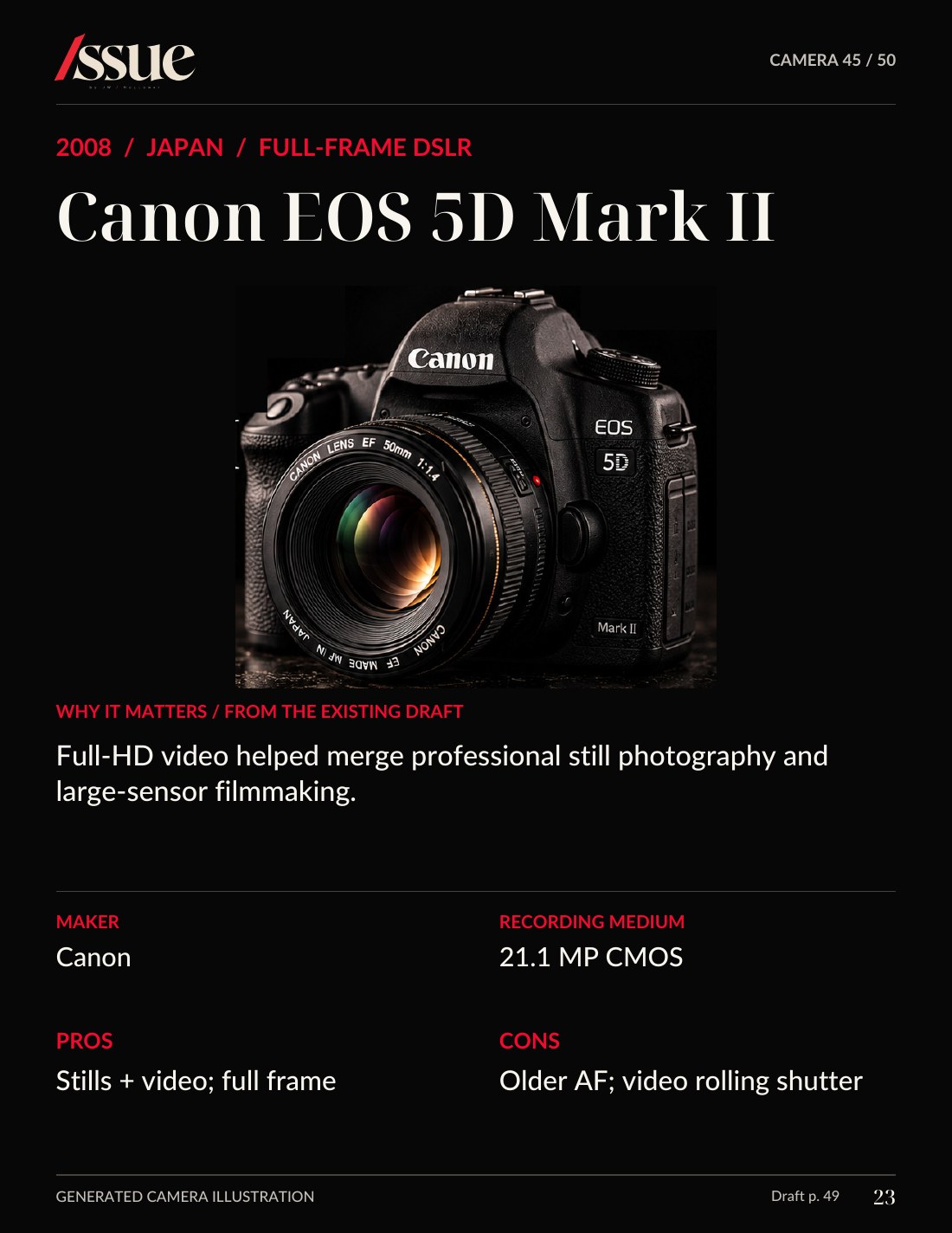
2008 / JAPAN / FULL-FRAME DSLR Canon EOS 5D Mark II
WHY IT MATTERS / FROM THE EXISTING DRAFT
Full-HD video helped merge professional still photography and large-sensor filmmaking.
MAKER RECORDING MEDIUM Canon 21.1 MP CMOS
PROS CONS
Stills + video; full frame Older AF; video rolling shutter
Page 24
Read page text
IMAGINED SETTING c. 2009
When the city moves
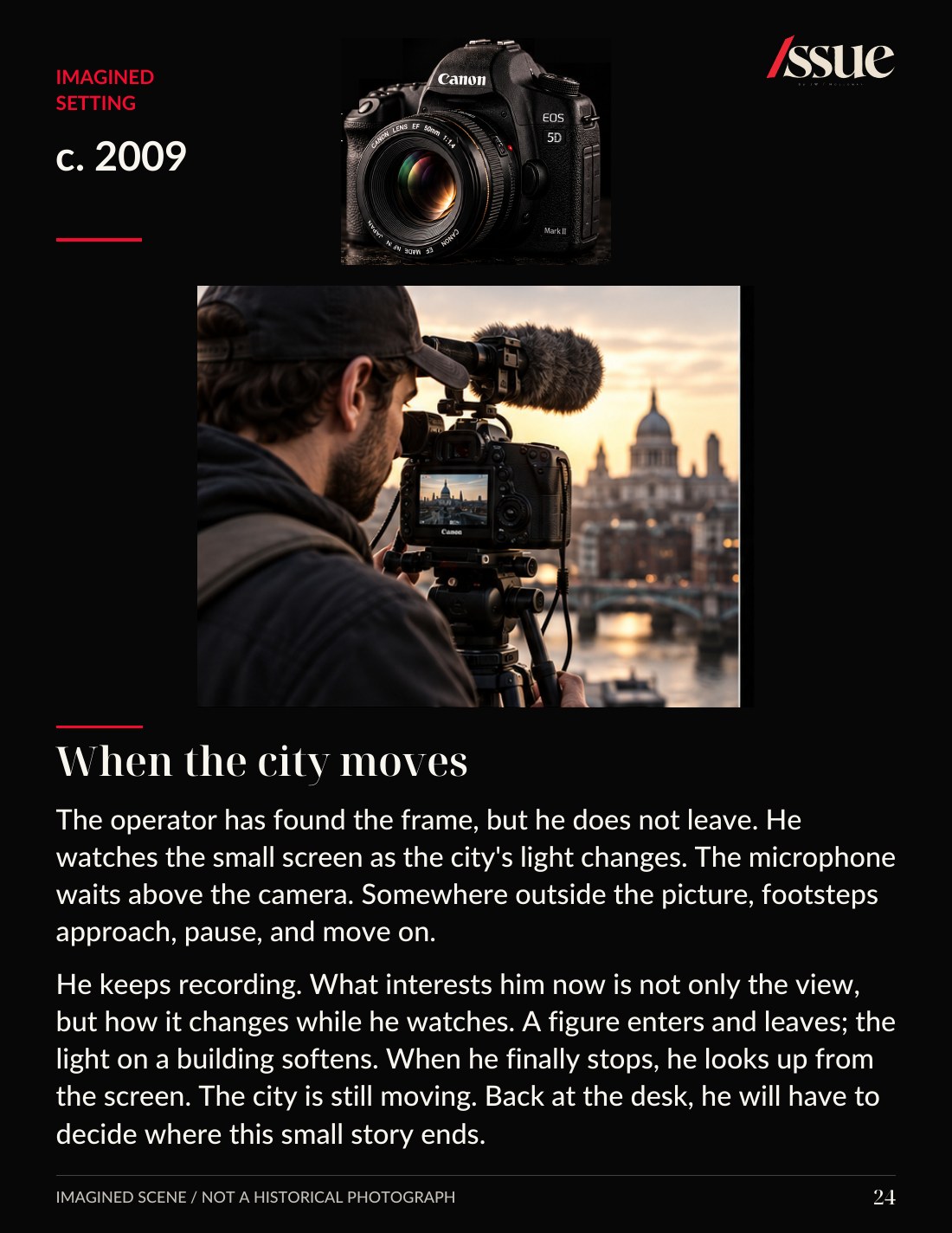
The operator has found the frame, but he does not leave. He watches the small screen as the city's light changes. The microphone waits above the camera. Somewhere outside the picture, footsteps approach, pause, and move on.
He keeps recording. What interests him now is not only the view, but how it changes while he watches. A figure enters and leaves; the light on a building softens. When he finally stops, he looks up from the screen. The city is still moving. Back at the desk, he will have to decide where this small story ends.
Page 25
Read page text
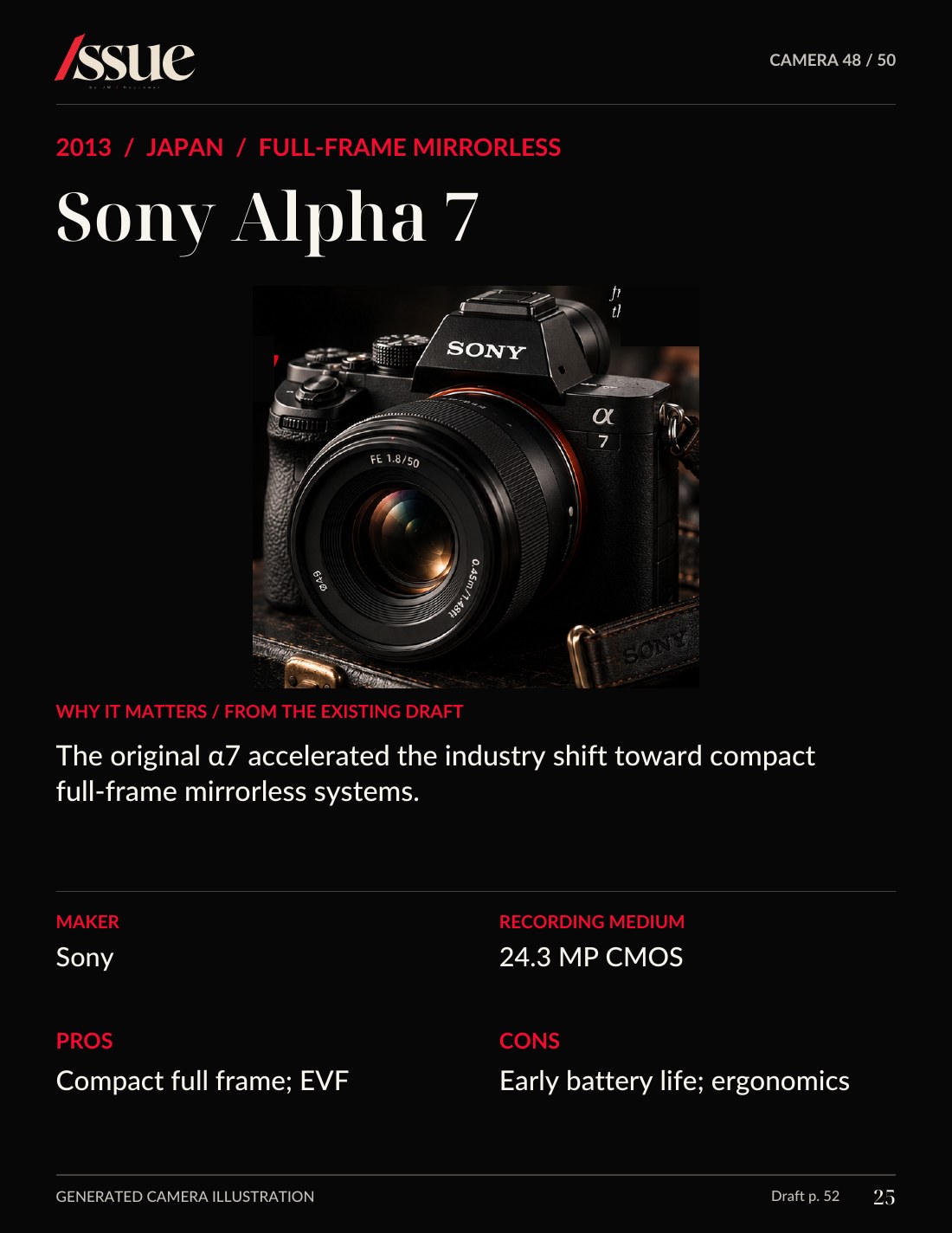
2013 / JAPAN / FULL-FRAME MIRRORLESS Sony Alpha 7
WHY IT MATTERS / FROM THE EXISTING DRAFT
The original α7 accelerated the industry shift toward compact full-frame mirrorless systems.
MAKER RECORDING MEDIUM Sony 24.3 MP CMOS
PROS CONS
Compact full frame; EVF Early battery life; ergonomics
Page 26
Read page text
IMAGINED SETTING c. 2014
Before the light is gone
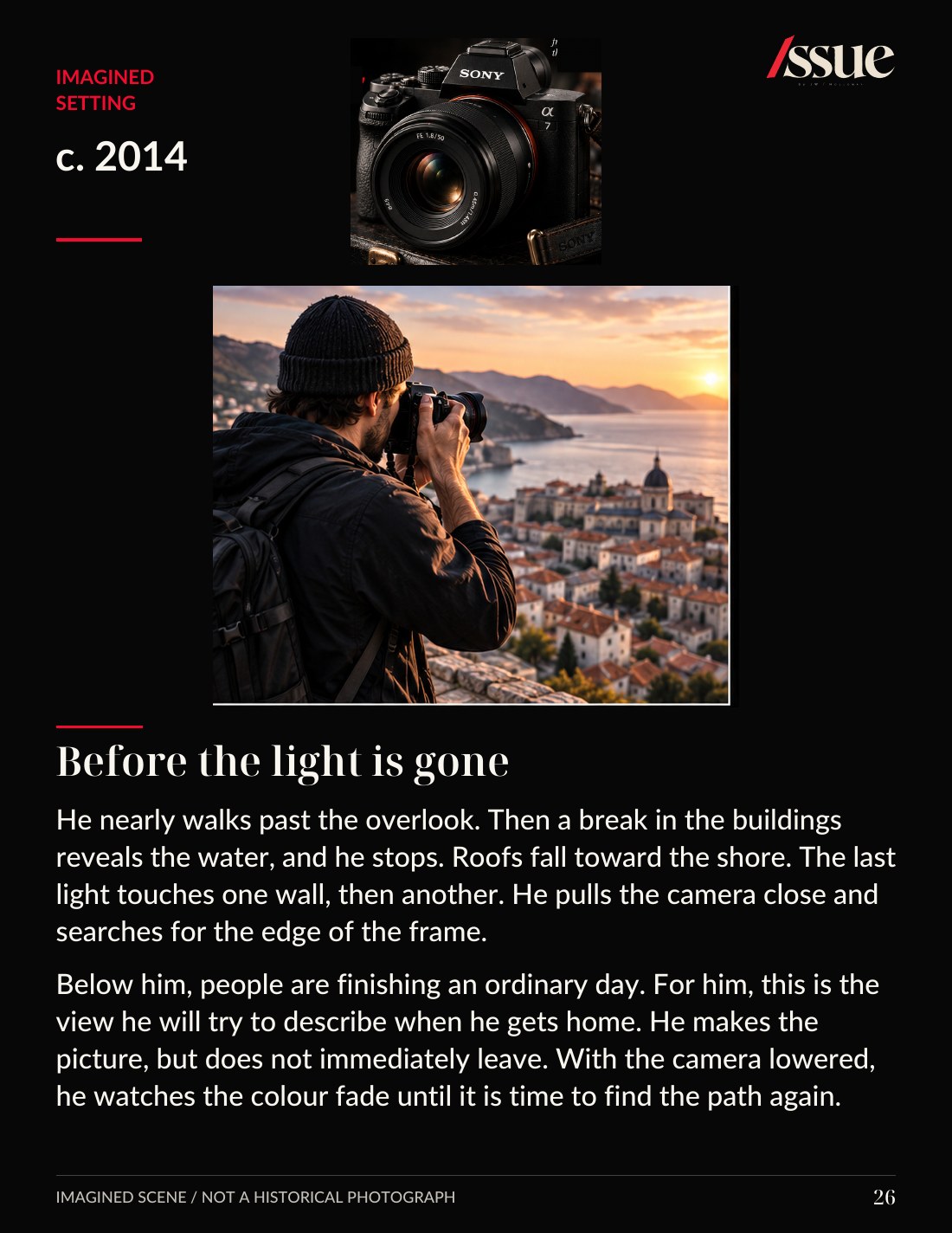
He nearly walks past the overlook. Then a break in the buildings reveals the water, and he stops. Roofs fall toward the shore. The last light touches one wall, then another. He pulls the camera close and searches for the edge of the frame.
Below him, people are finishing an ordinary day. For him, this is the view he will try to describe when he gets home. He makes the picture, but does not immediately leave. With the camera lowered, he watches the colour fade until it is time to find the path again.
Page 27
Read page text
Kodak No. 1
Eastman Kodak
USA Box camera MEDIUM / SENSOR
Roll film
WHY IT MATTERS
The simple Kodak system helped move photography from specialists toward everyday consumers.
PROS CONS
Simple; portable; mass-market concept
Fixed focus; limited control
Page 28
Read page text
Graflex Speed Graphic
Graflex
USA Press camera MEDIUM / SENSOR
Sheet film
WHY IT MATTERS
A defining press camera valued for ruggedness, large negatives and flexibility.
PROS CONS
Large negative; versatile; durable
Bulky; slow handling
Page 29
Read page text
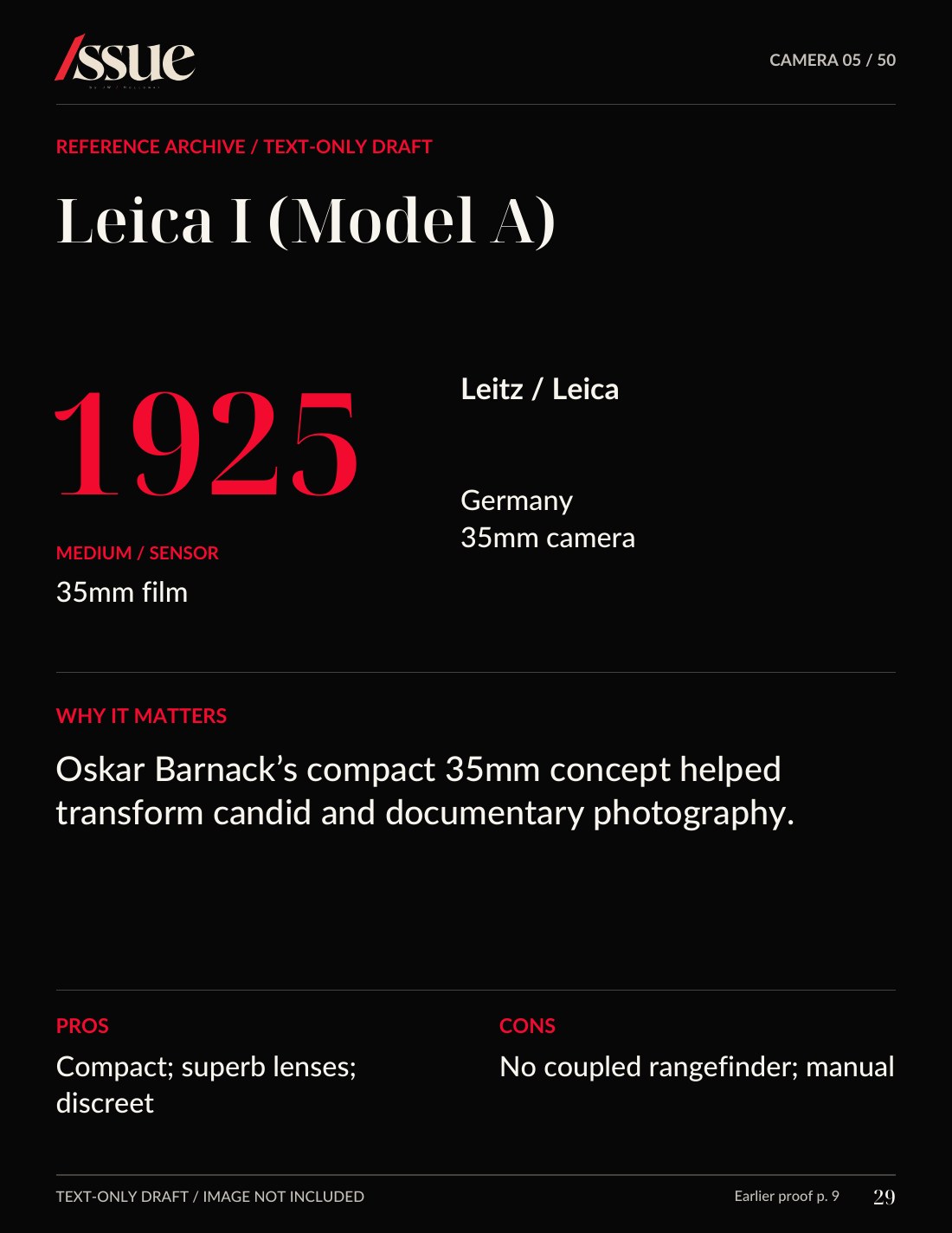
Leica I (Model A)
Leitz / Leica
Germany 35mm camera MEDIUM / SENSOR
35mm film
WHY IT MATTERS
Oskar Barnack’s compact 35mm concept helped transform candid and documentary photography.
PROS CONS
Compact; superb lenses; discreet
No coupled rangefinder; manual
Page 30
Read page text
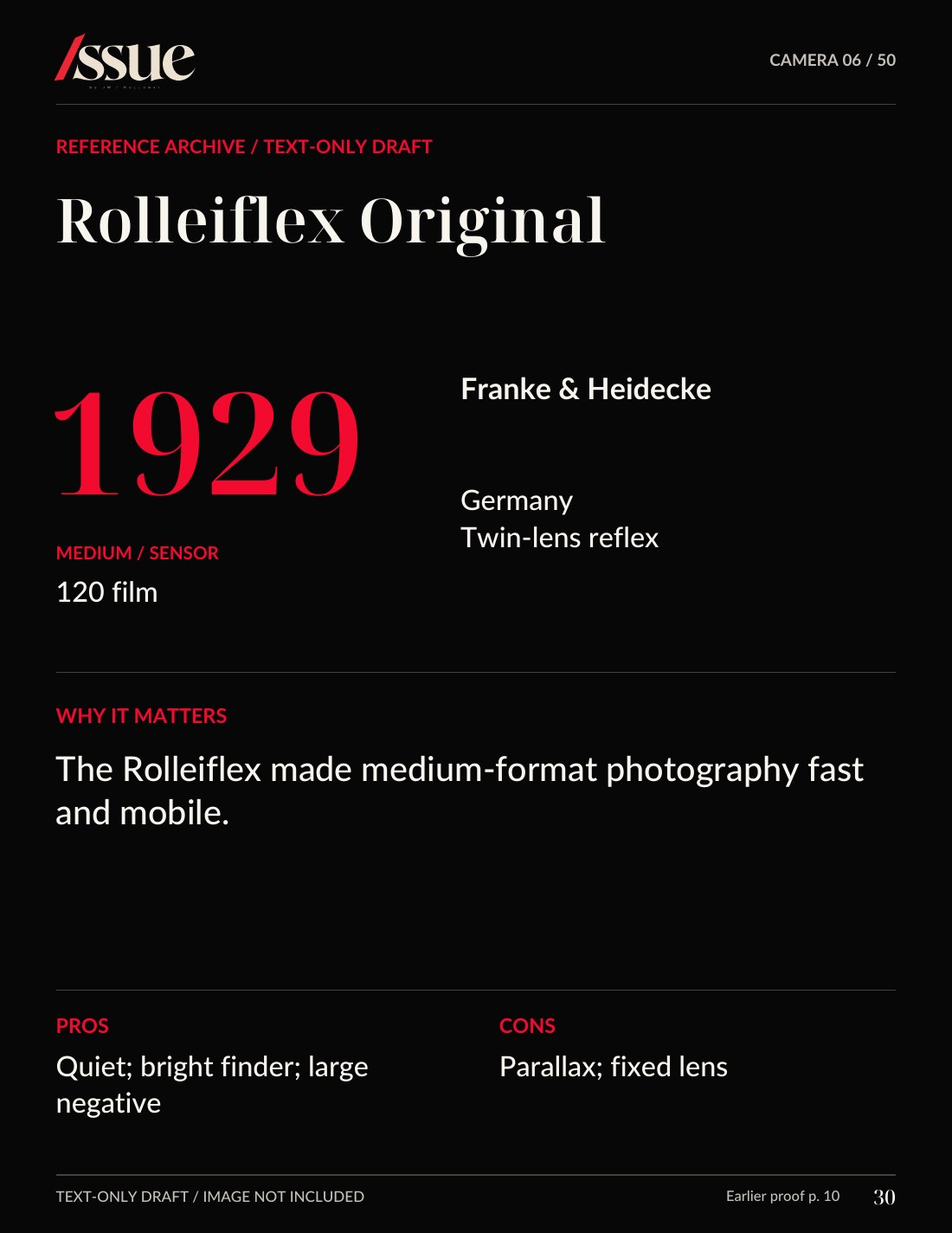
Rolleiflex Original
Franke & Heidecke
Germany Twin-lens reflex MEDIUM / SENSOR
120 film
WHY IT MATTERS
The Rolleiflex made medium-format photography fast and mobile.
PROS CONS
Quiet; bright finder; large negative
Parallax; fixed lens
Page 31
Read page text
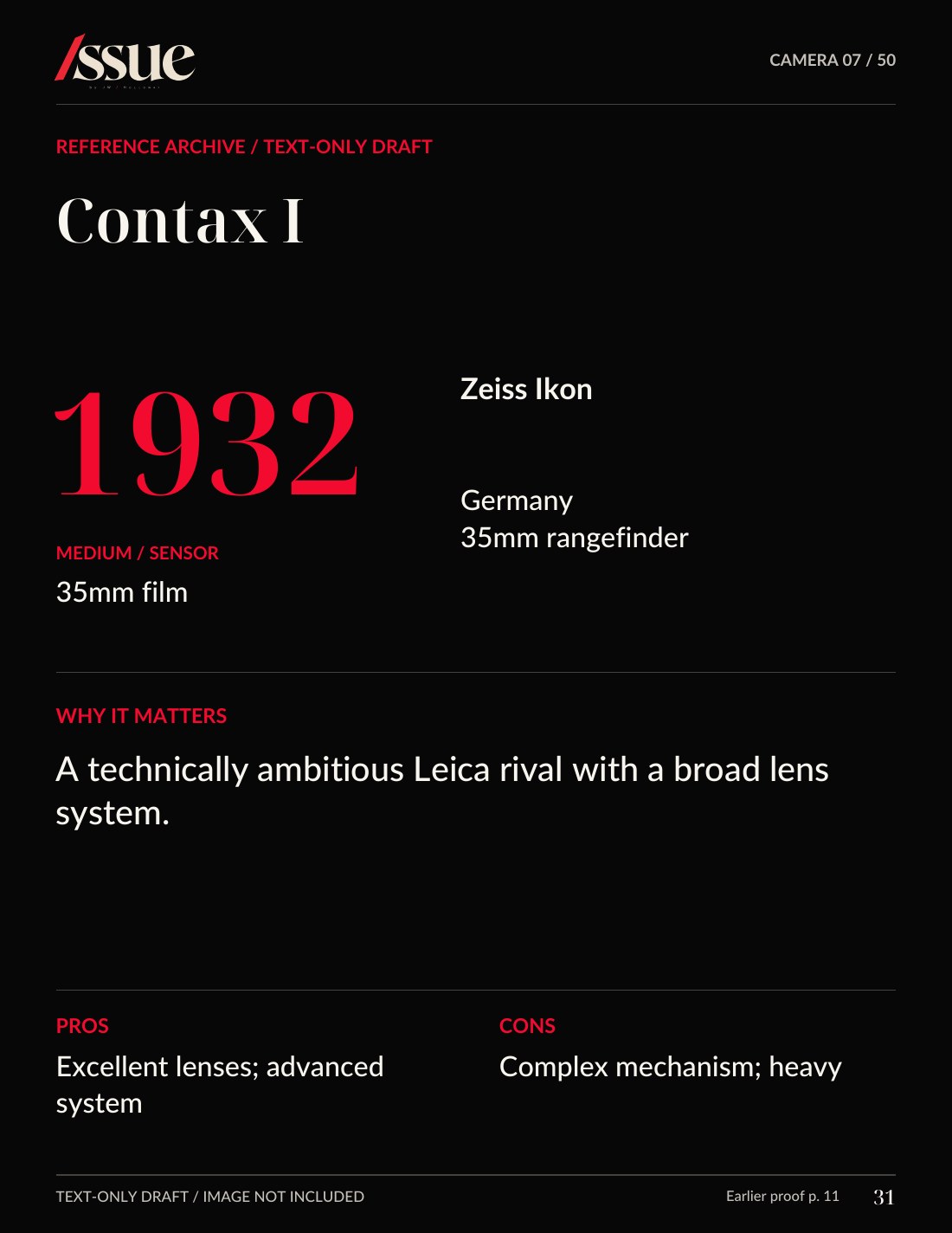
Contax I
Zeiss Ikon
Germany 35mm rangefinder MEDIUM / SENSOR
35mm film
WHY IT MATTERS
A technically ambitious Leica rival with a broad lens system.
PROS CONS
Excellent lenses; advanced system
Complex mechanism; heavy
Page 32
Read page text
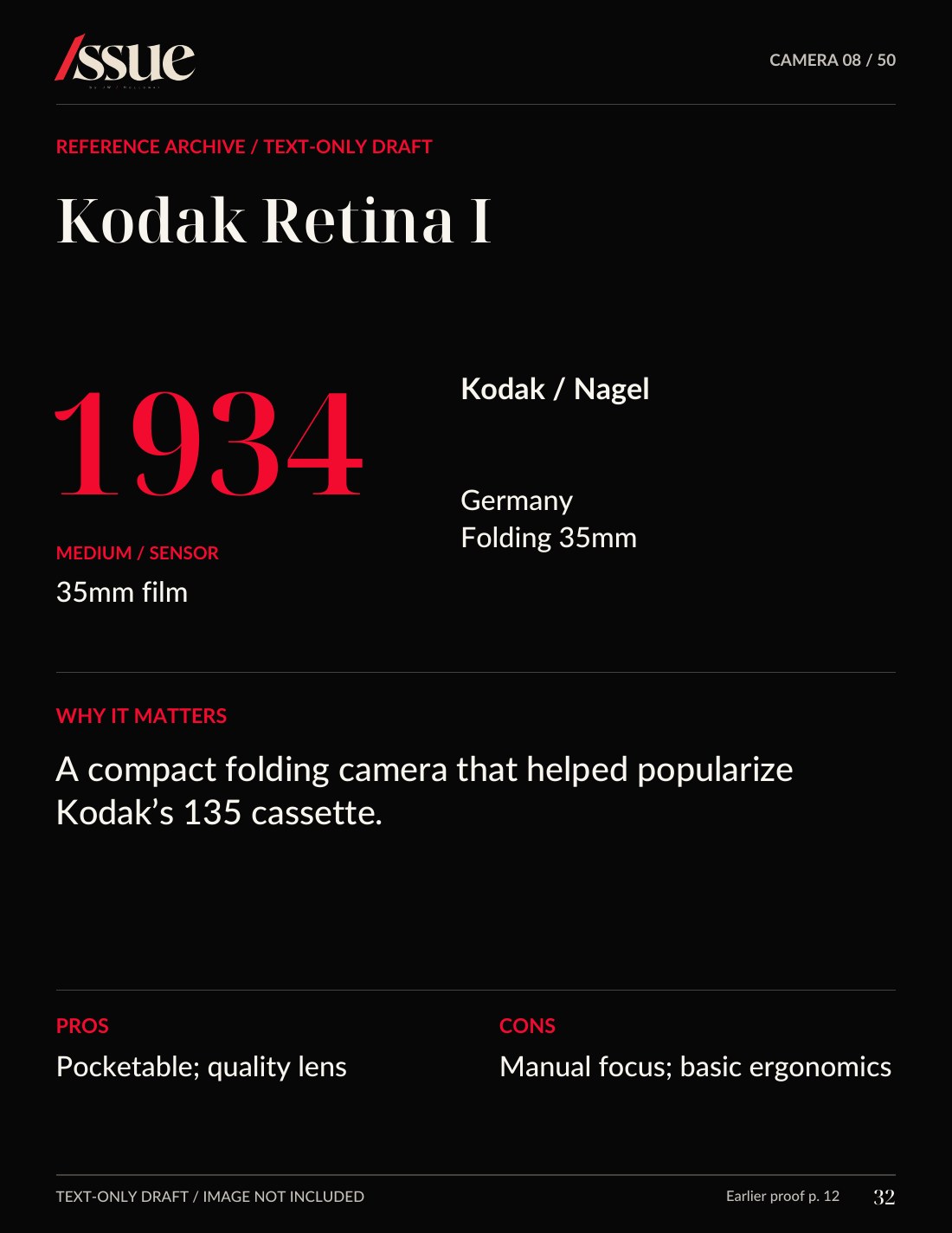
Kodak Retina I
Kodak / Nagel
Germany Folding 35mm MEDIUM / SENSOR
35mm film
WHY IT MATTERS
A compact folding camera that helped popularize Kodak’s 135 cassette.
PROS CONS
Pocketable; quality lens Manual focus; basic ergonomics
Page 33
Read page text
Kine Exakta
Ihagee
Germany 35mm SLR MEDIUM / SENSOR
35mm film
WHY IT MATTERS
One of the earliest successful 35mm SLRs, pointing toward the postwar SLR era.
PROS CONS
Through-lens viewing; interchangeable lenses
Complex controls
Page 34
Read page text
Polaroid Land Model 95
Polaroid
USA Instant camera MEDIUM / SENSOR
Instant roll film
WHY IT MATTERS
Edwin Land’s system collapsed the delay between exposure and finished photograph.
PROS CONS
Near-immediate print; novel Bulky; consumable-dependent
Page 35
Read page text
Hasselblad 1600F
Hasselblad
Sweden Medium-format SLR MEDIUM / SENSOR
120 film
WHY IT MATTERS
Hasselblad’s first civilian system established the modular philosophy of the brand.
PROS CONS
Modular; large negative Early reliability issues; costly
Page 36
Read page text
Nikon I
Nikon
Japan 35mm rangefinder MEDIUM / SENSOR
35mm film
WHY IT MATTERS
Nikon’s first camera established its postwar camera business and optical reputation.
PROS CONS
Compact; quality Nikkors Early format quirks
Page 37
Read page text
Hasselblad 500C
Hasselblad
Sweden Medium-format SLR MEDIUM / SENSOR
120 film
WHY IT MATTERS
The 500C perfected Hasselblad’s modular V system and became a studio and spaceflight icon.
PROS CONS
Modular; leaf shutters; Zeiss lenses
Slow; expensive
Page 38
Read page text
Nikon SP
Nikon
Japan 35mm rangefinder MEDIUM / SENSOR
35mm film
WHY IT MATTERS
Nikon’s sophisticated classic rangefinder represented the peak of its pre-SLR system.
PROS CONS
Advanced finder; rugged; lenses
Complex; eclipsed by SLR
Page 39
Read page text
Canon 7
Canon
Japan 35mm rangefinder MEDIUM / SENSOR
35mm film
WHY IT MATTERS
A late high point of Canon’s rangefinder era with built-in metering.
PROS CONS
Meter; lenses; value Large; SLR era arriving
Page 40
Read page text
Olympus Pen F
Olympus
Japan Half-frame SLR MEDIUM / SENSOR
35mm half-frame
WHY IT MATTERS
A remarkably compact system SLR with a distinctive rotary shutter.
PROS CONS
72 frames; compact Smaller negative
Page 41
Read page text
Pentax Spotmatic
Asahi Pentax
Japan 35mm SLR MEDIUM / SENSOR
35mm film
WHY IT MATTERS
TTL metering helped make accurate exposure measurement accessible to generations.
PROS CONS
TTL meter; compact; M42 lenses
Stop-down metering
Page 42
Read page text
Hasselblad 500EL
Hasselblad
Sweden Motorized medium-format SLR MEDIUM / SENSOR
120 film
WHY IT MATTERS
The motorized V-system became closely associated with NASA and remote photography.
PROS CONS
Motor drive; modular Heavy; battery dependent
Page 43
Read page text
Mamiya C330
Mamiya
Japan Interchangeable-lens TLR MEDIUM / SENSOR
120/220 film
WHY IT MATTERS
A rare TLR system with interchangeable lens pairs and bellows focusing.
PROS CONS
Lens choice; close focus Large; parallax
Page 44
Read page text
Canon F-1
Canon
Japan Professional 35mm SLR MEDIUM / SENSOR
35mm film
WHY IT MATTERS
Canon’s first full professional SLR system challenged Nikon with deep modularity.
PROS CONS
Rugged; modular; FD lenses Heavy; complex
Page 45
Read page text
Nikon F2
Nikon
Japan Professional 35mm SLR MEDIUM / SENSOR
35mm film
WHY IT MATTERS
The mechanical successor to the Nikon F refined durability and professional handling.
PROS CONS
Mechanical; modular; durable Heavy
Page 46
Read page text
Olympus OM-1
Olympus
Japan 35mm SLR MEDIUM / SENSOR
35mm film
WHY IT MATTERS
The OM-1 reset expectations for SLR size and weight.
PROS CONS
Small; quiet; Zuiko lenses Legacy battery issues
Page 47
Read page text
Pentax K1000
Pentax
Japan 35mm SLR MEDIUM / SENSOR
35mm film
WHY IT MATTERS
A simple mechanical SLR that became a photography-class staple.
PROS CONS
Simple; durable; K mount Basic; manual only
Page 48
Read page text
Minolta XD
Minolta
Japan 35mm SLR MEDIUM / SENSOR
35mm film
WHY IT MATTERS
An elegant electronic SLR combining aperture- and shutter-priority automation.
PROS CONS
Dual auto modes; compact Electronics age
Page 49
Read page text
Canon A-1
Canon
Japan 35mm SLR MEDIUM / SENSOR
35mm film
WHY IT MATTERS
A highly automated enthusiast SLR with multiple exposure modes in one body.
PROS CONS
Versatile; capable Dense controls; battery dependent
Page 50
Read page text
Nikon F3
Nikon
Japan Professional 35mm SLR MEDIUM / SENSOR
35mm film
WHY IT MATTERS
Nikon brought aperture-priority automation and Giugiaro styling to the professional F line.
PROS CONS
Reliable; modular; finder options
1/80 flash sync; electronic
Page 51
Read page text
Mamiya RZ67
Mamiya
Japan Medium-format SLR MEDIUM / SENSOR
120/220 film
WHY IT MATTERS
A studio workhorse built around a rotating back, bellows focus and large 6×7 negatives.
PROS CONS
Huge image area; rotating back Very heavy; slow
Page 52
Read page text
Leica M6
Leica
Germany 35mm rangefinder MEDIUM / SENSOR
35mm film
WHY IT MATTERS
The M6 preserved the mechanical M experience while adding TTL metering.
PROS CONS
Mechanical shutter; TTL meter Manual; expensive
Page 53
Read page text
Minolta Maxxum 7000
Minolta
Japan Autofocus 35mm SLR MEDIUM / SENSOR
35mm film
WHY IT MATTERS
Body-integrated autofocus helped reset expectations for camera automation.
PROS CONS
Integrated AF; accessible Early AF; electronic dependence
Page 54
Read page text
Canon EOS 650
Canon
Japan Autofocus 35mm SLR MEDIUM / SENSOR
35mm film
WHY IT MATTERS
The first EOS introduced the all-electronic EF mount architecture.
PROS CONS
AF; electronic mount; ergonomics
No FD compatibility
Page 55
Read page text
Nikon F4
Nikon
Japan Professional AF 35mm SLR MEDIUM / SENSOR
35mm film
WHY IT MATTERS
A bridge between Nikon’s manual-focus heritage and professional autofocus automation.
PROS CONS
AF; matrix meter; rugged Large; heavy
Page 56
Read page text
Kodak DCS 100
Kodak
USA Professional DSLR system MEDIUM / SENSOR
1.3 MP CCD
WHY IT MATTERS
Built around a Nikon F3, the DCS 100 was a landmark commercial DSLR system.
PROS CONS
Immediate digital workflow Very expensive; external unit
Page 57
Read page text
Apple QuickTake 100
Apple / Kodak
USA Consumer digital MEDIUM / SENSOR
CCD
WHY IT MATTERS
An early computer-oriented digital camera that introduced many consumers to filmless capture.
PROS CONS
Simple workflow; historic Very low resolution; no display
Page 58
Read page text
Casio QV-10
Casio
Japan Consumer digital MEDIUM / SENSOR
CCD
WHY IT MATTERS
An early consumer digital camera with a rear LCD, making instant review part of camera behavior.
PROS CONS
Rear LCD; compact Low resolution
Page 59
Read page text
Canon EOS D30
Canon
Japan Digital SLR MEDIUM / SENSOR
3.1 MP CMOS
WHY IT MATTERS
An early Canon-designed DSLR demonstrating the company’s CMOS strategy.
PROS CONS
CMOS; EF system Early digital limits
Page 60
Read page text
Canon EOS 300D / Digital Rebel
Canon
Japan Consumer DSLR MEDIUM / SENSOR
6.3 MP APS-C CMOS
WHY IT MATTERS
The sub-$1,000 DSLR that opened interchangeable-lens digital photography to a much broader audience.
PROS CONS
Affordable; strong ecosystem Basic controls
Page 61
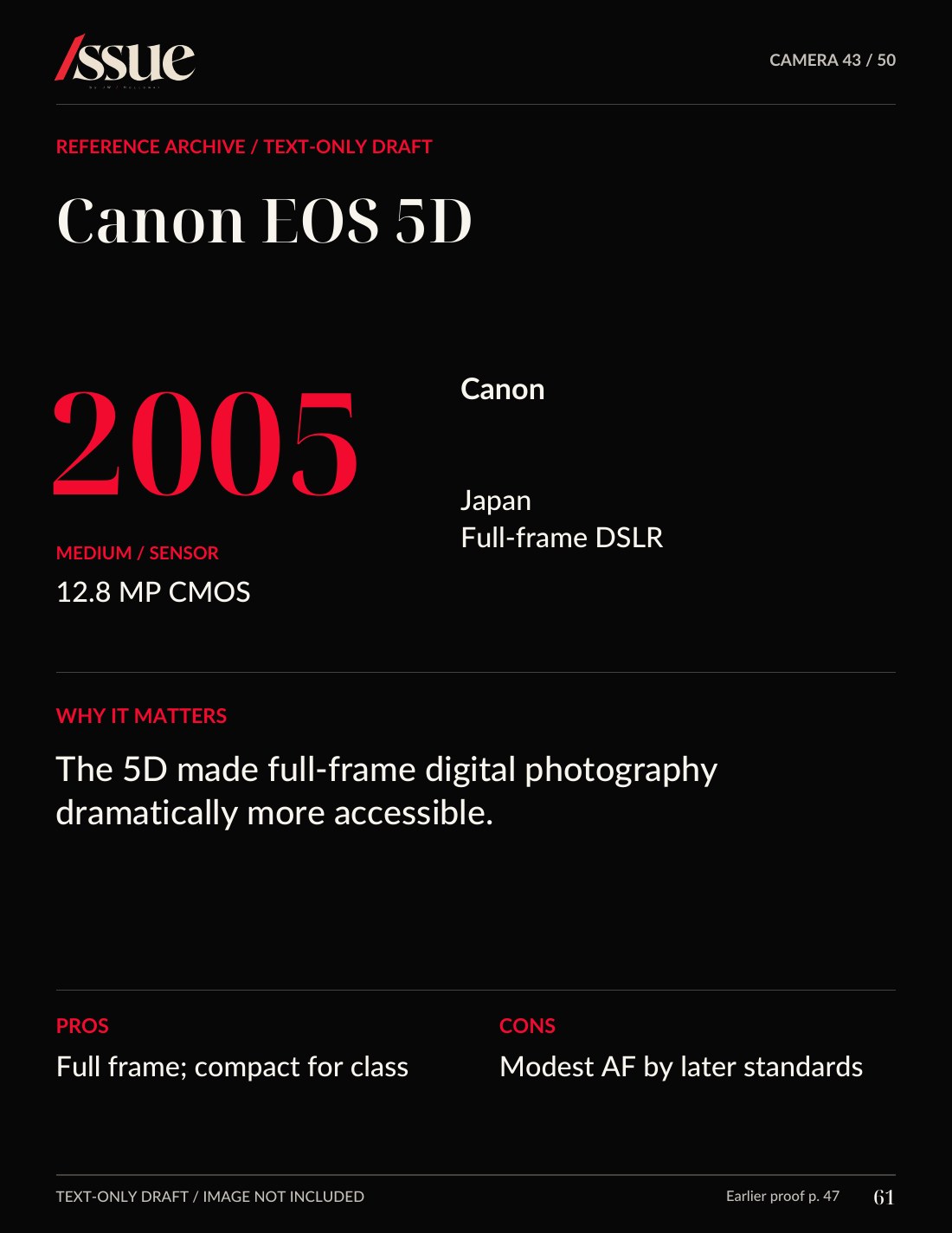
Read page text
Canon EOS 5D
Canon
Japan Full-frame DSLR MEDIUM / SENSOR
12.8 MP CMOS
WHY IT MATTERS
The 5D made full-frame digital photography dramatically more accessible.
PROS CONS
Full frame; compact for class Modest AF by later standards
Page 62
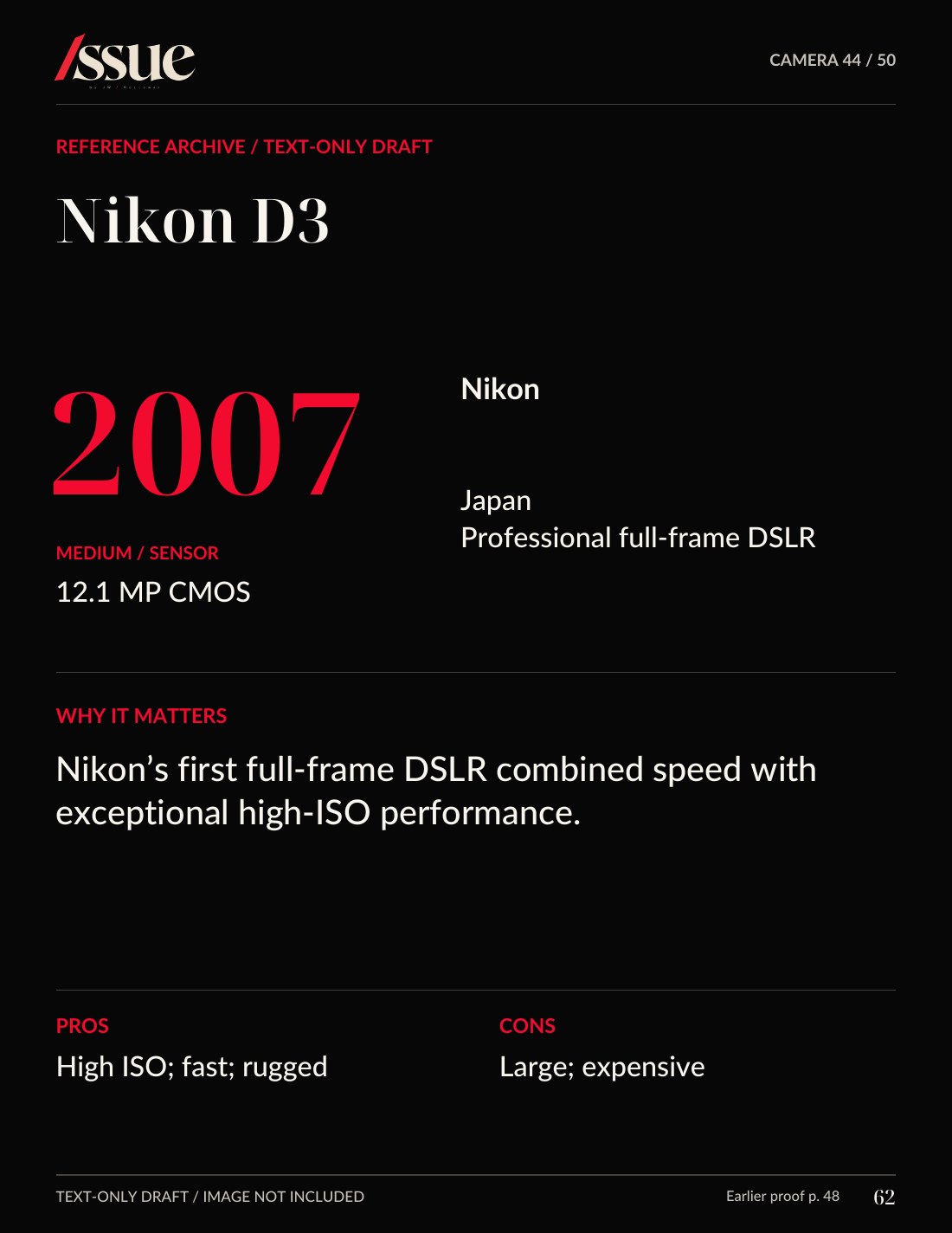
Read page text
Nikon D3
Nikon
Japan Professional full-frame DSLR MEDIUM / SENSOR
12.1 MP CMOS
WHY IT MATTERS
Nikon’s first full-frame DSLR combined speed with exceptional high-ISO performance.
PROS CONS
High ISO; fast; rugged Large; expensive
Page 63
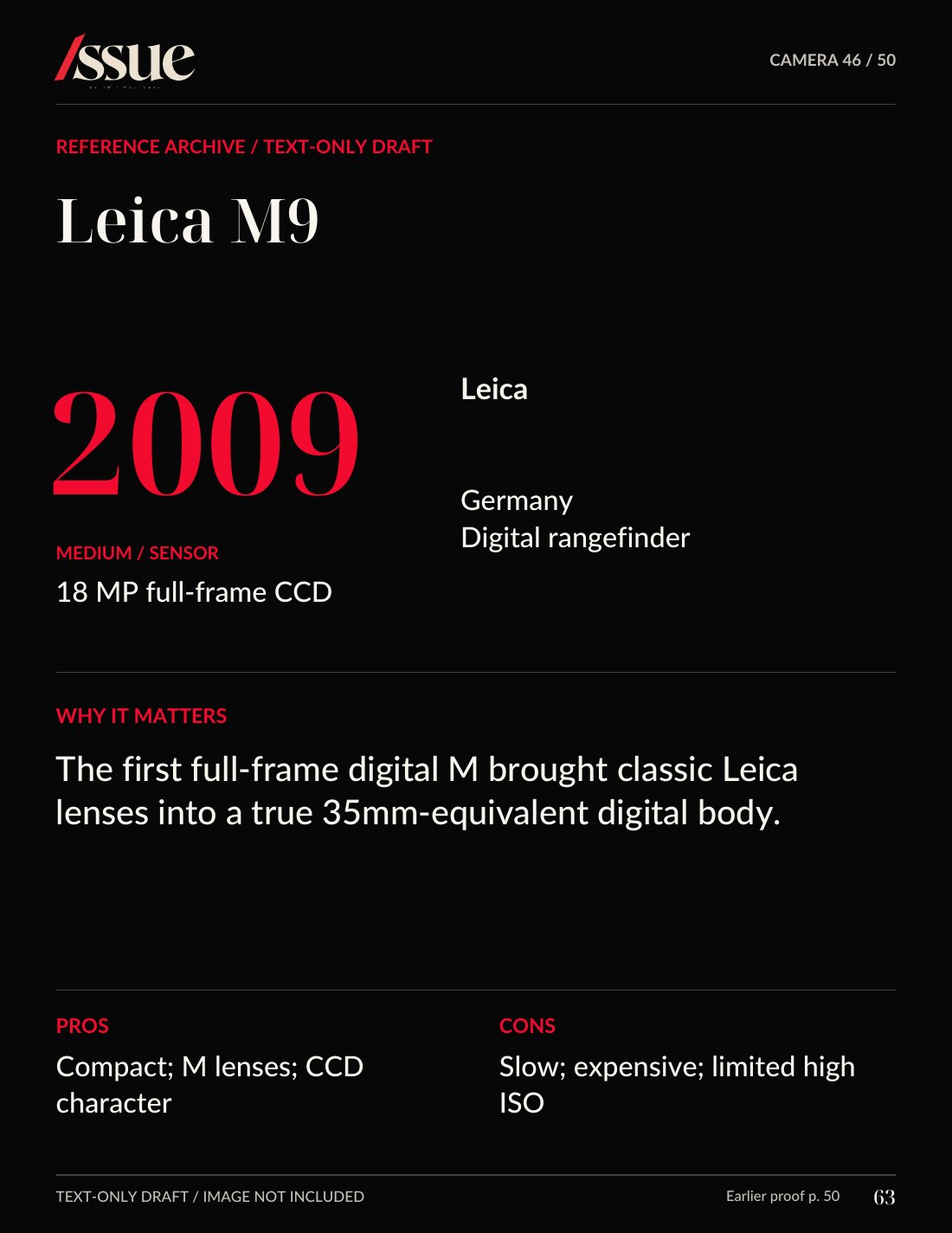
Read page text
Leica M9
Leica
Germany Digital rangefinder MEDIUM / SENSOR
18 MP full-frame CCD
WHY IT MATTERS
The first full-frame digital M brought classic Leica lenses into a true 35mm-equivalent digital body.
PROS CONS
Compact; M lenses; CCD character
Slow; expensive; limited high ISO
Page 64
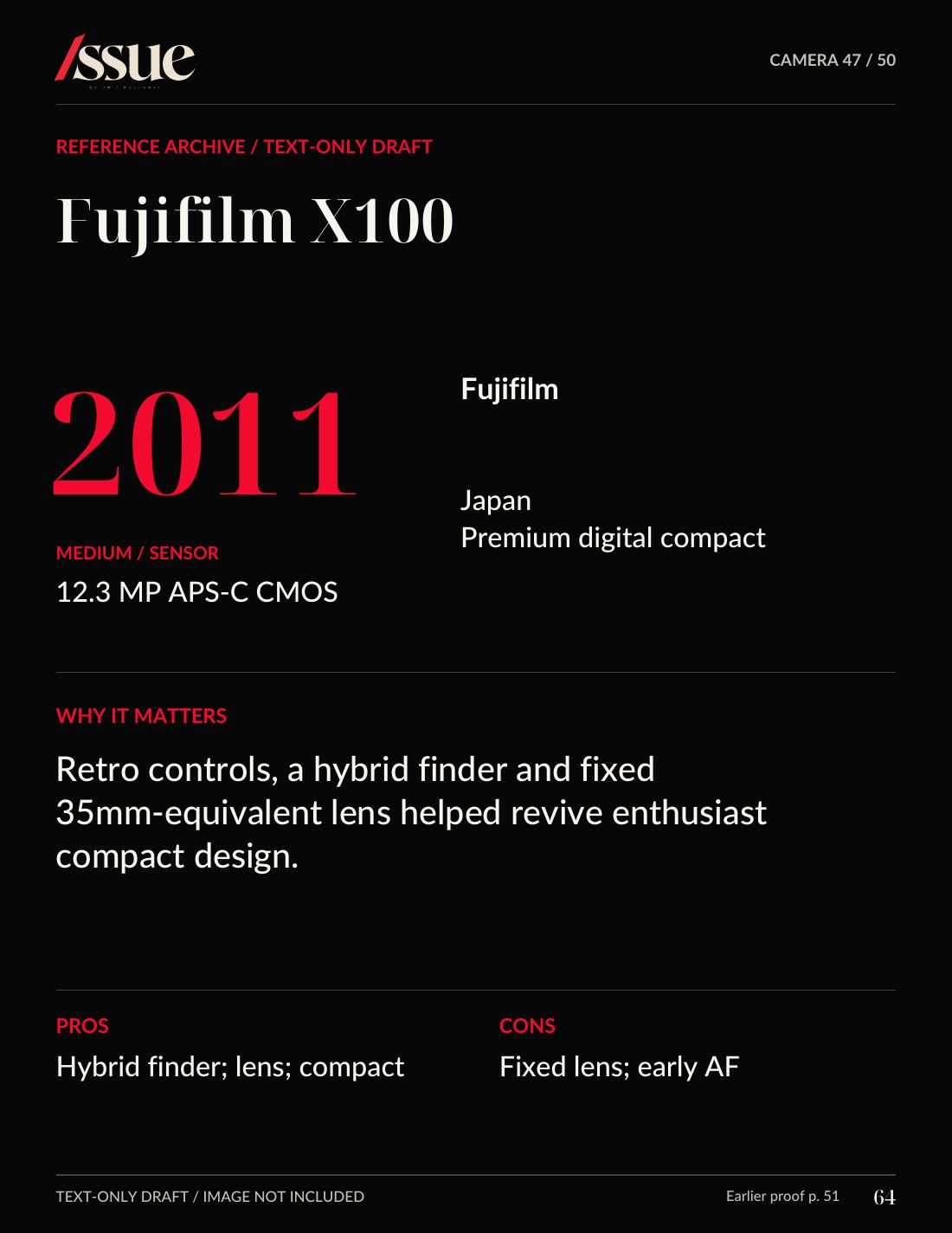
Read page text
Fujifilm X100
Fujifilm
Japan Premium digital compact MEDIUM / SENSOR
12.3 MP APS-C CMOS
WHY IT MATTERS
Retro controls, a hybrid finder and fixed 35mm-equivalent lens helped revive enthusiast compact design.
PROS CONS
Hybrid finder; lens; compact Fixed lens; early AF
Page 65
Read page text
Nikon D850
Nikon
Japan Full-frame DSLR MEDIUM / SENSOR
45.7 MP BSI CMOS
WHY IT MATTERS
A high-water mark for the DSLR, combining resolution, speed and professional handling.
PROS CONS
Resolution; dynamic range; versatile
Large; mirrorless competition
Page 66
Read page text
Canon EOS R5
Canon
Japan Full-frame mirrorless MEDIUM / SENSOR
45 MP CMOS
WHY IT MATTERS
A flagship-generation mirrorless body combining high-resolution stills, advanced autofocus and high-end video.
PROS CONS
AF; resolution; stabilization Heat/workflow demands; expensive
Page 67
Read page text
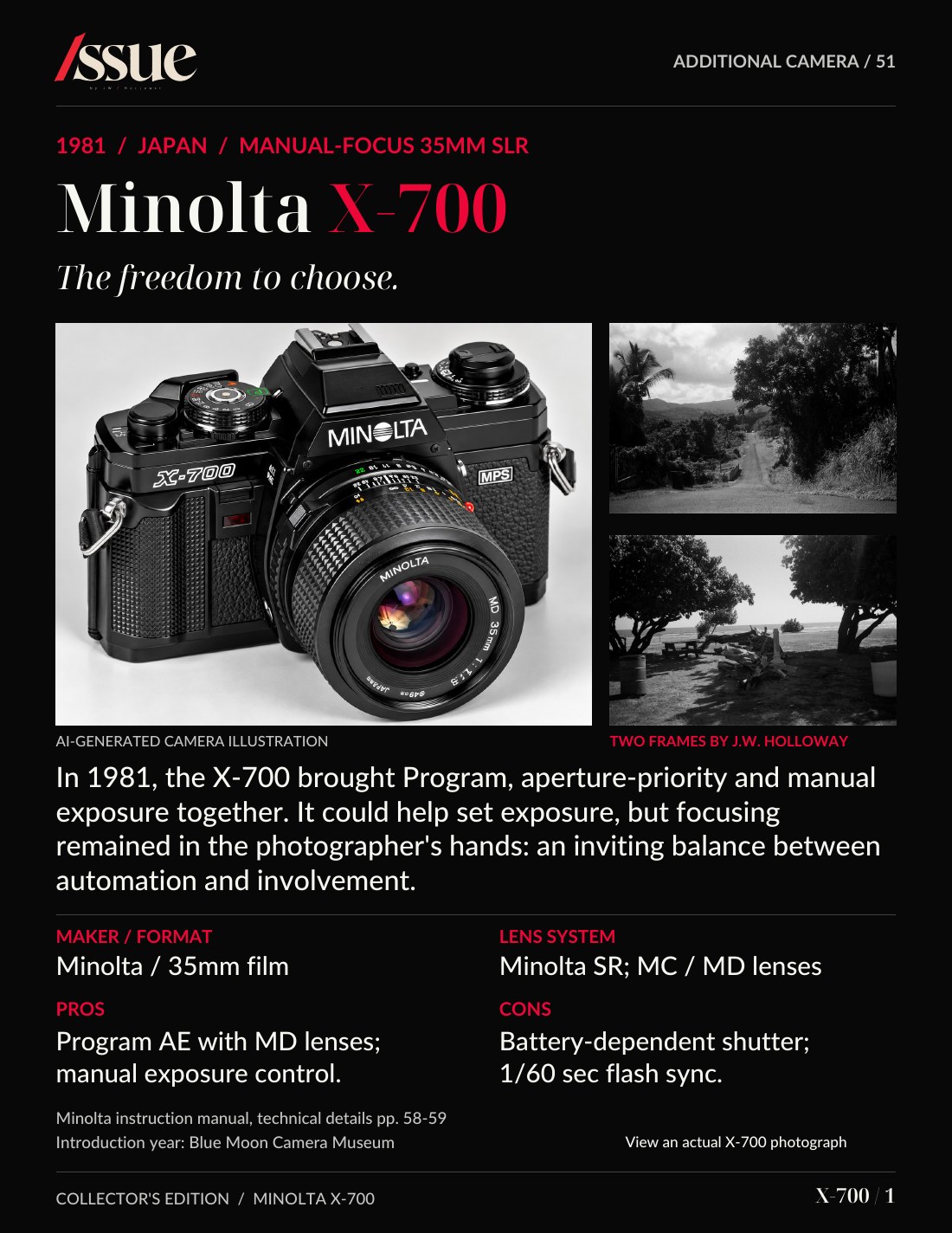
ADDITIONAL CAMERA / 51
1981 / JAPAN / MANUAL-FOCUS 35MM SLR Minolta X-700
The freedom to choose.
Minolta instruction manual, technical details pp. 58-59
Introduction year: Blue Moon Camera Museum View an actual X-700 photograph
AI-GENERATED CAMERA ILLUSTRATION TWO FRAMES BY J.W. HOLLOWAY In 1981, the X-700 brought Program, aperture-priority and manual exposure together. It could help set exposure, but focusing remained in the photographer's hands: an inviting balance between automation and involvement.
MAKER / FORMAT Minolta / 35mm film
LENS SYSTEM Minolta SR; MC / MD lenses
PROS Program AE with MD lenses; manual exposure control.
CONS Battery-dependent shutter; 1/60 sec flash sync.
Page 68
Read page text
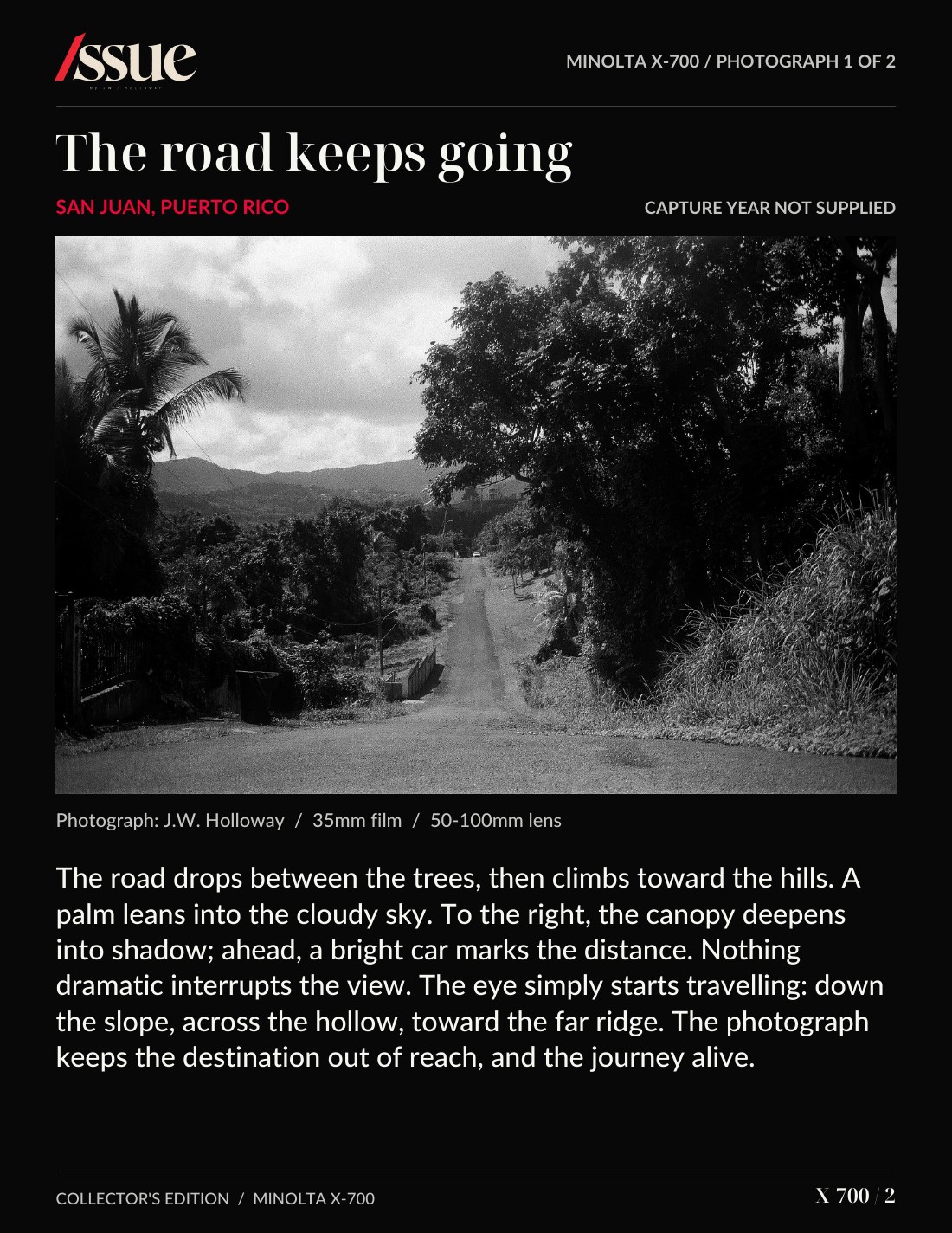
MINOLTA X-700 / PHOTOGRAPH 1 OF 2
The road keeps going
SAN JUAN, PUERTO RICO CAPTURE YEAR NOT SUPPLIED
Photograph: J.W. Holloway / 35mm film / 50-100mm lens
The road drops between the trees, then climbs toward the hills. A palm leans into the cloudy sky. To the right, the canopy deepens into shadow; ahead, a bright car marks the distance. Nothing dramatic interrupts the view. The eye simply starts travelling: down the slope, across the hollow, toward the far ridge. The photograph keeps the destination out of reach, and the journey alive.
Page 69
Read page text
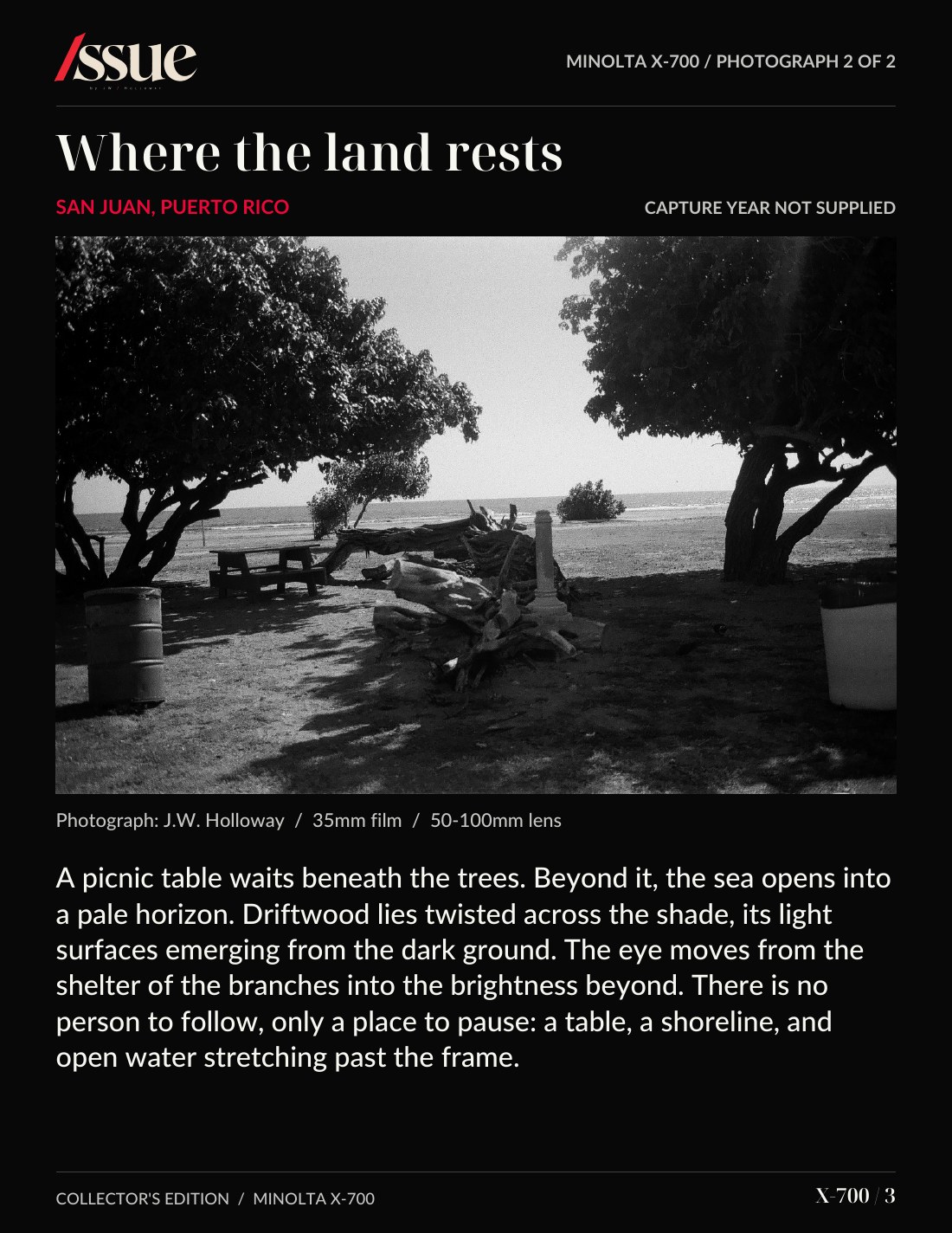
MINOLTA X-700 / PHOTOGRAPH 2 OF 2
Where the land rests
SAN JUAN, PUERTO RICO CAPTURE YEAR NOT SUPPLIED
Photograph: J.W. Holloway / 35mm film / 50-100mm lens
A picnic table waits beneath the trees. Beyond it, the sea opens into a pale horizon. Driftwood lies twisted across the shade, its light surfaces emerging from the dark ground. The eye moves from the shelter of the branches into the brightness beyond. There is no person to follow, only a place to pause: a table, a shoreline, and open water stretching past the frame.
Page 70
Read page text
Text source. The fifty camera records remain from ISSUE_Collectors_Special_Edition_50_Cameras.pdf, the earlier 55-page production proof. Camera numbering and introduction dates are retained as unverified draft material.
Artwork. The cover, camera portraits and scene pictures were generated earlier in this conversation. They are illustrations, not authenticated product photographs, documentary records or pictures taken with the featured cameras.
Dates and stories. Each companion has a chosen year or period and a fictional vignette. Dates identify imagined settings, not recovered capture dates. “c.” means approximately. People, actions and sensory details in the stories are invented, not historical evidence.
Production. Story text is 18 points with 24-point line spacing; dates are 26 points. Text remains selectable. Artwork is kept at available resolution, not certified as 300-ppi print imagery. Printer-specific bleed, binding and colour settings are not included.
What this edition contains
Page 71
Read page text
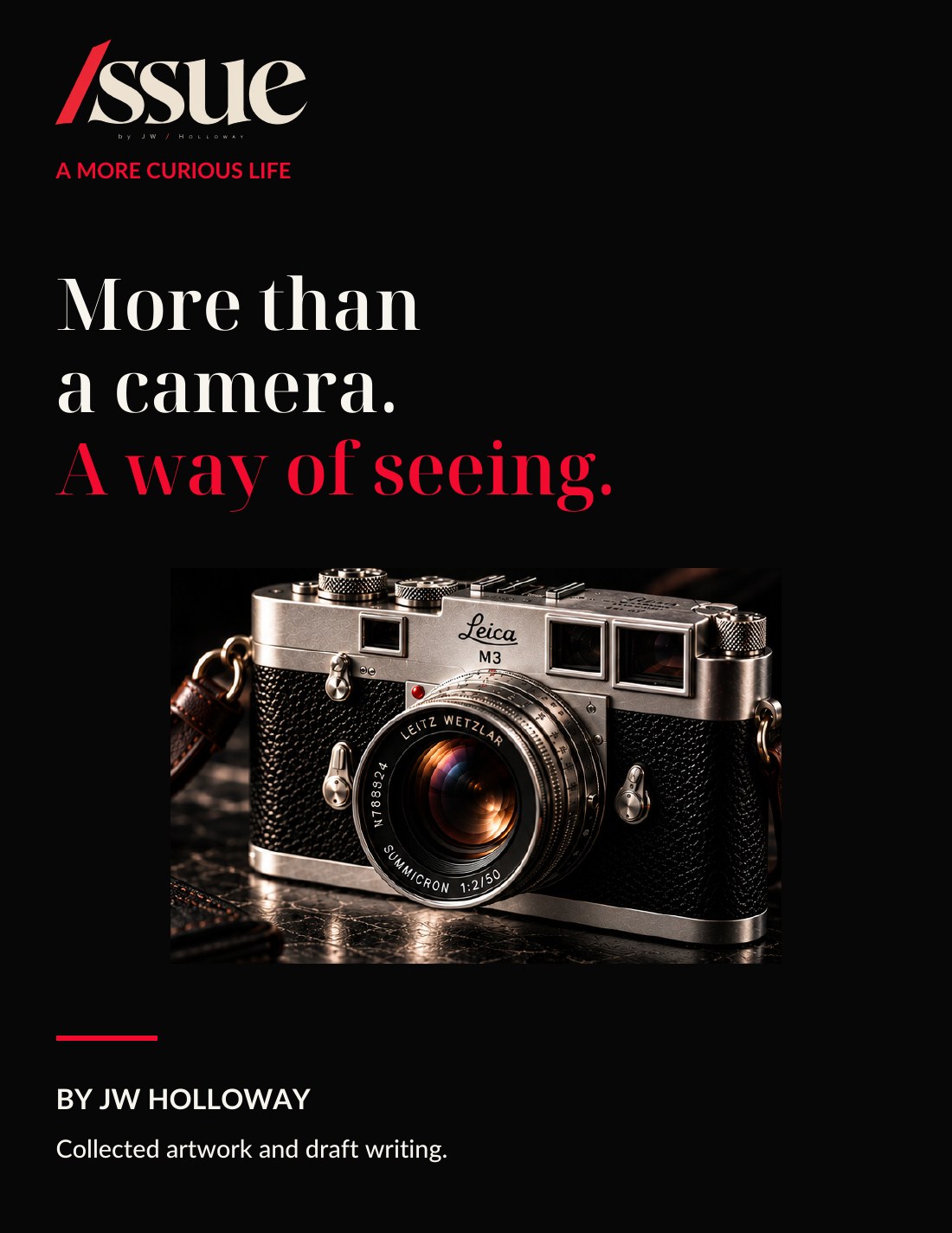
A MORE CURIOUS LIFE
More than a camera. A way of seeing.
Collected artwork and draft writing.